On eBird ↗
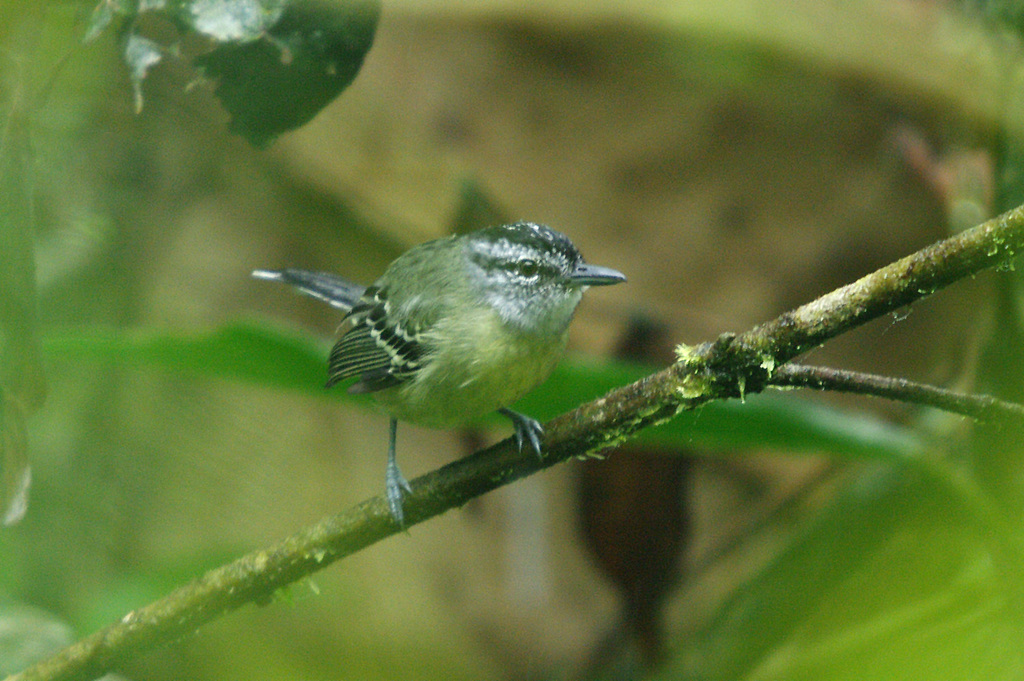
Yellow-breasted Antwren
Live sightings near you, the range map, bar charts of when it is seen, and Macaulay Library photos and recordings.
Yellow-breasted Antwren
Herpsilochmus axillaris
The yellow-breasted antwren (Herpsilochmus axillaris) is a species of bird in the family Thamnophilidae. It is found in Colombia, Ecuador, and Peru. Its natural habitat is subtropical or tropical moist montane forests.
From the article Yellow-breasted antwren on Wikipedia (CC BY-SA), quoted section by section
Description
The yellow-breasted antwren is 11 to 12 cm (4.3 to 4.7 in) long and weighs 10 to 13 g (0.35 to 0.46 oz). Adult males of the nominate subspecies H. a. axillaris have a black crown and nape with white spots on the crown and a broken whitish supercilium on an otherwise mottled blackish and yellow-olive face. Their upperparts are olive-gray. Their wings coverts are black with yellow-tinged white edges and tips; their flight feathers are very dark gray. Their tail is mostly dark gray, with white tips and part of the edges of the inner feathers and mostly white outer feathers. Their throat and underparts are mostly pale yellowish olive with a yellow center to the belly. Adult females have a cinnamon-rufous crown, olive-buff upperparts, and darker olive underparts except for the yellow belly center. Their wings and tail are like the male's. Males of subspecies H. a. senex are paler than the nominate, with spots only on the center of their crown and a grayish white throat and breast. Males of subspecies H. a. puncticeps have olive-tinged and grayer upperparts than the nominate and less white on their tail feathers. Females have a dark olive-gray crown with a cinnamon-rufous tinge. Males of subspecies H. a. aequatorialis also have olive-tinged and grayer upperparts than the nominate. …
Range & habitat
The subspecies of the yellow-breasted antwren are found thus:
H. a. senex: Colombia's Western and Central Andes between the departments of Risaralda and Cauca H. a. aequatorialis: east slope of the Andes from Caquetá Department in southwestern Colombia south through eastern Ecuador into northern Peru as far as the Marañón River in the Department of Cajamarca H. a. puncticeps: east slope of the Andes in east-central Peru from the Marañón south to the Department of Junín H. a. axillaris: east slope of the Andes of southeastern Peru between the departments of Cuzco and Puno The ranges of puncticeps and axillaris have a gap between them. The yellow-breasted antwren inhabits the interior and edges of humid evergreen forest, where it tends to favor the canopy. In elevation it ranges between 800 and 2,000 m (2,600 and 6,600 ft) in Colombia, between 800 and 1,700 m (2,600 and 5,600 ft) in Ecuador, and between 750 and 1,900 m (2,500 and 6,200 ft) in Peru.
Wikipedia: “Distribution and habitat”
What it does
The yellow-breasted antwren's diet has not been detailed but includes insects and probably spiders. It usually forages in pairs, sometimes in family groups, but seldom by itself, and almost always as a member of a mixed-species feeding flock. It typically feeds from the forest's mid-level to its canopy; in the mid-level it favors vine tangles. It forages actively and methodically, and usually captures prey by gleaning from leaves, stems, and vines by reaching and sometimes lunging from a perch. It occasionally makes short sallies to hover-glean. It is not known to follow army ants.
Wikipedia: “Feeding”
Listen
Looking for field recordings…
Where it lives
Recorded sightings
—
geo-referenced records in GBIF, from museums, herbaria and field observers.
Drag the globe to turn it. Dots are where records exist, not a range map; darker means more records.
In the stacks
Searching the stacks…
Every page naming Herpsilochmus axillaris in the Biodiversity Heritage Library →
This page is assembled live from iNaturalist, GBIF, Wikipedia, the Source Library and the Internet Archive. It is not yet part of the hand-edited codex. iNaturalist taxon 15778.