On eBird ↗
Rondonia Bushbird
Live sightings near you, the range map, bar charts of when it is seen, and Macaulay Library photos and recordings.
Rondônia Bushbird
Clytoctantes atrogularis
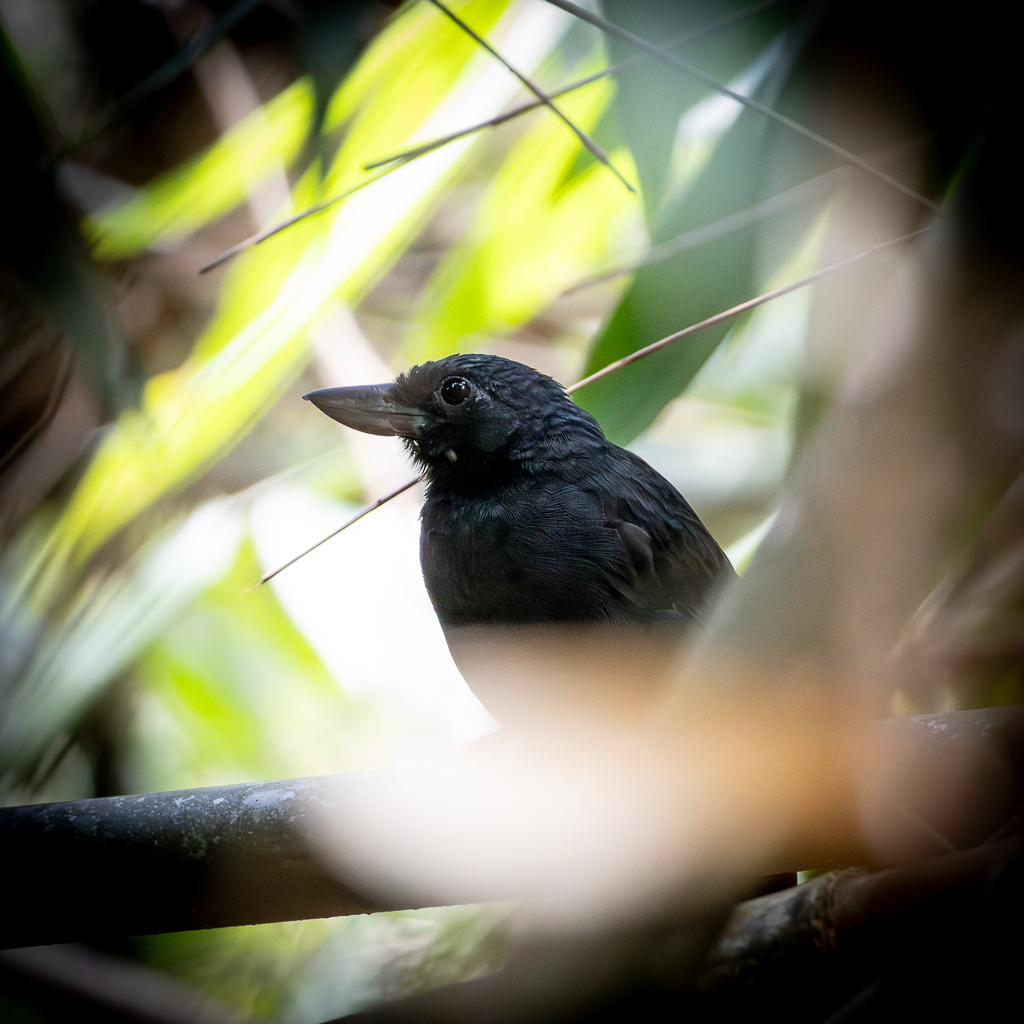
The Rondonia bushbird (Clytoctantes atrogularis) is a Near Threatened species of bird in subfamily Thamnophilinae of family Thamnophilidae, the "typical antbirds". It is endemic to Brazil.
From the article Rondônia bushbird on Wikipedia (CC BY-SA), quoted section by section
Description
The Rondonia bushbird is 16 to 18.5 cm (6.3 to 7.3 in) long and weighs about 31 to 36 g (1.1 to 1.3 oz). It is rather stocky with a short tail. Its large bill is laterally compressed and the mandible is upturned. The sexes have different plumage. Adult males are mostly dark gray, with a hidden white patch between their shoulders and a slightly blacker bib. Adult females have a chestnut head and upper back, with a concealed white patch like the male's. Their lower back is brown, their uppertail coverts gray, and their tail black. Their wing coverts are dark chestnut with paler edges and their flight feathers dark grayish brown with chestnut-brown edges. Their throat, cheeks, and upper breast are black, their lower breast, sides and belly light chestnut, and their flanks and undertail coverts gray. Their iris is brown, their maxilla black, their mandible dark gray to black, and their legs and feet gray. Subadult males are similar to adults but with dusky flight feathers and a scattering of brown feathers on the crown.
Range & habitat
The Rondonia bushbird was first described near the Rio Jiparana, a tributary of the Rio Madeira in the Brazilian state of Rondônia. Since then it has been documented at additional sites between the rios Madeira and Sucunduri to its east in the state of Amazonas, and also in Mato Grosso. It primarily inhabits lowland humid terra firme forest in locations with tangles of vines, a dense understory, and sometimes with Guadua bamboo. It has also been recorded in moderately disturbed forest and near recently logged areas, and once in campina. In elevation it is known only below 300 m (1,000 ft).
Wikipedia: “Distribution and habitat”
What it does
The Rondonia bushbird feeds on insects, especially ants. It forages in vine tangles and on bamboo; on the latter it uses its bill to slit open the stem. It has also been observed apparently foraging on palm leaves. Most of the sightings have been of single birds or pairs.
Wikipedia: “Feeding”
Listen
Looking for field recordings…
Where it lives
Recorded sightings
—
geo-referenced records in GBIF, from museums, herbaria and field observers.
Drag the globe to turn it. Dots are where records exist, not a range map; darker means more records.
In the stacks
Searching the stacks…
Every page naming Clytoctantes atrogularis in the Biodiversity Heritage Library →
This page is assembled live from iNaturalist, GBIF, Wikipedia, the Source Library and the Internet Archive. It is not yet part of the hand-edited codex. iNaturalist taxon 15748.