On eBird ↗
Recurve-billed Bushbird
Live sightings near you, the range map, bar charts of when it is seen, and Macaulay Library photos and recordings.
Recurve-billed Bushbird
Clytoctantes alixii
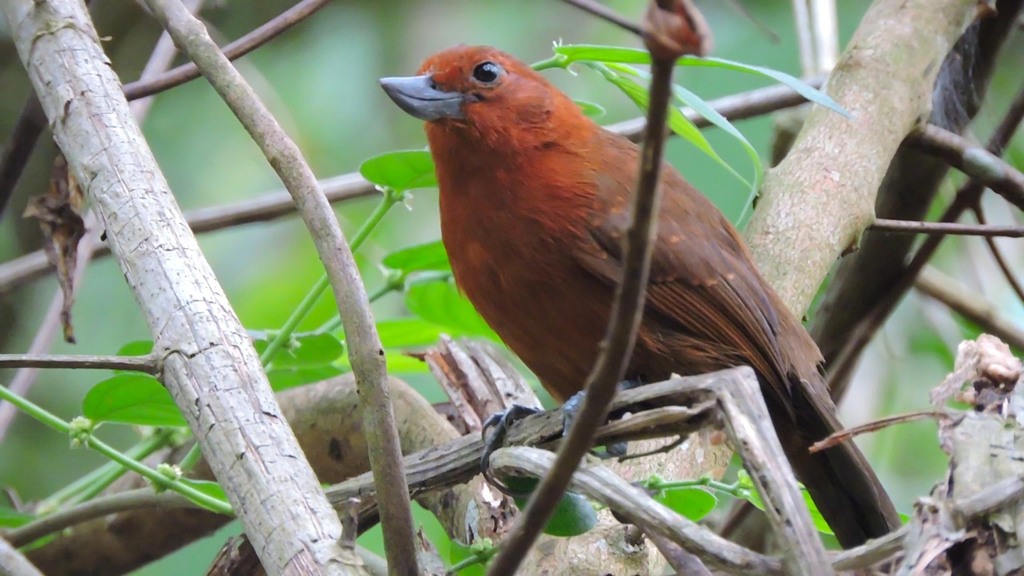
The recurve-billed bushbird (Clytoctantes alixii) is an Endangered species of Thamnophilid antbird that inhabits dense stands of secondary vegetation at the northern end of the Andes in Colombia and Venezuela. It is named for its extraordinary bill, which curves upwards. Until 2007, the bird was almost unknown in life and apart from earlier specimens it had only been seen in life once at an army ant swarm in Colombia in 1965.
From the article Recurve-billed bushbird on Wikipedia (CC BY-SA), quoted section by section
Description
The recurve-billed bushbird is 16 to 17 cm (6.3 to 6.7 in) long. It is rather stocky with a short tail. Its large bill is pale horn; it is laterally compressed and the mandible is upturned. The sexes have different plumage. Adult males are generally dark gray, with a white patch between their shoulders. Their lores, throat, and the center of their upper breast are black. Their wing coverts have small black spots and their flight feathers are brownish black. Adult females have a dark rufous-brown crown, back, and rump. Their wings and tail are blackish with pale rufous tips on the wing coverts. Their underparts are reddish brown that is darker on their flanks and undertail coverts. Subadult males are dark yellowish and blackish brown; their forehead, sides of the head, and throat are reddish yellow-brown and their wing coverts have white dots.
Range & habitat
The recurve-billed bushbird is known from a few sites in Venezuela's Sierra de Perijá and in the Colombian departments of Antioquia, Norte de Santander, and Santander. It was formerly much more widespread. The species inhabits dense undergrowth in the understory and edges of evergreen forest, clearings in the forest that are regenerating, and nearby secondary forest. In one Colombian area it is associated with bamboo. In elevation it ranges between 300 and 1,200 m (1,000 and 3,900 ft) in Venezuela. In Colombia it is mostly found between 200 and 1,000 m (700 and 3,300 ft) but occurs as high as 1,150 m (3,800 ft).
Wikipedia: “Distribution and habitat”
What it does
The recurve-billed bushbird apparently feeds mostly on insects. It has been observed seeking prey by pecking open and pulling strips from stems, and at least once has been seen attending an army ant swarm. It has not been observed as part of a mixed-species feeding flock.
Wikipedia: “Feeding”
Listen
Looking for field recordings…
Where it lives
Recorded sightings
—
geo-referenced records in GBIF, from museums, herbaria and field observers.
Drag the globe to turn it. Dots are where records exist, not a range map; darker means more records.
In the stacks
Searching the stacks…
Every page naming Clytoctantes alixii in the Biodiversity Heritage Library →
This page is assembled live from iNaturalist, GBIF, Wikipedia, the Source Library and the Internet Archive. It is not yet part of the hand-edited codex. iNaturalist taxon 15747.