On eBird ↗
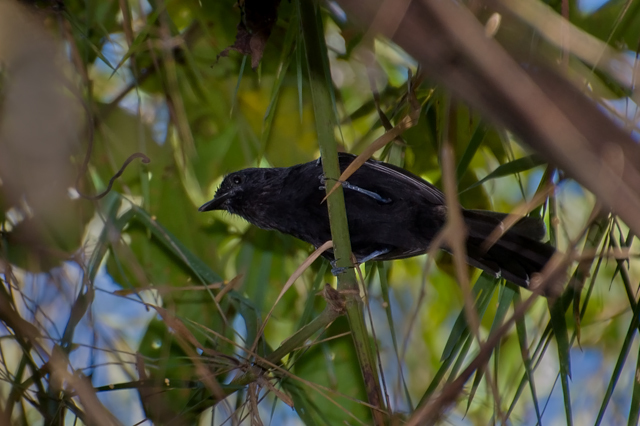
Manu Antbird
Live sightings near you, the range map, bar charts of when it is seen, and Macaulay Library photos and recordings.
Manú Antbird
Cercomacra manu
The Manu antbird (Cercomacra manu) is a species of bird in the family Thamnophilidae. It is found in Bolivia, Brazil, and Peru. Its natural habitat is subtropical or tropical moist lowland forests.
From the article Manu antbird on Wikipedia (CC BY-SA), quoted section by section
Description
The Manu antbird is 14 to 15.5 cm (5.5 to 6.1 in) long and weighs 16 to 20 g (0.56 to 0.71 oz). Adult males are mostly very dark gray, with paler gray on their face, flanks, and undertail coverts. They have a mostly hidden white patch between their scapulars, white tips on their wing coverts, and white tips on their tail feathers. Females have an olive-brown crown and back with a hidden white interscapular patch. Their wing coverts are dusky brown to black with white tips. Their tail is dark gray-brown with white crescents near the feather tips. Their face and underparts are neutral gray with faint white streaks on their chin and throat. Both sexes have a pale sandy brown iris, a black maxilla, a darkish-mottled silvery gray mandible, and pale gray legs and feet.
Range & habitat
The Mamu antbird has a disjunct distribution. By far the largest area encompasses southeastern Peru in southeastern Ucayali, northern Cuzco, and most of Madre de Dios departments; Pando and La Paz departments in northern Bolivia; and western Brazil's Acre state. Small isolated populations are also found further east in Amazonian Brazil. It almost exclusively inhabits stands of Guadua bamboo in partially shaded forest edges such as along watercourses and roads. In elevation it ranges between 250 and 1,350 m (800 and 4,400 ft).
Wikipedia: “Distribution and habitat”
What it does
The Manu antbird's diet has not been detailed but is known to be primarily insects. Pairs usually forage in the tops of bamboo stands and the canopy just above them, typically between about 4 and 15 m (15 and 50 ft) above the ground. They hop through the vegetation and usually take prey by gleaning while perched; they will occasionally hover-glean. They occasionally join mixed-species feeding flocks that pass through their territory.
Wikipedia: “Feeding”
Listen
Looking for field recordings…
Where it lives
Recorded sightings
—
geo-referenced records in GBIF, from museums, herbaria and field observers.
Drag the globe to turn it. Dots are where records exist, not a range map; darker means more records.
In the stacks
Searching the stacks…
Every page naming Cercomacra manu in the Biodiversity Heritage Library →
This page is assembled live from iNaturalist, GBIF, Wikipedia, the Source Library and the Internet Archive. It is not yet part of the hand-edited codex. iNaturalist taxon 15739.