On eBird ↗
White-browed Tit-Warbler
Live sightings near you, the range map, bar charts of when it is seen, and Macaulay Library photos and recordings.
White-browed Tit-Warbler
Leptopoecile sophiae
The white-browed tit-warbler (Leptopoecile sophiae) is a species of bird in the family Aegithalidae. The species was first described by Nikolai Severtzov in 1873. It is resident in the Tian Shan and central China as well as in the Himalayas where it is mainly found in winter. Its natural habitat is boreal forests.
From the article White-browed tit-warbler on Wikipedia (CC BY-SA), quoted section by section
Description
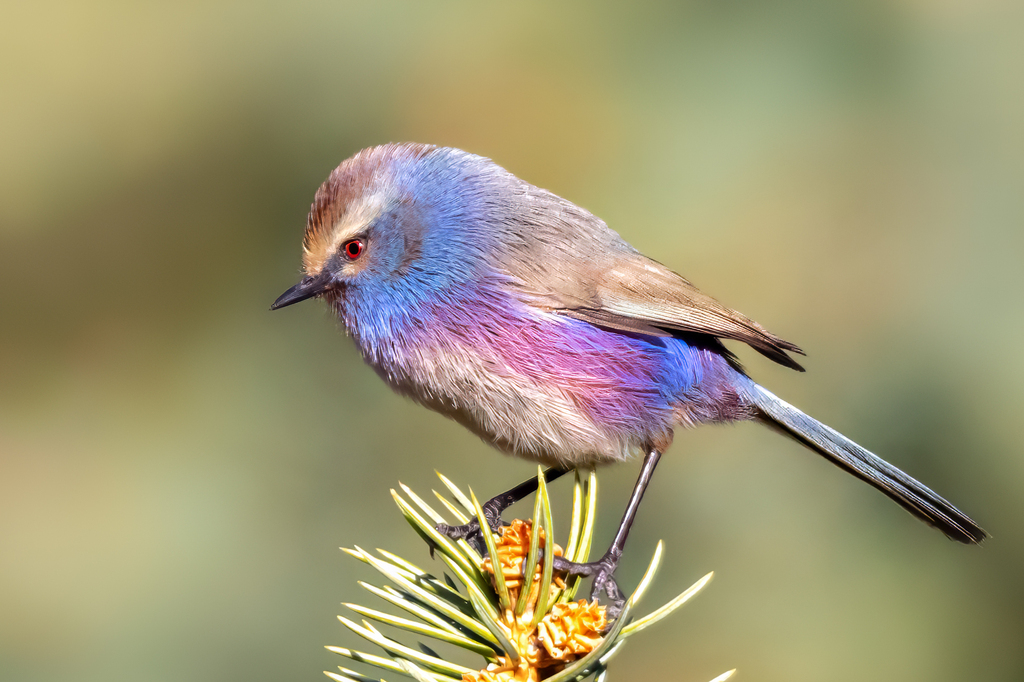
These birds are small, weighing 6–8 g (0.21–0.28 oz) and are 8.5–10 cm (3.3–3.9 in) long. The males are vibrantly colored, with distinctive blue-mauve underparts. Both males and females have a light brown crown and white supercilium (eyebrow). The rump and upper tail-coverts are violet blue. Females are generally duller, and can be distinguished by their pale underparts, whereas the males have violet-blue underparts and chest. The tail is relatively long.
Range & habitat
The white-browed tit-warbler prefers dry mountainous shrubland between 2,000–5,000 m (6,600–16,400 ft). It ranges in the Himalayas, the Tibetan Plateau, and much of Northwest China. They tend to disperse to lower elevations during the winter. A 2016 paper determined that they belonged to a "Middle-mountainous forest steppe community" within the Tian Shan mountain range. A study within Karakoram National Park found that they were uncommon residents, and that there was a winter influx of population.
Wikipedia: “Distribution and habitat”
What it does
White-browed tit-warblers generally live in pairs during the breeding season, but will join flocks of 25 or more individuals at the end of the season. During winter these flocks may become multi-species.
Breeding and nesting. A study in the mountains of Tibet found that the white-browed tit-warbler begins breeding before any other local songbird, generally starting in early April and running through July. Breeding is delayed as elevation increases. Pairs are monogamous, with males and females sharing nesting duties. Nests are dome-shaped and placed in shrubs about 0.9 m (3.0 ft) off the ground. Both sexes build nests over a period of two weeks. Four to six whitish eggs with red-brown spots on the tips are laid, although up to nine may be laid. Eggs average 1.14 g (0.040 oz) in mass and average 15.6 mm × 11.6 mm (0.61 in × 0.46 in) in dimension. Incubation lasts around 20.5 days. An average of 4.3 eggs hatch, but only 3.8 survive to fledging – which occurs around 17.5 days old. Broods raised late in the season tended to have higher ratios of females. When the nestlings hatch they are naked and do not open their eyes until they are approximately 7 days old. At this time their sex is identifiable. The Tibetan study noted some unusual behavior, such as two females attending a single nest, which means that the species may practice cooperative breeding. …
Wikipedia: “Behavior and ecology”
Listen
Looking for field recordings…
Where it lives
Recorded sightings
—
geo-referenced records in GBIF, from museums, herbaria and field observers.
Drag the globe to turn it. Dots are where records exist, not a range map; darker means more records.
In the stacks
Searching the stacks…
Every page naming Leptopoecile sophiae in the Biodiversity Heritage Library →
This page is assembled live from iNaturalist, GBIF, Wikipedia, the Source Library and the Internet Archive. It is not yet part of the hand-edited codex. iNaturalist taxon 15705.