On eBird ↗
Jerdon's Babbler
Live sightings near you, the range map, bar charts of when it is seen, and Macaulay Library photos and recordings.
Jerdon's Babbler
Chrysomma altirostre
Jerdon's babbler (Chrysomma altirostre) is a passerine bird native to wetlands and grasslands of the Indian sub-continent. It is listed as Vulnerable on the IUCN Red List since 1994. It is a member of the genus Chrysomma of the family Paradoxornithidae.
The common name commemorates the surgeon-naturalist Thomas C. Jerdon.
From the article Jerdon's babbler on Wikipedia (CC BY-SA), quoted section by section
Description
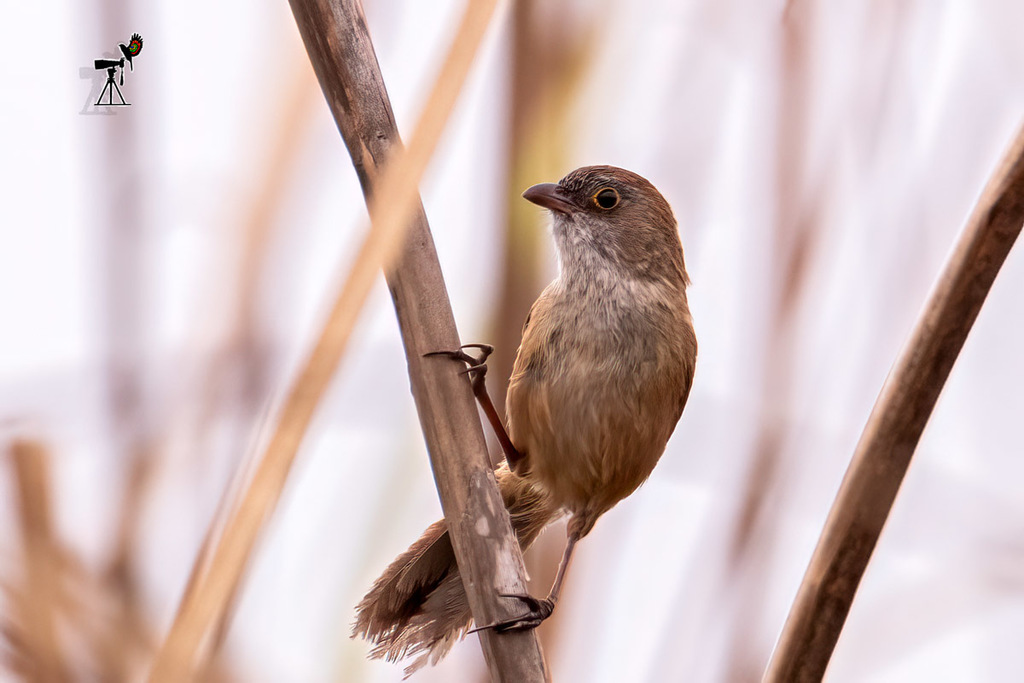
Measuring 16–17 cm in length, it is quite intermediate in habitus between certain typical warblers (Sylvia) and the parrotbills (Paradoxornis). Like these, it is a drab bird with a long tail used to balance when creeping through the vegetation; its bill is thicker than in Sylvia but not as heavy as in Paradoxornis. Buffy chestnut brown above and a slightly lighter yellowish-brown on the belly, its lores are pale greyish, as are the throat and breast. The tail and a wing patch are redder than the rest of the upperside. The legs and feet are dark, the bill is greyish-horn colored above and pale below; the eyes' irides are yellowish-brown and a thin nude ring of greenish-yellow skin surrounds the eye. The sexes are alike; young birds have a more orange hue to the upperside plumage, and the lower bill is pink. Differences between subspecies are slight, with the central population essentially having richer chestnut brown and darker grey colours. Its relative, the yellow-eyed babbler (C. sinense), looks like a brighter version of the same but has somewhat more vivid colors, with white replacing grey in the plumage, an additional white supercilium, yellowish legs, feet and irides, and an orange-yellow eye-ring.
Range & habitat
Jerdon's babbler lives all-year-round near river courses, where it inhabits dense reedbeds and tall grasslands consisting of cogongrass (Imperata cylindrica), common reed (Phragmites) and reedmace (Typha) species. In Pakistan, it occurs along the Indus and its tributaries. In Punjab, India, it was recorded in Harike Wildlife Sanctuary. In the Terai, it was recorded in Shuklaphanta National Park and Dudhwa National Park. In northeast India, it was sighted in Kaziranga, Orang, Manas and Dibru-Saikhowa National Parks, Majuli, and D'Ering Memorial Wildlife Sanctuary. In Myanmar, it was thought to be extinct, but rediscovered in May 2014 in the lower Ayeyarwady floodplain near Yangon. Plants dominating its favorite habitat are typically tall reeds several meters in height. In the Indus River basin, it is associated with hardy sugarcane (Tripidium arundinaceum) and kans grass (Saccharum spontaneum). In the dooars, it also lives in stands of ravennagrass (Tripidium ravennae). On the other hand, sugarcane plantings or other single-species reedbeds as well as lower growth are not very attractive to the species. Other plants, typically grasses, are found to a lesser extent in the bird's haunts, including satintails, giant cane (Arundo donax), vetiver or khus (Chrysopogon zizanioides), Desmostachya bipinnata and Themeda arundinacea.
Wikipedia: “Distribution and habitat”
What it does
Its song is a weak 4- to 8-note warbling chi-chi-chi-chew-chew-chew, tew-tew-tew-tew chew or ih-ih-ih-ih chew chitit chew i'wwiuu, with a drawn-out end note and sometimes starting with a chatter of itch, itit or tchew. Birds sing usually in the early morning and in the evening, perching upright on a reed, with the head slightly elevated. Calls include a short tic or tsik, sometimes extended into a series ts-ts-tsik which may end in a plaintive tew. Pairs or families, occasionally small flocks of 1-2 dozen, move about quietly in dense stands of grasses and reeds that grow several meters high, usually avoiding lower growth and shrubland. A typical foraging technique involves perching nearly horizontally on a reed stem, picking up a leaf sheath with the bill, and quickly tearing off the leaf and its base sheet to expose small arthropods and other invertebrates. The tearing of dry leaves produces a subdued crackling sound that can sometimes be heard from some dozens of meters away.
Wikipedia: “Behaviour and ecology”
Listen
Looking for field recordings…
Where it lives
Recorded sightings
—
geo-referenced records in GBIF, from museums, herbaria and field observers.
Drag the globe to turn it. Dots are where records exist, not a range map; darker means more records.
In the stacks
Searching the stacks…
Every page naming Chrysomma altirostre in the Biodiversity Heritage Library →
This page is assembled live from iNaturalist, GBIF, Wikipedia, the Source Library and the Internet Archive. It is not yet part of the hand-edited codex. iNaturalist taxon 15668.