- Plants
- ›Vascular Plants
- ›flowering plants
- ›Dicots
- ›Sunflowers, Bellflowers, Fanflowers, and Allies
- ›bellflower family
- ›Lobelia subfamily
- ›Hippobroma
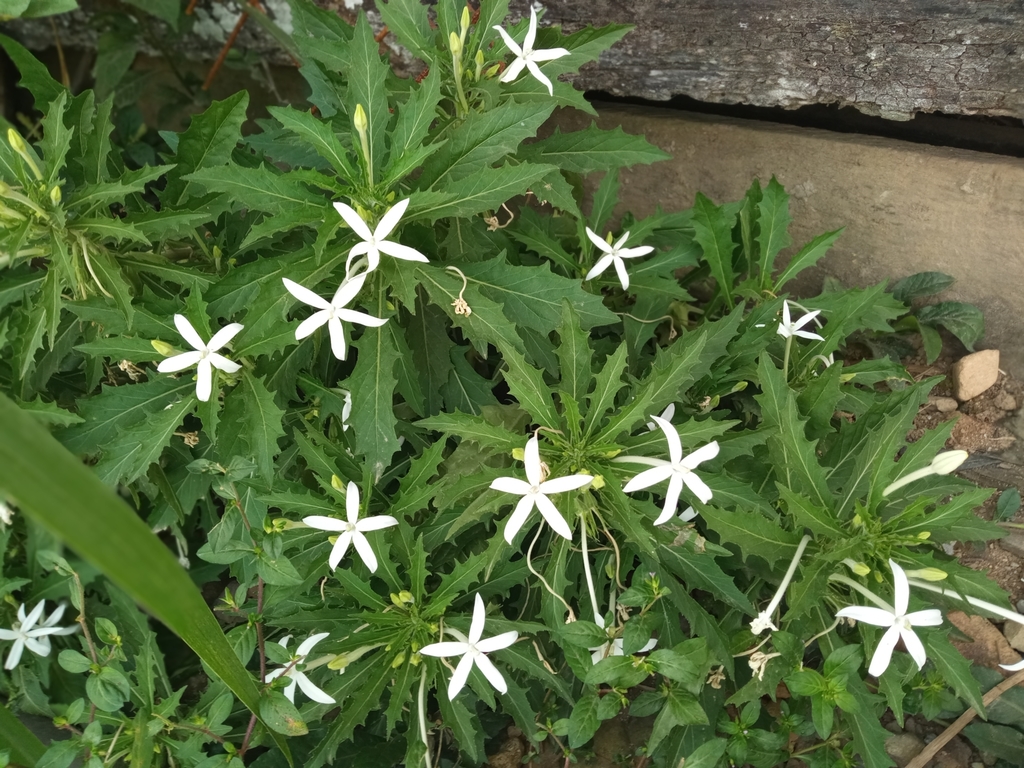
Star of Bethlehem
Hippobroma longiflora
Hippobroma longiflora, also called Star of Bethlehem or madamfate, is a flowering plant in the family Campanulaceae. It is the only species in the genus Hippobroma. It is endemic to Jamaica in the West Indies, but has become naturalised across the American tropics, Madagascar, southern and southeastern Asia, and Oceania.
It is a perennial herbaceous plant growing to 35 cm tall, with leaves 7–16 cm long and 1–3.7 cm broad, with a coarsely toothed margin. The five-petaled white flower has a slender floral tube only 2 or 3 mm (0.1 or 0.1 in) wide by 7 to 8 cm (2.8 to 3.1 in) in length. The plant contains two pyridine alkaloids, lobeline and nicotine. The effects of nicotine and lobeline are quite similar, with psychoactive effects at small dosages and with unpleasant effects including vomiting, muscle paralysis, and trembling at higher dosages. For this reason, H. longiflora (and its various synonyms) is often referenced for both its toxicity and its ethnobotanical uses.
Where it lives
Recorded sightings
—
geo-referenced records in GBIF, from museums, herbaria and field observers.
Drag the globe to turn it. Dots are where records exist, not a range map; darker means more records.
In the old herbals & bestiaries

Hortus Eystettensis
Basilius Besler · 1640 · p.101

Notable Commentaries on the History of Plants
Leonhart Fuchs · 1542 · p.203

Commentaries on the Six Books of Dioscorides
Pietro Andrea Mattioli · 1560 · p.421

Commentaries on the Six Books of Pedanius Dioscorides on Medical Matter
Pietro Andrea Mattioli · 1565 · p.711

History of Rare Plants of Pannonia
Carolus Clusius · 1576 · p.196

A New Herbal, or History of Plants
Rembert Dodoens (trans. Henry Lyte) · 1578 · p.230

Six Groups of the History of Plants
Rembert Dodoens · 1583 · p.242

Hortus Eystettensis
Basilius Besler · 1640 · p.55

Herbarium Portatile, Oder Behendes Kräuter- und Gewächs-Buch: Darinn nicht allein 1363. so wol Einheimische als Außländndische Kräuter mit Lateinisch und Deutscher Benennung abgebildet, sondern auch die meisten, so in der Medicin gebräuchlich, kürtzlich erkläret werden
Panckow, Thomas · 1656 · p.75
In the stacks
Searching the stacks…
Every page naming Hippobroma longiflora in the Biodiversity Heritage Library →
This page is assembled live from iNaturalist, GBIF, Wikipedia, the Source Library and the Internet Archive. It is not yet part of the hand-edited codex. iNaturalist taxon 154827.