On eBird ↗
Turner's Eremomela
Live sightings near you, the range map, bar charts of when it is seen, and Macaulay Library photos and recordings.
Turner's Eremomela
Eremomela turneri
Turner's eremomela (Eremomela turneri) is a species of bird formerly placed since 1990 in the "Old World warbler" (Sylviidae) assemblage. It was definitely placed in the family Cisticolidae in 2008 after multiple genetic analyses.
It is found in the Democratic Republic of the Congo, Kenya, and Uganda. Its natural habitats are subtropical or tropical moist lowland forests and subtropical or tropical moist montane forests. It is threatened by habitat loss.
From the article Turner's eremomela on Wikipedia (CC BY-SA), quoted section by section
Description
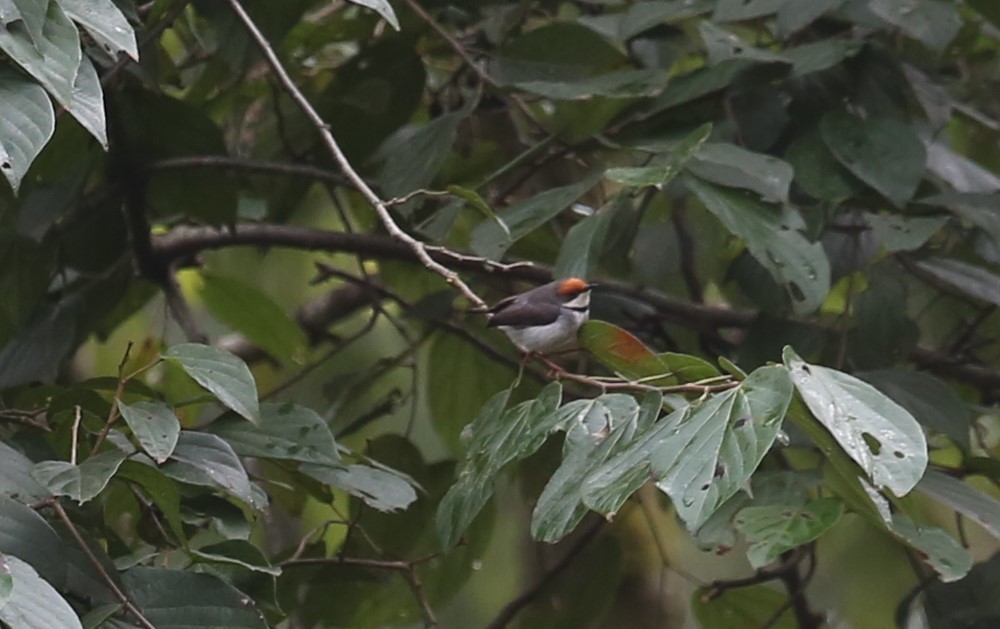
Turner's eremomela is a small, discreet bird being only 9 centimetres long and weighing 6 to 9 grams. It does not exhibit a sexual dimorphism. All adults have pale grey underparts, the rear of the head, and the back. The upper wings are slightly darker grey. They are easily distinguishable by a bright rufous forehead which extends to the top of the head. Under their dark eye streak, they have a white throat and a darker band right underneath. Unlike the adults, juveniles are a duller olive-brown above and pale yellow below. They also do not have the rufous forehead or the throatband. This species is very similar to the Rufous-crowned Eremomela. Turner's eremomela is smaller overall and has less rufous present on the head.
Range & habitat
Found in several small patches of Central and East Africa, Turner's eremomela's distribution is quite patchy and not very well known. It is estimated they occupy only about 1 400 km2 in 11 to 20 distinct locations, over a total extent of 39,100 km2. In Kenya they are currently present in Kakamega and Nandi Forests, with the type specimen for this species collected in the Yala River, in western Kenya. This species is also found in the south-eastern corner of the equatorial forest belt in Central-Eastern Democratic Republic of Congo. It is a native species to all these regions and has not been introduced or is considered invasive anywhere. It is a sedentary species; it does not migrate between areas with the seasons. Therefore, it heavily relies on its current distribution and habitat for survival. However, its area of occupancy is continually declining. Turner's eremomela occupies the canopy of large trees in lowland to mid-altitude forests, and is a specialist of this habitat. In Kenya, the rainforest fragments they inhabit are between 1500 and 1700 meters of elevation. But in the Democratic Republic of Congo, these altitudes are lower. Overall, this species' elevation limits have been recorded to be from 470 meters to 1900 meters. They are usually found in the open parts of the forest: clearings, edges, along streams and can live in isolated mature trees outside of the forest. …
Wikipedia: “Distribution and habitat”
What it does
Being almost always observed in groups, Turner's eremomela is a social species. Most of the time, these groups are composed of around 4 individuals, but some up to 15 have been recorded in the Democratic Republic of Congo.
Vocalisations. Like most rainforest species, Turner's eremomela is shy and difficult to spot in the dense canopy. Flocks are more easily heard than seen: a series of very high "titititititititi," followed by louder "si-si-chick" or "weet-su-sweet."
Diet. In local itinerant groups of between 3 and 10 individuals, these insectivorous birds search together for arthropods and caterpillars in mature tree canopies. Turner's eremomela is often seen joining larger mixed feeding flocks composed of several other Sylviid species. These 'bird-parties' are very common in the family Cisticolidae, and this species is often seen feeding alongside the Buff-throated Apalis, it shares its range with. In their area of overlap, Turner's eremomela and the Rufous-crowned eremomela do not feed in the same areas of the trees.
Breeding. Little is known on the breeding behaviour of Turner's eremomela and its early years. It is estimated that one generation lasts about 3.6 years.
Wikipedia: “Behaviour”
Listen
Looking for field recordings…
Where it lives
Recorded sightings
—
geo-referenced records in GBIF, from museums, herbaria and field observers.
Drag the globe to turn it. Dots are where records exist, not a range map; darker means more records.
In the stacks
Searching the stacks…
Every page naming Eremomela turneri in the Biodiversity Heritage Library →
This page is assembled live from iNaturalist, GBIF, Wikipedia, the Source Library and the Internet Archive. It is not yet part of the hand-edited codex. iNaturalist taxon 15464.