- Animals
- ›Arthropods
- ›Hexapods
- ›Insects
- ›Winged and Once-winged Insects
- ›True Bugs, Hoppers, Aphids, and allies
- ›True Bugs
- ›Cimicomorph Bugs
- ›Reduvioidea
- ›Assassin Bugs
- ›Reduviinae
- ›Psyttalini
- ›Psyttala
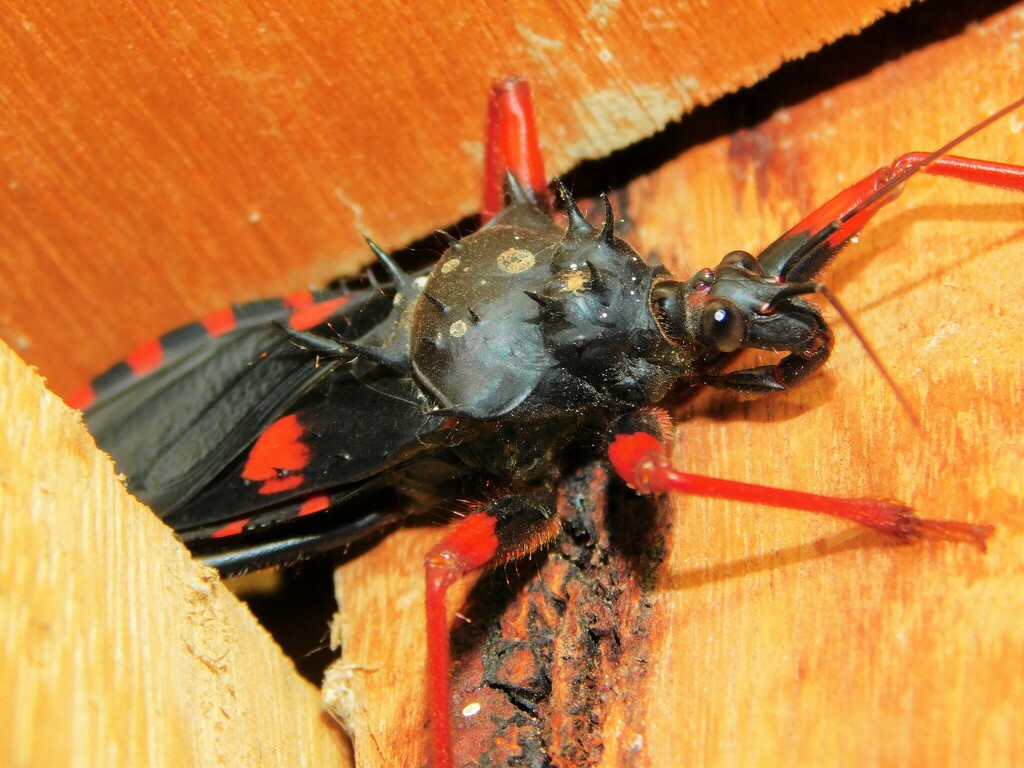
Horrid King Assassin Bug
Psyttala horrida
Psyttala horrida is an insect in the assassin bug genus Psyttala. It is commonly called the horrid king assassin bug or giant spiny assassin bug. The genus name is sometimes misspelled as Psytalla, but the original author Carl Stål spelt it Psyttala.
From the article Psyttala horrida on Wikipedia (CC BY-SA), quoted section by section
Description
Psyttala horrida can reach a body length of 3–4.5 centimetres (1.2–1.8 in). and over 5 centimetres (2.0 in) in private collections. It is the largest species of assassin bug in the world. These large and sturdy built insects are characterized by an elongated head, a relatively narrow neck and a rigid, prominent, segmented, tubular mouthparts or proboscis (also called rostrum). Antennae are long and thin. The basic color of the body is black. They show a very prominent crown of thorns on thorax and red and black warning colors on the edge of the abdomen (laterotergites). On the hemelytra are present a few red markings. Legs are rather long, with red and black femurs and completely red tibiae. This species presents an evident sexual dimorphism. In fact the underside of the female's abdomen is completely smooth, while the males at the end of the abdomen have a round outgrowth.
What it does
Females lay their eggs in the substrate a few weeks after mating. The incubation may last four to six weeks. The young insects at birth measure about five millimeters. They have a red thorax and abdomen and yellow legs. The chest turns black within a few days. The growth lasts between six and eight months and the young will make six moults to reach the adult stage. Adults live on average one to two years. These terrestrial ambush predators live hidden in timber or dead trees during the day, coming out at night to feed on their prey, that they kill with the venom injected by their rigid rostrum. They can also spray a noxious fluid.
Wikipedia: “Biology and behavior”
Listen
Looking for field recordings…
Where it lives
Recorded sightings
—
geo-referenced records in GBIF, from museums, herbaria and field observers.
Drag the globe to turn it. Dots are where records exist, not a range map; darker means more records.
In the stacks
Searching the stacks…
Every page naming Psyttala horrida in the Biodiversity Heritage Library →
This page is assembled live from iNaturalist, GBIF, Wikipedia, the Source Library and the Internet Archive. It is not yet part of the hand-edited codex. iNaturalist taxon 1546086.