- Animals
- ›Arthropods
- ›Hexapods
- ›Insects
- ›Winged and Once-winged Insects
- ›Butterflies and Moths
- ›Owlet Moths and Allies
- ›Cutworm Moths and Allies
- ›Bagisarinae
- ›Xanthodes
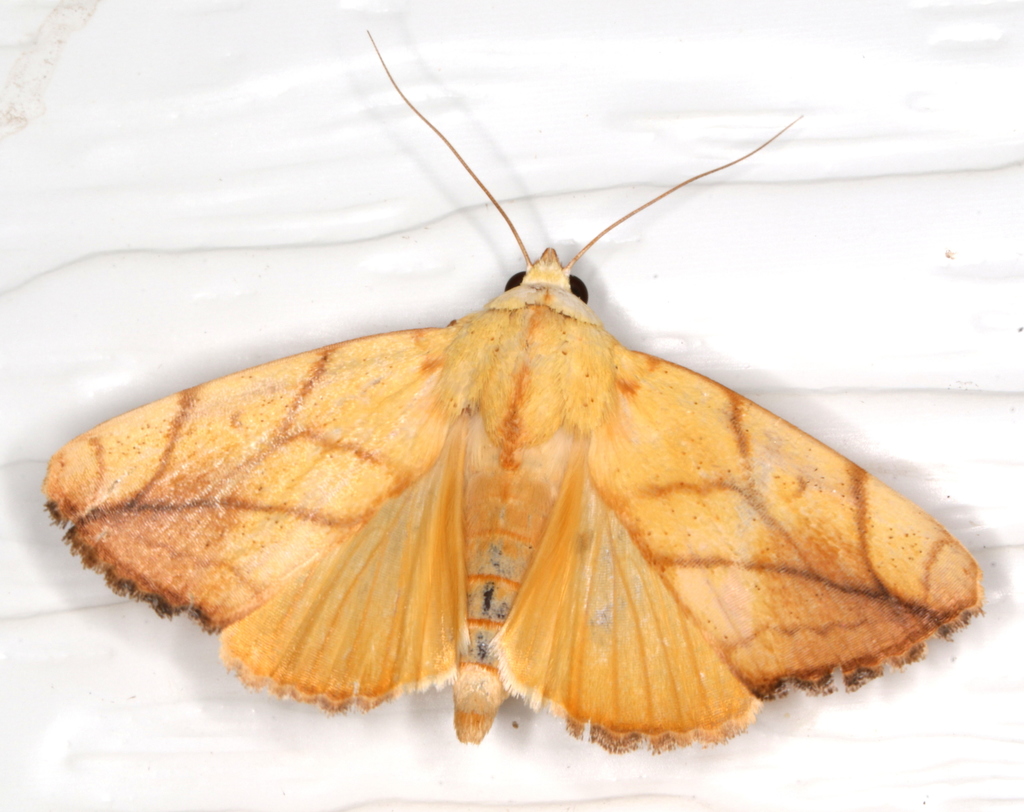
Transverse moth
Xanthodes transversa
Xanthodes transversa, the transverse moth' or hibiscus caterpillar, is a moth of the family Nolidae. The species was first described by Achille Guenée in 1852. It is found in India, Sri Lanka, the Andaman Islands, the Nicobar Islands, China, Hong Kong, Vanuatu, Java, New Guinea, Japan, the Ryukyu Islands, Singapore, Indonesia and Australia.
From the article Xanthodes transversa on Wikipedia (CC BY-SA), quoted section by section
Description
The wingspan of the female is 36 mm and male is 35–42 mm. Palpi reddish brown and porrect (extending forward). Head, thorax and abdomen bright canary yellow. Vertex of thorax rufous. Legs reddish brown. Tibia with long hairs. Forewings bright yellowish with distinct three brown arrow-shaped lines across each forewing. The caterpillars show remarkable color variations. A large bright rufous triangular patch is found over the whole outer area of the forewings. A black sub-apical speck visible. Cilia rufous. Hindwings reddish brown suffusion with rufous outer margin. The caterpillar is 35–40 mm in length. It is a multivoltine moth species, where organism having more than two broods or generations per year. The caterpillar is a pest on several economically important crops such as Hibiscus mutabilis, Hibiscus heterophyllus, Hibiscus rosa-sinensis, Hibiscus splendens, Malvaviscus arboreus, Urena lobata, Gossypium, okra (bhendi), Abelmoschus esculentus, Abelmoschus crinitus, Sida, Alcea rosea, Citrus, and Grewia tiliaefolia.
Listen
Looking for field recordings…
Where it lives
Recorded sightings
—
geo-referenced records in GBIF, from museums, herbaria and field observers.
Drag the globe to turn it. Dots are where records exist, not a range map; darker means more records.
In the stacks
Searching the stacks…
Every page naming Xanthodes transversa in the Biodiversity Heritage Library →
This page is assembled live from iNaturalist, GBIF, Wikipedia, the Source Library and the Internet Archive. It is not yet part of the hand-edited codex. iNaturalist taxon 153452.