- Plants
- ›Vascular Plants
- ›flowering plants
- ›Dicots
- ›honeysuckles, moschatels, and allies
- ›elder family
- ›Viburnum
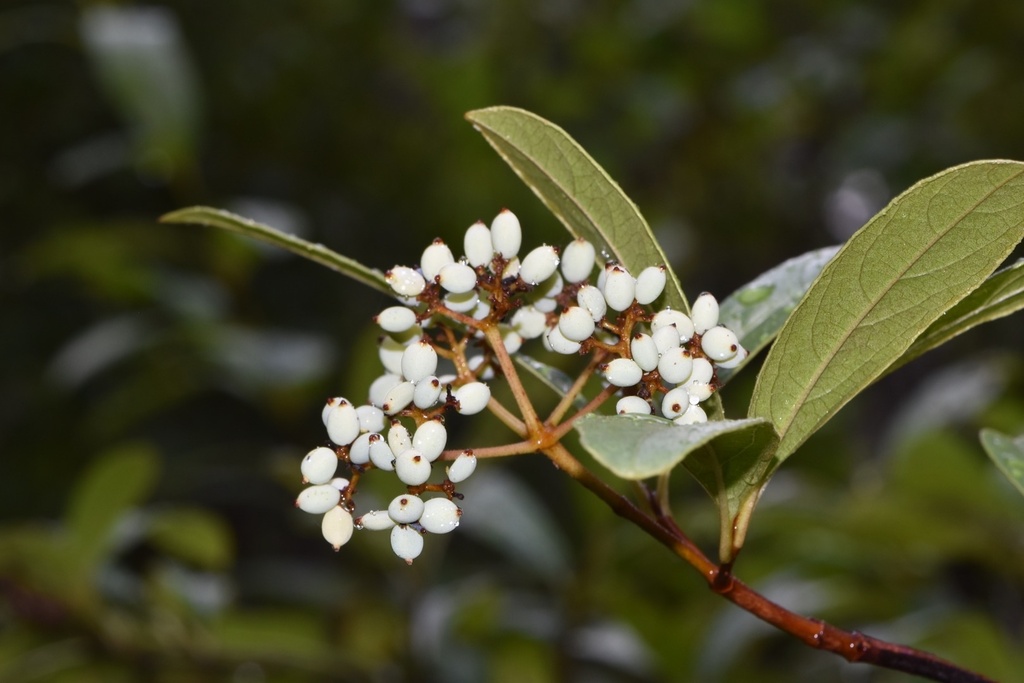
southern wild raisin
Viburnum nudum
Viburnum nudum is a deciduous shrub in the genus Viburnum within the family Viburnaceae (it was formerly part of the family Caprifoliaceae).
One variety of the species is Viburnum nudum var. cassinoides; synonyms for this variety Viburnum nitidum Aiton, Viburnum cassinoides, Viburnum cassinoides var. harbisonii, Viburnum cassinoides var. nitidum, and Viburnum nitidum.
From the article Viburnum nudum on Wikipedia (CC BY-SA), quoted section by section
Description
Viburnum nudum is a shrub with opposite, simple leaves, on slender stems. The flowers are white, borne in late spring.
Range & habitat
It is native to North America from southern Ontario and Quebec to Newfoundland, south to Florida, and west to Wisconsin. It has been observed in habitats such as floodplains, hardwood stands, mesic woodlands, and in pine flatwoods.
Wikipedia: “Range”
What it does
The fruit is eaten by wildlife, and deer browse the foliage. It is a larval host to spring azures and hummingbird clearwing moths.
Wikipedia: “Ecology”
At the table
The Abenaki use the fruit and the grains of var. cassinoides for food. The Algonquin people eat the berries of var. cassinoides.
Wikipedia: “Cuisine”
In medicine
The Cherokee have several medicinal uses for Viburnum nudum var. cassinoides. They take an infusion of it to prevent recurrent spasms, use the root bark as a diaphoretic and a tonic, and take a compound infusion of it for fever, smallpox and ague. They also use an infusion of the bark as a wash for a sore tongue.
== References ==
Wikipedia: “Medicinal use”
Where it lives
Recorded sightings
—
geo-referenced records in GBIF, from museums, herbaria and field observers.
Drag the globe to turn it. Dots are where records exist, not a range map; darker means more records.
In the stacks
Searching the stacks…
Every page naming Viburnum nudum in the Biodiversity Heritage Library →
This page is assembled live from iNaturalist, GBIF, Wikipedia, the Source Library and the Internet Archive. It is not yet part of the hand-edited codex. iNaturalist taxon 153200.