On eBird ↗
Eurasian Blackcap
Live sightings near you, the range map, bar charts of when it is seen, and Macaulay Library photos and recordings.
Eurasian Blackcap
Sylvia atricapilla
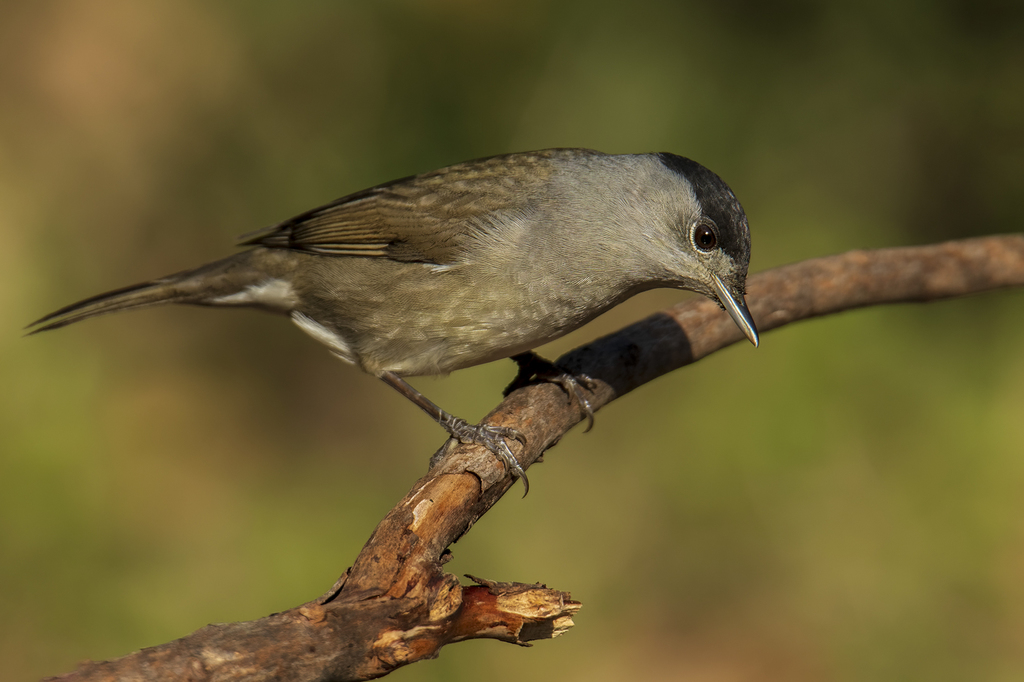
The Eurasian blackcap (Sylvia atricapilla) is a bird usually known simply as the blackcap. It is a common and widespread warbler. It has mainly olive-grey upperparts and pale grey underparts, and differences across the five subspecies are small. Both sexes have a neat coloured cap to the head, black in the male and reddish-brown in the female. The male's typical song is a rich musical warbling, often ending in a loud high-pitched crescendo, but a simpler song is given in some isolated areas, such as valleys in the Alps. The blackcap's closest relative is the garden warbler, which looks quite different but has a similar song.
The blackcap breeds in much of Europe, western Asia and northwestern Africa, and its preferred habitat is mature deciduous woodland. The male holds a territory when breeding, which is defended against garden warblers as well as other blackcaps. The nest is a neat cup, built low in brambles or scrub, and the clutch is typically 4–6 mainly buff eggs, which hatch in about 11 days. The chicks fledge in 11–12 days, but are cared for by both adults for some time after leaving the nest. The blackcap is a partial migrant; birds from the colder areas of its range winter in scrub or trees in northwestern Europe, around the Mediterranean and in tropical Africa. Some birds from Germany and western continental Europe have adapted to spending the winter in gardens in Great Britain and Ireland. Insects are the main food in the breeding season, but, for the rest of the year, blackcaps survive primarily on small fruit.
From the article Eurasian blackcap on Wikipedia (CC BY-SA), quoted section by section
Description
The blackcap is a mainly grey warbler with distinct male and female plumages. The nominate subspecies is about 13 cm (5.1 in) long with a 7–8 cm (2.8–3.1 in) wing length. The weight is typically 16–25 g (0.56–0.88 oz), but can be up to 31 g (1.1 oz) for birds preparing to migrate. The adult male has olive-grey upperparts, other than a paler grey nape and a neat black cap on the head. The underparts are light grey, becoming silvery white on the chin, throat and upper breast. The tail is dark grey, with an olive tint to the outer edge of each feather. The bill and long legs are grey, and the iris is reddish brown. The female resembles the male, but has a reddish-brown cap and a slightly browner tone to the grey of the upperparts. Juveniles are similar to the female, but their upperparts have a slight rufous tinge, and the breast and flanks have a more olive tone; young males have a darker brown cap than their female counterparts. This species is unmistakable; other dark-headed Sylvia species, such Sardinian and Orphean warblers have extensive black on the head instead of a small cap. They are also larger and have white edges on the tail. Blackcaps have a complete moult in their breeding areas in August and September prior to migration. Some birds, typically those migrating the greatest distances, have a further partial moult between December and March. …
Range & habitat
The continental breeding range of the blackcap lies between the 14–30° July isotherms, and is occupied by the nominate subspecies, the other forms being restricted to islands or fringe areas in the Caucasus and eastern Iberia. Birds on the Mediterranean and Atlantic islands and in the milder west and south of the main Eurasian distribution often winter within the nesting range, but populations elsewhere are migratory. The blackcap is a leap-frog migrant; birds from the north of the breeding range travel furthest south, whereas Mediterranean breeders move much shorter distances. The wintering areas overlap with the breeding range, but also include extensive areas in West Africa, East Africa south to Lake Malawi, and further north in Ethiopia, South Sudan and Eritrea. The large majority of birds wintering in eastern Africa are of the southwest Asian race, S. a. dammholzi. There is a migratory divide in Europe at longitude 10–11°E. Birds to the west of this line head southwest towards Iberia or West Africa, whereas populations to the east migrate to the eastern Mediterranean and on to East Africa. Cross-breeding in captivity of birds from the resident population on the Canary Islands with migratory blackcaps from Germany showed the urge to migrate is genetically controlled, the offspring showing intermediate behaviour in terms of restlessness at migration time. …
Wikipedia: “Distribution”
What it does
The blackcap feeds mainly on insects during the breeding season, then switches to fruit in late summer, the change being triggered by an internal biological rhythm. When migrants arrive on their territories they initially take berries, pollen and nectar if there are insufficient insects available, then soon switch to their preferred diet. They mainly pick prey off foliage and twigs, but may occasionally hover, flycatch or feed on the ground. Blackcaps eat a wide range of invertebrate prey, although aphids are particularly important early in the season, and flies, beetles and caterpillars are also taken in large numbers. Small snails are swallowed whole, since the shell is a source of calcium for the bird's eggs. Chicks are mainly fed soft-bodied insects, fruit only if invertebrates are scarce. In July, the diet switches increasingly to fruit. The protein needed for egg-laying and for the chicks to grow is replaced by fruit sugar which helps the birds to fatten for migration. Aphids are still taken while they are available, since they often contain sugars from the plant sap on which they feed. Blackcaps eat a wide range of small fruit, and squeeze out any seeds on a branch before consuming the pulp. This technique makes them an important propagator of mistletoe, which requires this location for its seeds. …
Wikipedia: “Feeding”
In human culture
Aristotle, in his History of Animals, considered that the garden warbler eventually metamorphosed into a blackcap. The blackcap's song has led to it being described as the "mock nightingale" or "country nightingale", and John Clare, in "The March Nightingale" describes the listener as believing that the rarer species has arrived prematurely. "He stops his own and thinks the nightingale/Hath of her monthly reckoning counted wrong". The song is also the topic of Italian poet Giovanni Pascoli's "La Capinera" [The Blackcap]. Giovanni Verga's 1871 novel Storia di una capinera, according to its author, was inspired by a story of a blackcap trapped and caged by children. The bird, silent and pining for its lost freedom, eventually dies. In the book, a nun evacuated from her convent by cholera falls in love with a family friend, only to have to return to her confinement when the disease wanes. The novel was adapted as films of the same name in 1917, 1943 and 1993. The last version was directed by Franco Zeffirelli, and its English-language version was retitled as Sparrow. In Saint François d'Assise, an opera by Messiaen, the orchestration is based on bird song. …
Wikipedia: “In culture”
Listen
Looking for field recordings…
Where it lives
Recorded sightings
—
geo-referenced records in GBIF, from museums, herbaria and field observers.
Drag the globe to turn it. Dots are where records exist, not a range map; darker means more records.
In the stacks
Searching the stacks…
Every page naming Sylvia atricapilla in the Biodiversity Heritage Library →
This page is assembled live from iNaturalist, GBIF, Wikipedia, the Source Library and the Internet Archive. It is not yet part of the hand-edited codex. iNaturalist taxon 15282.