- Animals
- ›Chordates
- ›Vertebrates
- ›Birds
- ›Perching Birds
- ›Ovenbirds and Woodcreepers
- ›Typical Ovenbirds
- ›Automolus
On eBird ↗
Western Woodhaunter
Live sightings near you, the range map, bar charts of when it is seen, and Macaulay Library photos and recordings.
Western Woodhaunter
Automolus virgatus
The western woodhaunter (Automolus virgatus) is a species of bird in the Furnariinae subfamily of the ovenbird family Furnariidae. It is found in Colombia, Costa Rica, Ecuador, Honduras, Nicaragua, and Panama.
From the article Western woodhaunter on Wikipedia (CC BY-SA), quoted section by section
Description
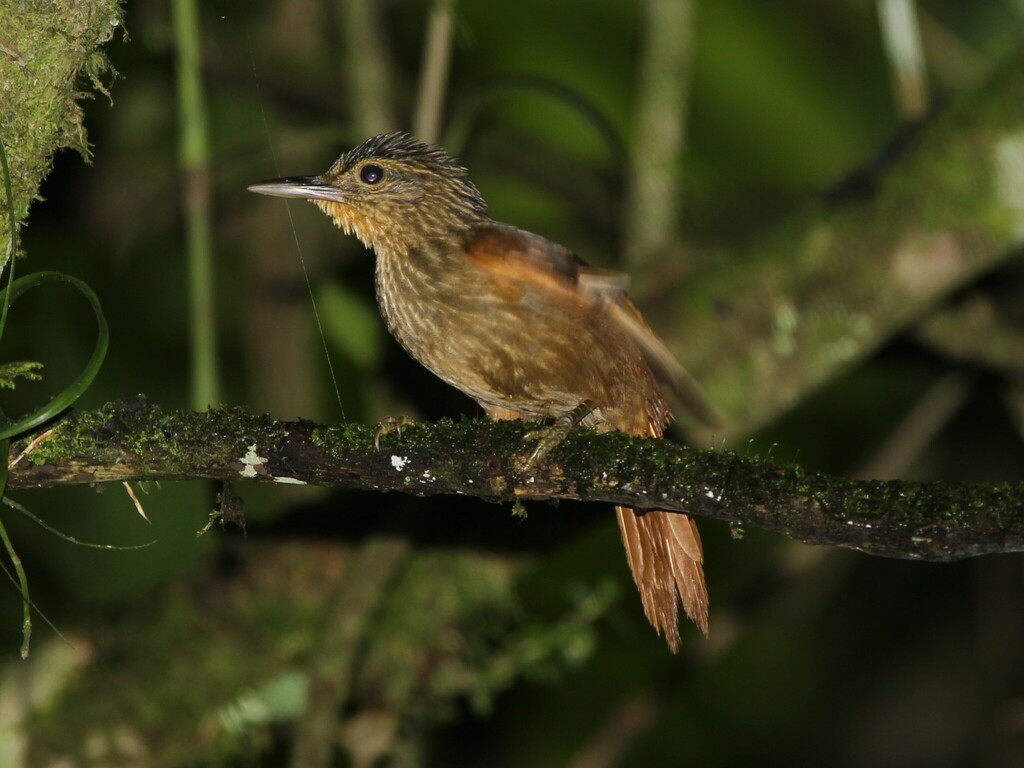
The western woodhaunter is 17 to 18 cm (6.7 to 7.1 in) long and weighs about 35 g (1.2 oz). It is a fairly large member of its genus and has a shortish and heavy bill. The sexes have the same plumage. Adults of the nominate subspecies A. v. virgatus have a mostly dark brownish face with golden-buff streaks, a pale eyering and stripe behind the eye, and grizzled brownish and buff lores. Their crown is blackish brown with golden-buff streaks that widen as they extend onto the blackish brown back. Their rump is dull rusty olivaceous brown, their uppertail coverts deep reddish cinnamon, and their tail a lighter cinnamon than the uppertail coverts. Their wings are dull cinnamon brown with brownish black on the flight feathers. Their chin and throat are pale fawn with faint brownish feather edges. Their breast is a deeper fawn with dusky feather edges. Their belly, flanks, and undertail coverts are olivaceous brown. Their iris is brown, their bill brownish black with some yellow on the mandible, and their legs and feet brown. Subspecies A. v. nicaraguae has blackish brown upperparts and slightly lighter underparts than the nominate. A. v. assimilis has a more reddish brown back than the nominate, a darker chestnut-rufous rump, uppertail coverts, and tail, and a strong olivaceous wash on the breast. A. v. cordobae has an unstreaked back and nearly unmarked underparts.
Range & habitat
The subspecies of the western woodhaunter are found thus:
A. v. nicaraguae: southeastern Nicaragua with a few records in Honduras A. v. virgatus: Costa Rica into Panama as far as Veraguas Province A. v. assimilis: from Eastern Panama south through western Colombia and most of the length of western Ecuador A. v. cordobae: northern Colombia's Córdoba, Antioquia, Bolívar, Santander, and Boyacá departments The western woodhaunter inhabits humid forest and woodlands in foothills and the lower montane zone. In elevation it mostly occurs below 1,100 m (3,600 ft), but locally reaches about 1,500 m (4,900 ft) in Costa Rica, Panama, and Ecuador.
Wikipedia: “Distribution and habitat”
What it does
The western woodhaunter's diet is not known in detail but includes arthropods and small vertebrates. It usually forages singly and usually as part of a mixed-species feeding flock, from the forest understory to its middle levels. It searches for prey along large branches and vines, gleaning and probing among dead leaves, epiphytes, palm fronds and other vegetation. It has been noted "burrowing" into clumps and flinging aside debris to reach prey.
Wikipedia: “Feeding”
Listen
Looking for field recordings…
Where it lives
Recorded sightings
—
geo-referenced records in GBIF, from museums, herbaria and field observers.
Drag the globe to turn it. Dots are where records exist, not a range map; darker means more records.
In the stacks
Searching the stacks…
Every page naming Automolus virgatus in the Biodiversity Heritage Library →
This page is assembled live from iNaturalist, GBIF, Wikipedia, the Source Library and the Internet Archive. It is not yet part of the hand-edited codex. iNaturalist taxon 1507574.