On eBird ↗
Siberian Nuthatch
Live sightings near you, the range map, bar charts of when it is seen, and Macaulay Library photos and recordings.
Siberian Nuthatch
Sitta arctica
The Siberian nuthatch (Sitta arctica) is a bird species of the family Sittidae. For a long time considered as a subspecies of the Eurasian nuthatch (S. europaea), it was clearly differentiated in 2006 on the basis of morphological and molecular characters. It is on average marginally larger than the Eurasian nuthatch (though with considerable overlap), and also differs in some morphological features such as the shape of its bill, the size of its claws and the colour of its underwing and outer rectrices. Its song has also been described as "distinctly different" from that of the Eurasian nuthatch, though without further clarification.
The Siberian nuthatch inhabits the forests northeast of Lake Baikal, up to the Bering Sea and the Sea of Okhotsk, but not near the coast. It lives in northeastern Siberia, barely exceeding the 105th meridian east in the west. It lives in Daurian larch (Larix gmelinii) stands on flood plains. The Siberian nuthatch has a wide range and its numbers are presumed to be stable, so the International Union for Conservation of Nature considers the bird to be of "least concern".
From the article Siberian nuthatch on Wikipedia (CC BY-SA), quoted section by section
Description
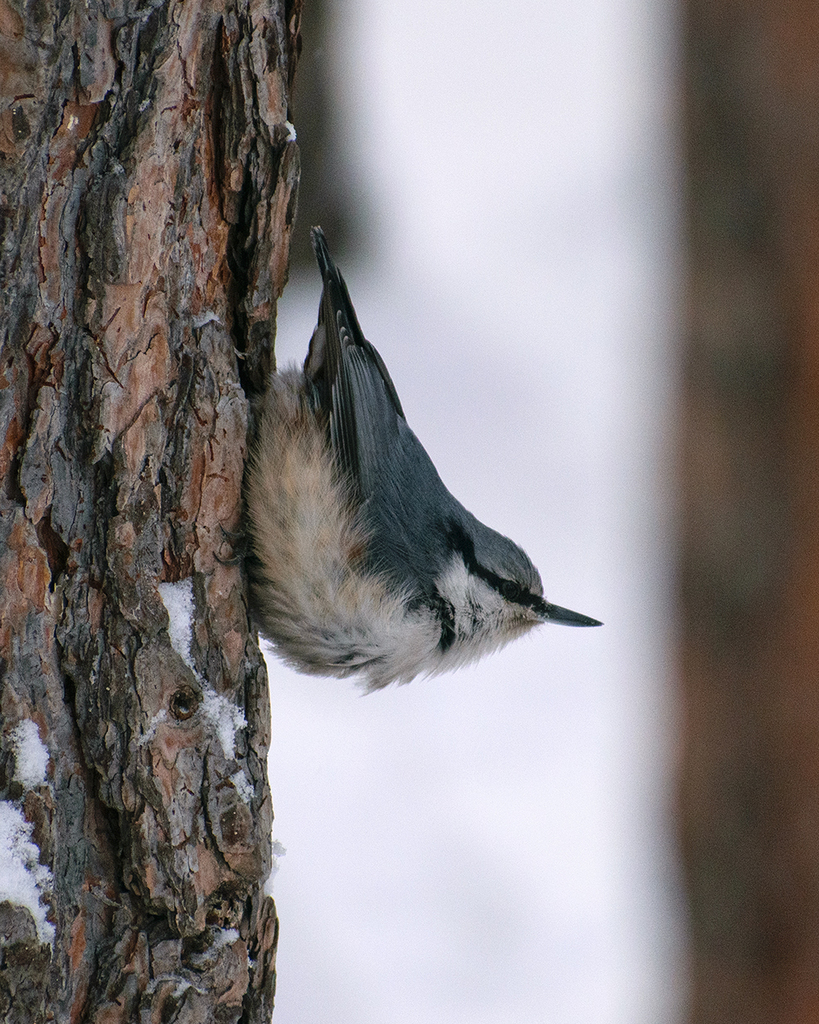
The Siberian nuthatch is a medium-sized nuthatch, measuring about 15 cm (5.9 in) in length. The upperparts are bluish-grey and the underparts brilliant white. It is quite similar to the white-breasted subspecies of the Eurasian nuthatch encountered in the most northern regions of Eurasia, but is distinguished by its marginally larger average size and by several anatomical particularities that are more or less easy to identify. The upperparts are dull blue-grey, as in the subspecies S. europaea amurensis, but darker than in all other Eurasian nuthatch subspecies. The eyestripe is black, thinner and shorter than in the latter. Red'kin and Konovalova of the Moscow Museum say there is no clear mark on the forehead and above this black line, although such a mark is present in some subspecies of S. europaea. Unlike S. europaea, the rufous brown of the rump extends further down the flanks; the underwing-coverts are dark grey (not pale), the outer rectrices are white for more than half their length, and there is no apparent sexual dimorphism. The bill is longer and narrower than in the various subspecies of the Eurasian nuthatch, with its upper margin completely or almost straight and its lower margin curved upward. The base of the bill is densely covered with long feathers. …
Range & habitat
The Siberian nuthatch is endemic to Russia and lives in central and northeastern Siberia. In the west, its distribution begins around the 105th meridian east, near the upper reaches of the Nizhnyaya Tunguska River and Vilyuy River in the north (to around the 65th or 67th parallel north) and those of the Lena River in the south. In the east it does not go beyond the lower reaches of the Anadyr River, the northwestern Koryak Mountains and the sources of the Punjina River. The distribution does not reach any coastal areas, neither the Bering Sea nor the Sea of Okhotsk. The main part of its distribution ends in the south, where the distribution of the Eurasian nuthatch subspecies asiatica begins, and in the east it is replaced in the Kamchatka peninsula by S. e. albifrons. The Siberian nuthatch inhabits Daurian larch (Larix gmelinii) forests primarily on floodplains. The species is nomadic in winter, and has been recorded as a vagrant as far west as northern Europe.
Wikipedia: “Distribution and habitat”
What it does
During fall and winter, the Siberian nuthatch migrates, forming mixed-species foraging flocks with the Eurasian nuthatch subspecies S. e. asiatica and S. e. baicalensis.
Vocalisations. The Siberian nuthatch's song is powerful. Some sonograms of calls and songs of the Siberian nuthatch were published in 1996, and the voice is described as "distinctly different" from that of the Eurasian nuthatch, but without further specification.
Breeding. Available data on the ecology of the species are very patchy. Observations in 1994 showed that pairs had already formed by 15 May. Like other nuthatches, notably the Eurasian nuthatch, this species occasionally reuses the nest of a Great spotted woodpecker (Dendrocopos major) and plasters the entrance with mud in order to reduce its diameter. The young observed fledged between 30 June and 4 July.
Wikipedia: “Ecology and behaviour”
Listen
Looking for field recordings…
Where it lives
Recorded sightings
—
geo-referenced records in GBIF, from museums, herbaria and field observers.
Drag the globe to turn it. Dots are where records exist, not a range map; darker means more records.
In the stacks
Searching the stacks…
Every page naming Sitta arctica in the Biodiversity Heritage Library →
This page is assembled live from iNaturalist, GBIF, Wikipedia, the Source Library and the Internet Archive. It is not yet part of the hand-edited codex. iNaturalist taxon 1506934.