On eBird ↗
Puerto Rican Euphonia
Live sightings near you, the range map, bar charts of when it is seen, and Macaulay Library photos and recordings.
Puerto Rican Euphonia
Chlorophonia sclateri
The Puerto Rican euphonia (Chlorophonia sclateri), or jilguero de Puerto Rico is a bird species in the finch family, Fringillidae that is endemic to the island of Puerto Rico in the Caribbean. It was formerly considered as a subspecies of the Hispaniolan euphonia.
From the article Puerto Rican euphonia on Wikipedia (CC BY-SA), quoted section by section
Description
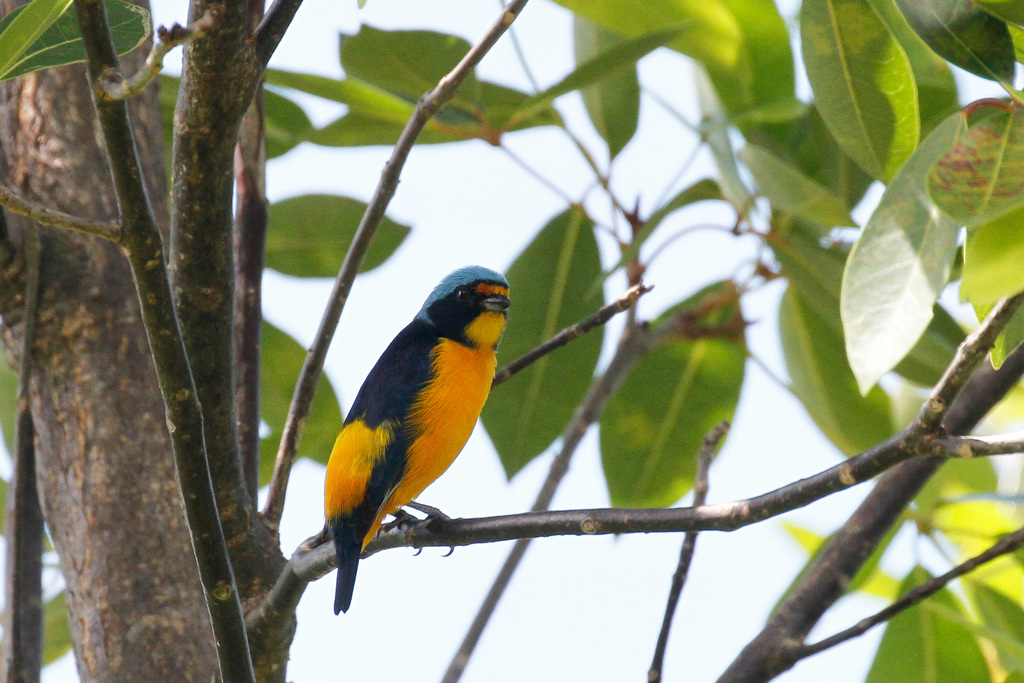
The Puerto Rican euphonia is about 10 to 12 cm (3.9 to 4.7 in) long and weighs about 12 to 16 g (0.42 to 0.56 oz). The species is sexually dimorphic. Adult males have an orange-yellow forehead that is separated from the forecrown by a narrow dark blue strip. Their crown and nape are sky blue that extends forward from the latter under the ear coverts. The rest of their head is dark violet blue. Their back is black with a blue gloss; it appears blue in direct light. Their rump and uppertail coverts are bright yellow. Their tail and wing coverts are black with bluish reflections. Their flight feathers are black with thin blue edges. Their throat is yellow and the rest of their underparts dull orange yellow with a slight brownish tinge on the crissum. Adult females' foreheads can be red, yellow, or yellowish olive green. Their crown and nape are blue that curves forward like the male's. The rest of their head is mostly olive green with a yellowish chin and throat. Their back, wings, and tail are olive green. Their underparts are dull olive yellow. Both sexes have a dark brown iris, a black maxilla, a blackish mandible with a grayish base, and dark gray to black legs and feet.
Range & habitat
The Puerto Rican euphonia is found throughout the island of Puerto Rico. It inhabits a variety of landscapes including the interior and edges of evergreen, deciduous, and secondary forests. It especially favors areas heavy with mistletoe (Loranthaceae). In elevation it ranges from sea level to the island's highest point at about 1,300 m (4,300 ft).
Wikipedia: “Distribution and habitat”
What it does
The Puerto Rican euphonia feeds on small fruits, almost entirely those of mistletoe. It includes smaller amounts of other fruits and also small arthropods in its diet. It feeds mostly in the forest canopy. It forages mostly in pairs and occasionally joins mixed-species feeding flocks.
Wikipedia: “Feeding”
Listen
Looking for field recordings…
Where it lives
Recorded sightings
—
geo-referenced records in GBIF, from museums, herbaria and field observers.
Drag the globe to turn it. Dots are where records exist, not a range map; darker means more records.
In the stacks
Searching the stacks…
Every page naming Chlorophonia sclateri in the Biodiversity Heritage Library →
This page is assembled live from iNaturalist, GBIF, Wikipedia, the Source Library and the Internet Archive. It is not yet part of the hand-edited codex. iNaturalist taxon 1506249.