On eBird ↗
Brown Babbler
Live sightings near you, the range map, bar charts of when it is seen, and Macaulay Library photos and recordings.
Brown Babbler
Turdoides plebejus
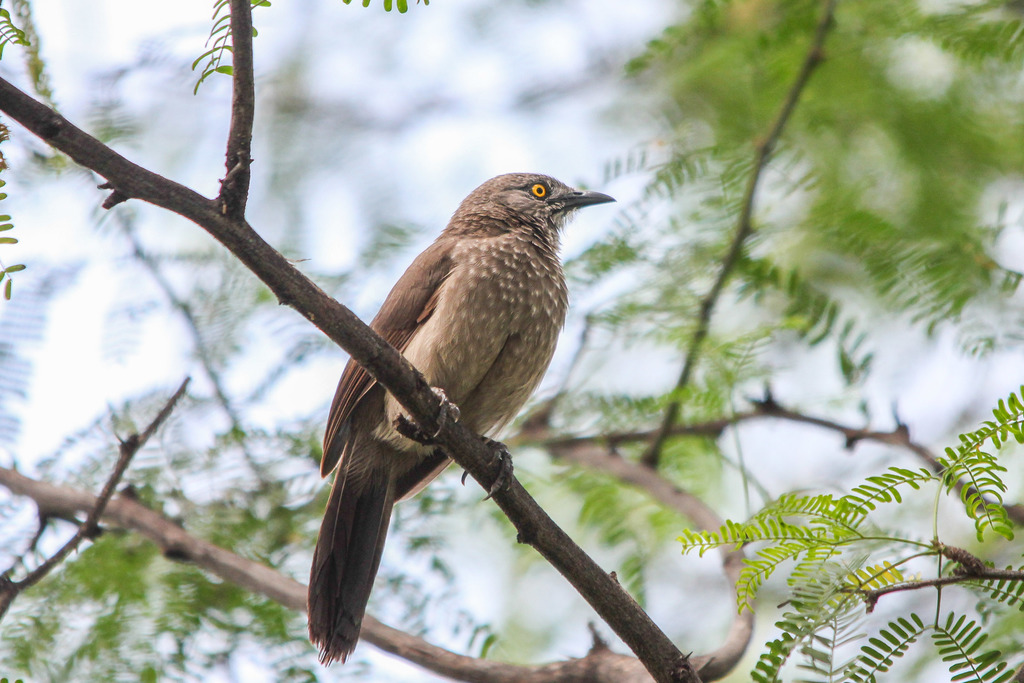
The brown babbler (Turdoides plebejus) is a species of bird in the family Leiothrichidae. It is predominantly found in West Africa, but ranging from the Gambia to Kenya. The species is common across its range. The species is also known as the Sudan babbler.
From the article Brown babbler on Wikipedia (CC BY-SA), quoted section by section
Description
The brown babbler is a medium-sized Turdoides babbler, measuring 22–25 centimetres (8.7–9.8 in) in length and weighs around 52–80 grams (1.8–2.8 oz). The plumage is grey-brown with a white-streaked throat and breast and a scaled head. The wings are bronze-brown, the bill black and the legs dusky or slaty black. The iris of the eyes are yellow. The sexes are alike, and juvenile birds are like the adults but with plainer and browner plumage and brown irises.
Range & habitat
The brown babbler inhabits the broad band of the Sahel between the Sahara Desert and the tropical forests of Western Africa, from southern Mauritania, Senegal and the Gambia to southern Sudan, Uganda and western Kenya. The species lives in open savanna, wooded grasslands, riparian habitat in drier areas, degraded cultivation, farmlands, parks and gardens. The species is common across its range and readily lives in human-modified habitat and is not considered threatened with extinction. The species is mostly sedentary (non-migratory), but is thought to make some seasonal movements based upon local conditions related to the rainy seasons. In central Burkina Faso it is observed more frequently during the rainy season, and it has also been observed to be erratically absent or present in the Kampala region of Uganda.
Wikipedia: “Distribution and habitat”
What it does
The brown babbler consumes a variety of insects including ants, beetles, termites, and praying mantises, as well as other invertebrates, berries, and fruit. It will also opportunistically take carrion. They generally forage on the ground and in family parties of up to 14 individuals.
Wikipedia: “Behaviour”
Listen
Looking for field recordings…
Where it lives
Recorded sightings
—
geo-referenced records in GBIF, from museums, herbaria and field observers.
Drag the globe to turn it. Dots are where records exist, not a range map; darker means more records.
In the stacks
Searching the stacks…
Every page naming Turdoides plebejus in the Biodiversity Heritage Library →
This page is assembled live from iNaturalist, GBIF, Wikipedia, the Source Library and the Internet Archive. It is not yet part of the hand-edited codex. iNaturalist taxon 15057.