On eBird ↗
Sahul Sunbird
Live sightings near you, the range map, bar charts of when it is seen, and Macaulay Library photos and recordings.
Sahul Sunbird
Cinnyris frenatus
The Sahul sunbird (Cinnyris frenatus) is a species of bird in the sunbird family Nectariniidae that is endemic to Sulawesi eastwards to New Guinea and the Soloman Islands. It is also found in northeast Australia. It was formerly considered to be a subspecies of the olive-backed sunbird, now renamed the garden sunbird (Cinnyris jugularis).
From the article Sahul sunbird on Wikipedia (CC BY-SA), quoted section by section
Description
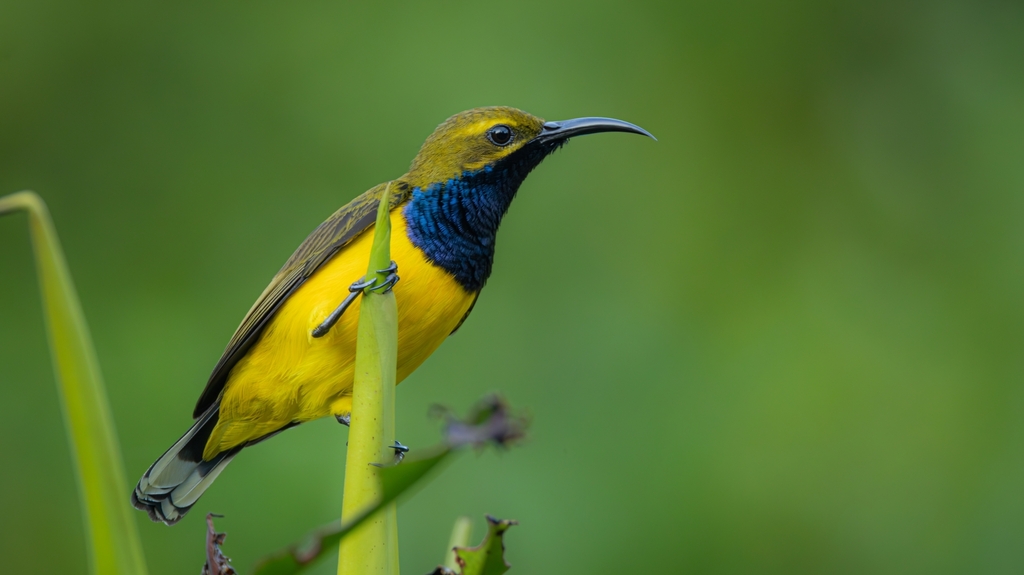
The Sahul sunbird is 10–11.4 cm (3.9–4.5 in) in length. The male weighs 6.7–11.9 g (0.24–0.42 oz), the female 6–10 g (0.21–0.35 oz). The species is sexual dimorphic. The male of the nominate subspecies is olive above, the remiges are black with green edging and the black tail has a white tip. The throat, side of neck and breast are blue-black iridescent. It has a yellow supercilium and a yellow moustachial stripe. The underparts are yellow. The iris is dark brown and the legs are black. The female lacks the iridescent throat patch.
Range & habitat
The Sahul sunbird is a resident species from Sulawesi and the Maluku Islands to New Guinea, the Aru Islands, the Bismarck Archipelago, northern Solomon Islands and northeastern Australia. It is found in various habitats including mangroves, forest edge, open scrub as well as parks and gardens.
Wikipedia: “Distribution and habitat”
What it does
It forages either singly or in small groups. The diet consists of small insects, spiders, nectar and small fruit.
== References ==
Wikipedia: “Feeding”
Listen
Looking for field recordings…
Where it lives
Recorded sightings
—
geo-referenced records in GBIF, from museums, herbaria and field observers.
Drag the globe to turn it. Dots are where records exist, not a range map; darker means more records.
In the stacks
Searching the stacks…
Every page naming Cinnyris frenatus in the Biodiversity Heritage Library →
This page is assembled live from iNaturalist, GBIF, Wikipedia, the Source Library and the Internet Archive. It is not yet part of the hand-edited codex. iNaturalist taxon 1504995.