- Animals
- ›Arthropods
- ›Hexapods
- ›Insects
- ›Winged and Once-winged Insects
- ›Beetles
- ›Water, Rove, Scarab, Long-horned, Leaf, and Snout Beetles
- ›Cucujiform Beetles
- ›Leaf Beetles and Allies
- ›Leaf Beetles
- ›Skeletonizing Leaf and Flea Beetles
- ›Galerucini
- ›Diorhabda
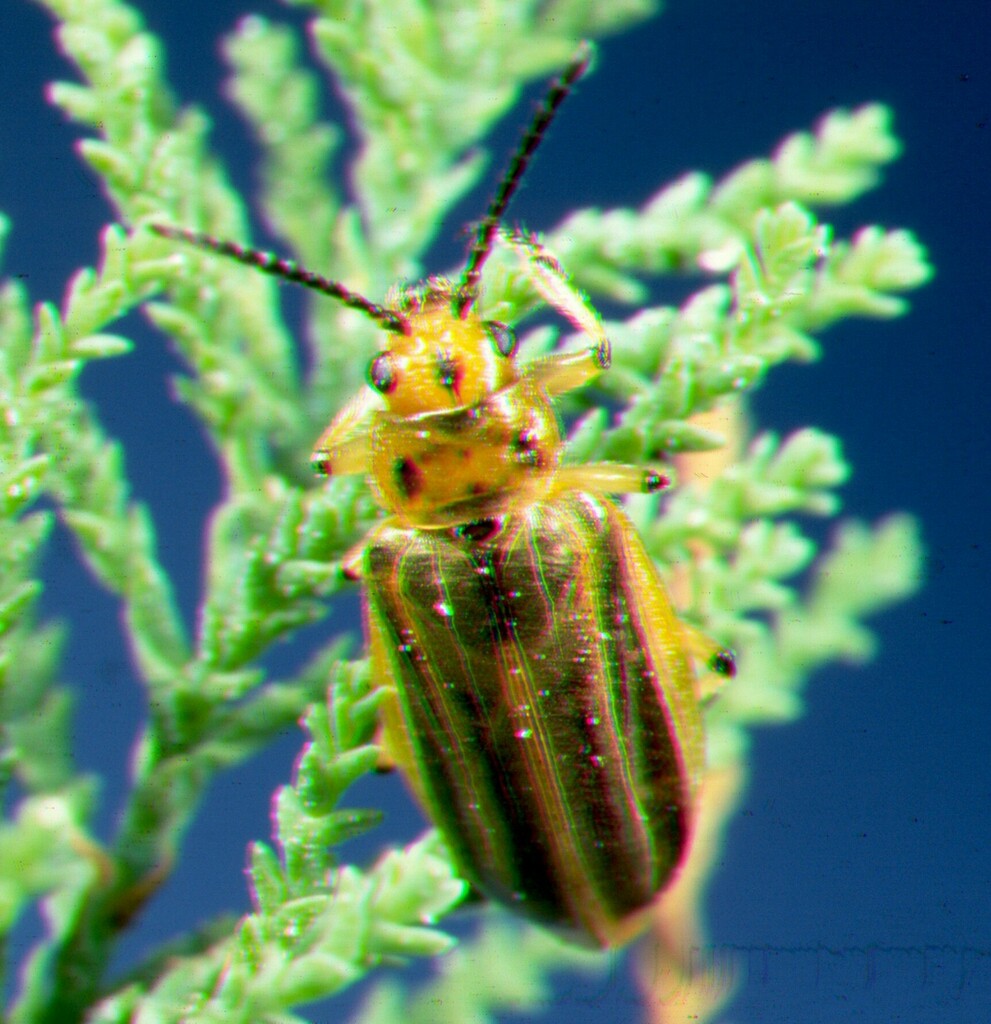
Larger Tamarisk Beetle
Diorhabda carinata
Diorhabda carinata is a species of leaf beetle known as the larger tamarisk beetle (larger tamarisk beetle) which feeds on tamarisk trees from Ukraine, eastern Turkey and Syria east to northwest China, Kyrgyzstan and Pakistan, extending as far south as southern Iran. It is used in North America as a biological pest control agent against saltcedar or tamarisk (Tamarix spp.), an invasive species in arid and semi-arid ecosystems (where the larger tamarisk beetle and its closely related sibling species also may be less accurately referred to as the 'saltcedar beetle', 'saltcedar leaf beetle', 'salt cedar leaf beetle', or 'tamarisk leaf beetle').
From the article Diorhabda carinata on Wikipedia (CC BY-SA), quoted section by section
What it does
The larger tamarisk beetle overwinters as adults on the ground. Adults become active and begin feeding and mating in the early spring when tamarisk leaves are budding. Eggs are laid on tamarisk leaves and bark and hatch in about a week in warm weather. Three larval stages feed on tamarisk leaves for about two and a half weeks when they crawl to the ground and spend about 5 days as a C-shaped inactive prepupa before pupating about one week. Adults emerge from pupae to complete the life cycle in about 4–5 weeks in the summer. Five generations of larger tamarisk beetle occur through spring and fall in central Texas. Similar to the northern tamarisk beetle, adults begin to enter diapause in the late summer and early fall, ceasing reproduction and feeding to build fat bodies before seeking a protected place to overwinter. Larvae and adults are sensitive to shorter daylengths as the summer progresses that signal the coming of winter and induce diapause. Robert Bartelt and Allard Cossé (USDA-ARS, Peoria, Illinois) found that male larger tamarisk beetle emit a putative aggregation pheromone, similar to that found in Diorhabda carinulata, that could serve to attract both males and females to certain tamarisk trees.
Wikipedia: “Life cycle”
Listen
Looking for field recordings…
Where it lives
Recorded sightings
—
geo-referenced records in GBIF, from museums, herbaria and field observers.
Drag the globe to turn it. Dots are where records exist, not a range map; darker means more records.
In the stacks
Searching the stacks…
Every page naming Diorhabda carinata in the Biodiversity Heritage Library →
This page is assembled live from iNaturalist, GBIF, Wikipedia, the Source Library and the Internet Archive. It is not yet part of the hand-edited codex. iNaturalist taxon 1497540.