On eBird ↗
Tasman Starling
Live sightings near you, the range map, bar charts of when it is seen, and Macaulay Library photos and recordings.
Tasman Starling
Aplonis fusca
The Tasman starling (Aplonis fusca) was described in 1836 by John Gould as a species which occurred on both Norfolk Island and Lord Howe Island. In 1928 Australian ornithologist Gregory Mathews recognized that the plumage of the race from Lord Howe Island was much browner and more greyish than the plumage of the Norfolk Island race and split the species into two forms, the Norfolk starling (Aplonis fusca fusca), and the Lord Howe starling (Aplonis fusca hulliana). Both subspecies are now extinct, thus so the species.
From the article Tasman starling on Wikipedia (CC BY-SA), quoted section by section
Description
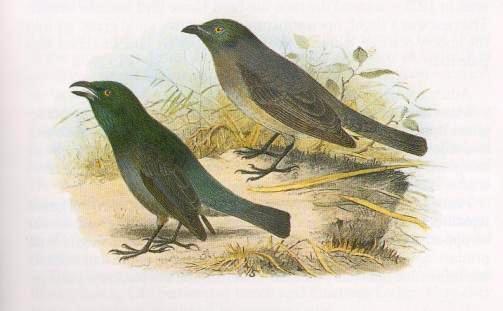
The Norfolk starling was 20 cm long. The wing length was 9.8 cm to 10.3 cm, the length of the tail was 6.3 to 6.8 cm, the length of the culmen 1.3 cm and tarsus was 2.5 cm. It was generally greyish brown. The males were glossy metallic green from head to the throat. The back, the rump, the uppertail coverts, the wing coverts, and underparts were grey, but undertail coverts were whitish. The bill was black and the eyes orange red. The females were coloured similarly but the greenish gloss were slightly duller and a grey throat contrasted with pale brownish flanks. The under breast was washed ochraceous. The abdomen and the undertail coverts were yellowish white. The Lord Howe starling was 18 cm long. The head, the neck, the mantle and the throat were glossy metallic green. The back was slaty grey with a dull greenish gloss. The rump and the underparts were grey. The tail was grey with brownish tips to the feathers. The wings were rich brown. The iris was orange red.
Range & habitat
The Norfolk starling was confined to Norfolk Island, an Australian territory in the Tasman Sea between Australia and New Zealand.
Wikipedia: “Distribution”
What it does
The starlings were called "red-eyes" from their eye colour, or "cudgimeruk" from their distinctive calls, by the islanders. They were forest dwellers which lived and foraged in pairs. During the nesting period a clutch of four to five bluish green eggs with red blotches were laid in a nest in a hollow in a dead tree or tree fern.
Wikipedia: “Ecology”
Listen
Looking for field recordings…
Where it lives
Recorded sightings
—
geo-referenced records in GBIF, from museums, herbaria and field observers.
Drag the globe to turn it. Dots are where records exist, not a range map; darker means more records.
In the stacks
Searching the stacks…
Every page naming Aplonis fusca in the Biodiversity Heritage Library →
This page is assembled live from iNaturalist, GBIF, Wikipedia, the Source Library and the Internet Archive. It is not yet part of the hand-edited codex. iNaturalist taxon 14945.