On eBird ↗
Cape Starling
Live sightings near you, the range map, bar charts of when it is seen, and Macaulay Library photos and recordings.
Cape Starling
Lamprotornis nitens
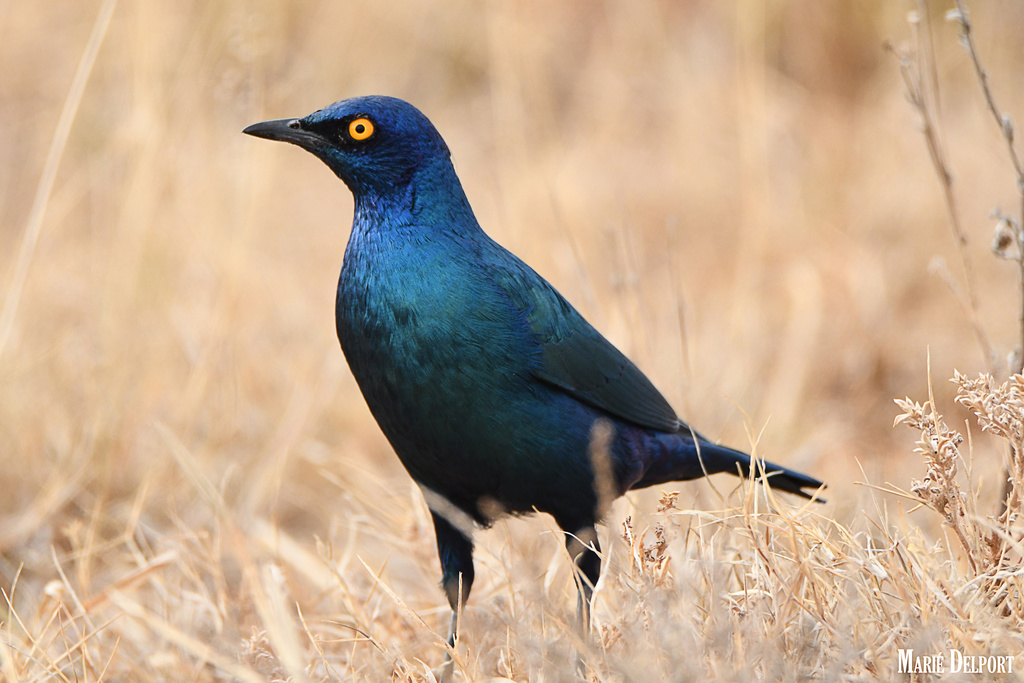
The Cape starling (Lamprotornis nitens), also known as red-shouldered glossy-starling or Cape glossy starling, is a species of starling in the family Sturnidae. It is found in Southern Africa, where it lives in woodlands, bushveld and in suburbs.
From the article Cape starling on Wikipedia (CC BY-SA), quoted section by section
Description
The Cape starling has an adult length of about 25 cm (10 in) and weight of about 100 grams (3.5 oz). The plumage of an adult bird is a fairly uniform bright, glossy colour. The head is blue with darker ear coverts and the upper parts of the body are greenish-blue. It has a lengthy warbling song which may include an imitation of sounds it hears in its environment.
Range & habitat
The Cape starling is found in the southern part of Africa. Its range encompasses the extreme south of Gabon, the west and south of Angola, the extreme south of Zambia, throughout Zimbabwe, Namibia, Botswana, Lesotho and South Africa. It is a vagrant to the Republic of the Congo but does not breed there. In the other countries in its range it is a resident (non-migratory) species and its total extent of occurrence is about 3,000,000 square kilometres (1,200,000 sq mi). The Cape starling is found where trees in which it can roost and nest are found. It is not a bird of dense forest or of pasture and is not associated with any particular plant type. It does occur in open woodland, plantations, savannah, bushveld, rough grassland, parks and gardens and is quite numerous in the central Kalahari where isolated trees occur.
Wikipedia: “Distribution and habitat”
What it does
The Cape starling is a gregarious bird and forms large flocks in the non-breeding season. It usually feeds on the ground often foraging alongside other species of starlings such as the pied starling, the common starling, the greater blue-eared starling, the lesser blue-eared starling, the wattled starling and Burchell's starling. It is habituated to humans and its diet includes fruit, insects and nectar. It sometimes feeds on ectoparasites that it picks off the backs of animals and it sometimes visits bird tables for scraps.
Wikipedia: “Behaviour”
Listen
Looking for field recordings…
Where it lives
Recorded sightings
—
geo-referenced records in GBIF, from museums, herbaria and field observers.
Drag the globe to turn it. Dots are where records exist, not a range map; darker means more records.
In the stacks
Searching the stacks…
Every page naming Lamprotornis nitens in the Biodiversity Heritage Library →
This page is assembled live from iNaturalist, GBIF, Wikipedia, the Source Library and the Internet Archive. It is not yet part of the hand-edited codex. iNaturalist taxon 14930.