On eBird ↗
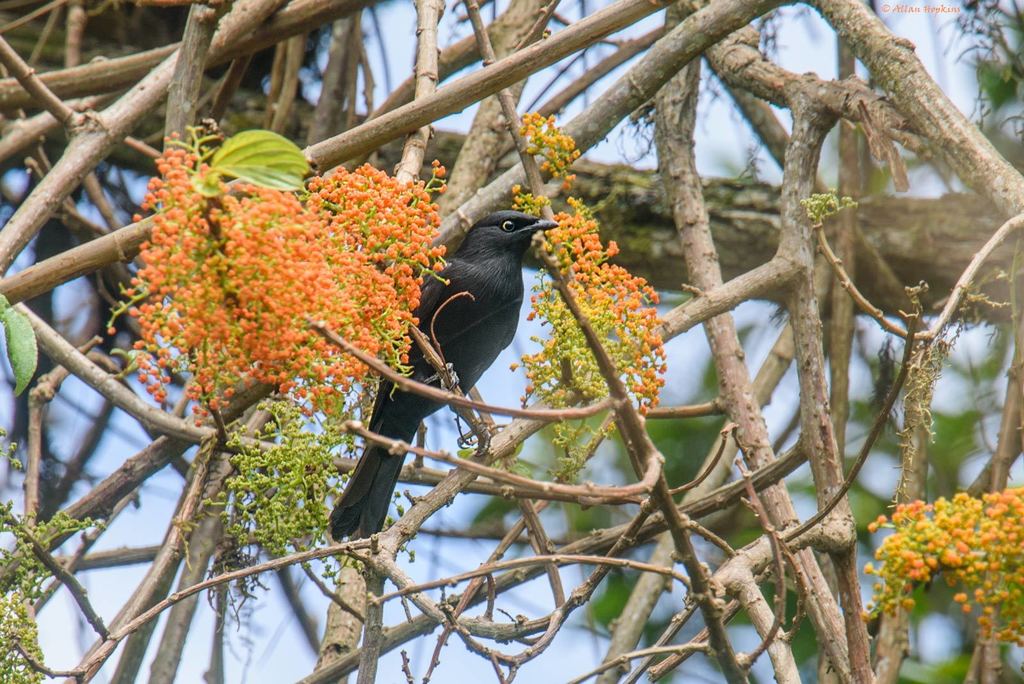
Kenrick's Starling
Live sightings near you, the range map, bar charts of when it is seen, and Macaulay Library photos and recordings.
Kenrick's Starling
Poeoptera kenricki
Kenrick's starling (Poeoptera kenricki) is a species of starling in the family Sturnidae. It is found in Kenya and Tanzania.
From the article Kenrick's starling on Wikipedia (CC BY-SA), quoted section by section
Description
Kenrick's starling is a medium-sized bird with male weighing 50g and females weighing 38g. Like other birds in its genus, males are a glossy black colour and females are an ashy grey. Females also possess chestnut-coloured primary feathers, which are most easily seen during flight. It can be differentiated from Stuhlmann's starling mainly by range, with the two being separated by the Rift Valley. Kenrick's starling also has a yellow eye as compared to the slaty one of Stuhlmann's starling, although this feature is not always apparent in the field. The two subspecies differ slightly in morphology, with P. k. bensoni being larger, with a heavier bill, and a more noticeable change in colour between the lower and upper breast than P. k. kenricki.
Range & habitat
It is found in Kenya and Tanzania, with a recent record also coming from Malawi of a flock of over 150 birds. In Kenya it is found in the area surrounding Mount Kenya. In Tanzania it is found in the east and northeast in the Usambara and Uluguru Mountains as well as at Mount Kilimanjaro and Mount Meru.
Wikipedia: “Distribution & habitat”
What it does
Kenrick's starlings are cavity nesters, and have been observed nesting in the old holes of woodpeckers and barbets. Whether it also uses natural cavities is unknown. It prefers to nest in cavities that are made in dead trees or dead limbs of trees. Very little is known about its rearing behaviour besides the fact that both parents feed the chick.
Wikipedia: “Behaviour”
Listen
Looking for field recordings…
Where it lives
Recorded sightings
—
geo-referenced records in GBIF, from museums, herbaria and field observers.
Drag the globe to turn it. Dots are where records exist, not a range map; darker means more records.
In the stacks
Searching the stacks…
Every page naming Poeoptera kenricki in the Biodiversity Heritage Library →
This page is assembled live from iNaturalist, GBIF, Wikipedia, the Source Library and the Internet Archive. It is not yet part of the hand-edited codex. iNaturalist taxon 14920.