On eBird ↗
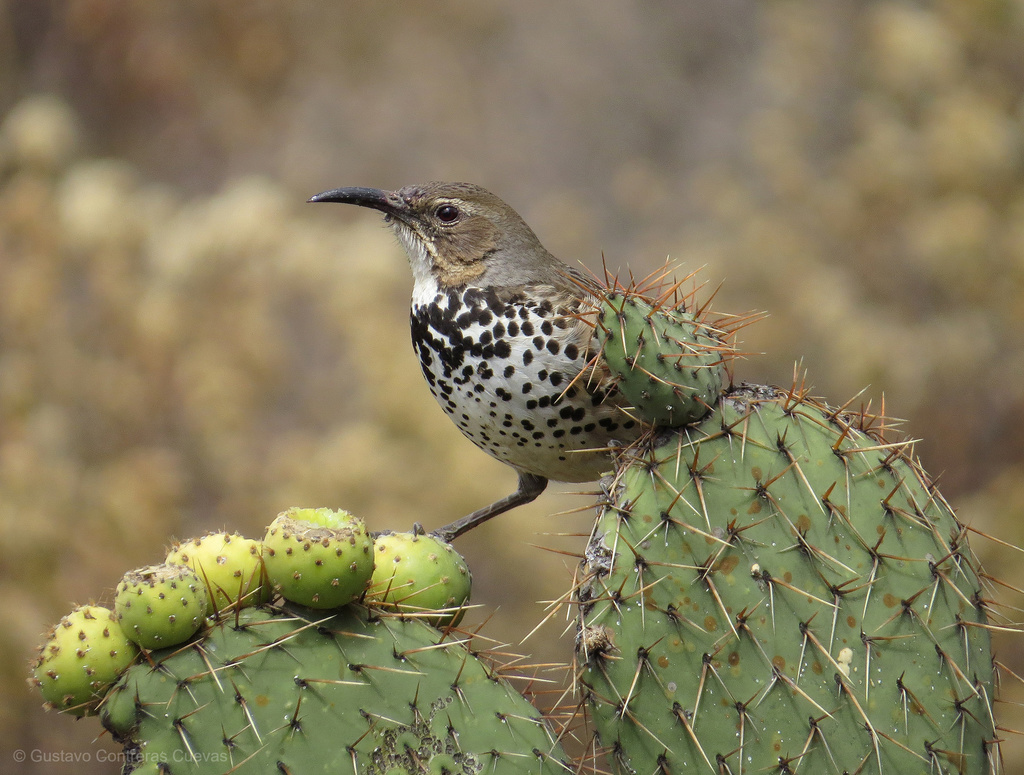
Ocellated Thrasher
Live sightings near you, the range map, bar charts of when it is seen, and Macaulay Library photos and recordings.
Ocellated Thrasher
Toxostoma ocellatum
The ocellated thrasher (Toxostoma ocellatum) is a species of bird in the family Mimidae. It is endemic to the highlands of south-central Mexico, where ts natural habitats are dry scrubland and open oak and pine woodland between 1500 and 3000 m above sea-level.
From the article Ocellated thrasher on Wikipedia (CC BY-SA), quoted section by section
Description
The ocellated thrasher is 26.5 to 29.5 cm (10.4 to 11.6 in) long; 14 specimens weighed 77.3 to 95.8 g (2.73 to 3.38 oz). Adults' upperparts are dark brown and have a slight olive wash. They have a dull white to buff supercilium and brown cheeks. The folded wings show two white bars and the outer tail feathers have narrow white tips. The underparts are whitish darkening to buff on the belly and brown on the flanks. The breast, sides, and flanks have bold black spots.
Range & habitat
The nominate subspecies of ocellated thrasher is found in central Mexico from San Luis Potosí south to the states of Hidalgo and México. T. o. villai is found in southern Mexico between Puebla and Oaxaca. The ocellated thrasher inhabits a variety of landscapes including arid and semi-arid scrub and the brushy understory of oak and pine-oak forests. In elevation it ranges from 1,400 to 3,000 m (4,600 to 9,800 ft).
Wikipedia: “Distribution and habitat”
What it does
The ocellated thrasher forages mostly in dense vegetation, on the ground or near it. Though its diet has not been documented, it is presumed to be mostly arthropods, other invertebrates, and possibly fruit.
Wikipedia: “Feeding”
Listen
Looking for field recordings…
Where it lives
Recorded sightings
—
geo-referenced records in GBIF, from museums, herbaria and field observers.
Drag the globe to turn it. Dots are where records exist, not a range map; darker means more records.
In the stacks
Searching the stacks…
Every page naming Toxostoma ocellatum in the Biodiversity Heritage Library →
This page is assembled live from iNaturalist, GBIF, Wikipedia, the Source Library and the Internet Archive. It is not yet part of the hand-edited codex. iNaturalist taxon 14917.