On eBird ↗
Tropical Mockingbird
Live sightings near you, the range map, bar charts of when it is seen, and Macaulay Library photos and recordings.
Tropical Mockingbird
Mimus gilvus
The tropical mockingbird (Mimus gilvus) is a resident breeding bird from southern Mexico south to northern Brazil, and in the Lesser Antilles and other Caribbean islands. The birds in Panama and Trinidad may have been introduced. The northern mockingbird (M. polyglottos) is its closest living relative, but the critically endangered Socorro mockingbird (M. graysoni) is also much closer to these two than previously believed .
From the article Tropical mockingbird on Wikipedia (CC BY-SA), quoted section by section
Description
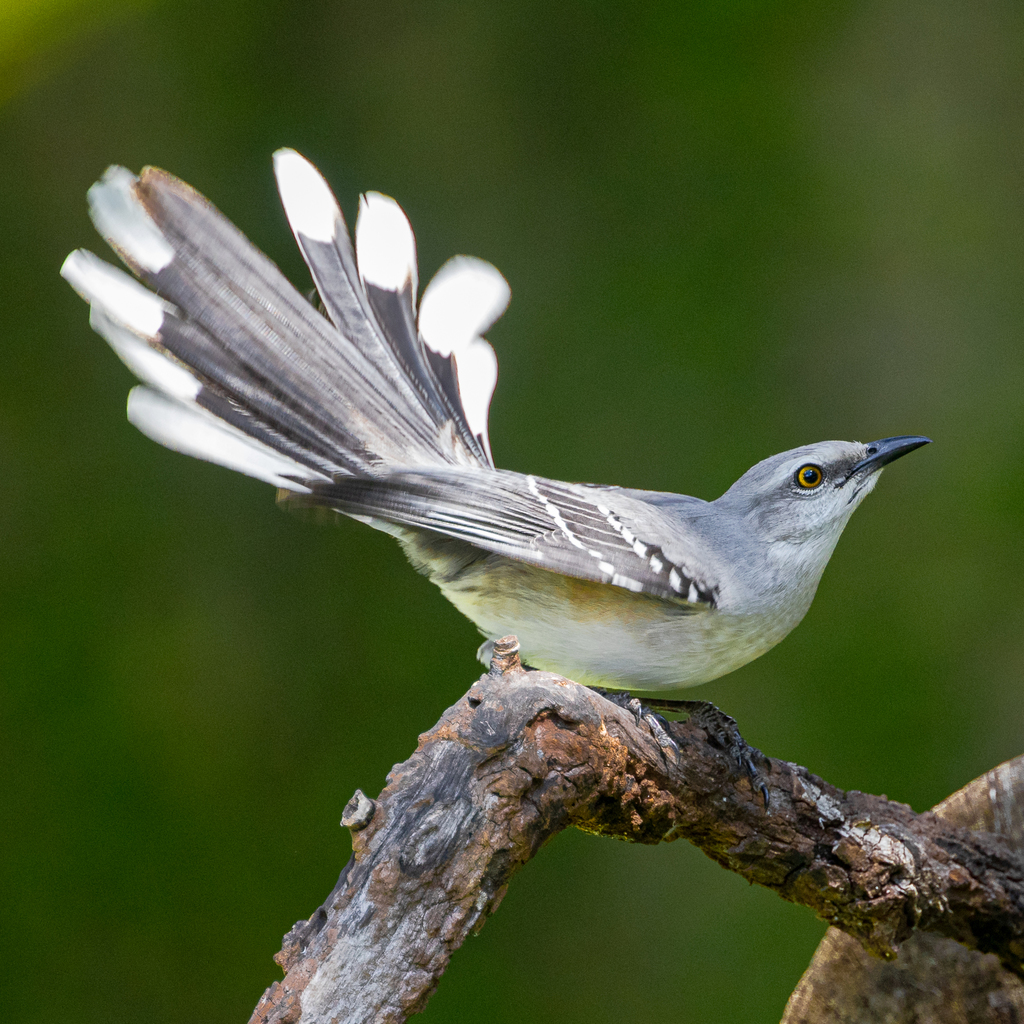
Adult tropical mockingbirds are 23 to 25.5 cm (9.1 to 10.0 in) long. The mean weights of various subspecies vary greatly. Adults of the nominate subspecies are gray on the head and upper parts and have a whitish supercilium and a dark stripe through the eye. The underparts are off-white and the wings are blackish with two white wing bars and white edges to the flight feathers. They have a long dark tail with white feather tips, a slim black bill with a slight downward curve and long dark legs. Juveniles are browner and their chest and flanks have dusky streaks. The subspecies vary in overall size and the length of wings and tail, the intensity of their plumage colors, the extent of pale markings, and eye color. M. g. magnirostris is the largest and has a significantly heavier bill than the others; M. g. tolimensis is also larger than the nominate.
Range & habitat
The subspecies of the tropical mockingbird are distributed thus:
M. g. gracilis, southern Mexico south to Honduras and El Salvador M. g. leucophaeus, the Yucatán Peninsula and Cozumel and other offshore islands M. g. antillarum, the Lesser Antilles from Antigua south M. g. tobagensis, Trinidad and Tobago M. g. rostratus, southern Caribbean islands from Aruba east to Blanquilla M. g. melanopterus, northern and northeastern Colombia, Venezuela, Guyana, and Brazil's Roraima state M. g. gilvus, Suriname and French Guiana M. g. tolimensis, western and central Colombia south to extreme northern Ecuador; El Salvador to Panama M. g. antelius, coastal northeastern and eastern Brazil south to Rio de Janeiro state M. g. magnirostris, San Andrés Island off eastern Nicaragua The population of M. g. tolimensis in El Salvador, Nicaragua, Costa Rica, and Panama are descendants of escaped cage birds imported from Colombia. The tropical mockingbird is common in most open habitats, including around human habitation. Examples include scrublands, savannas, parks, and farmlands. It avoids closed forests and mangroves. It is a bird of the lowlands to middle elevations; it reaches about 2,500 m (8,200 ft) in Central American and the northern Andes. It has been found as high as 2,600 m (8,500 ft) in Colombia and 3,100 m (10,200 ft) in northern Ecuador.
Wikipedia: “Distribution and habitat”
What it does
The tropical mockingbird forages on the ground or low in vegetation; it also captures flying insects such as swarming termites on the wing. It is omnivorous; its diet includes a variety of arthropods (such as spiders, grasshoppers, and beetles), seeds, small fruits and berries, larger cultivated fruits (such as mangoes and sapodillas), lizards, bird and lizard eggs, the contents of bird feeders, and human food.
Wikipedia: “Feeding”
Listen
Looking for field recordings…
Where it lives
Recorded sightings
—
geo-referenced records in GBIF, from museums, herbaria and field observers.
Drag the globe to turn it. Dots are where records exist, not a range map; darker means more records.
In the stacks
Searching the stacks…
Every page naming Mimus gilvus in the Biodiversity Heritage Library →
This page is assembled live from iNaturalist, GBIF, Wikipedia, the Source Library and the Internet Archive. It is not yet part of the hand-edited codex. iNaturalist taxon 14884.