On eBird ↗
Sulawesi Myna
Live sightings near you, the range map, bar charts of when it is seen, and Macaulay Library photos and recordings.
Sulawesi Myna
Basilornis celebensis
The Sulawesi myna (Basilornis celebensis) is a species of starling in the family Sturnidae. It is endemic to Sulawesi, Indonesia. Its natural habitat is subtropical or tropical moist lowland forests.
From the article Sulawesi myna on Wikipedia (CC BY-SA), quoted section by section
Description
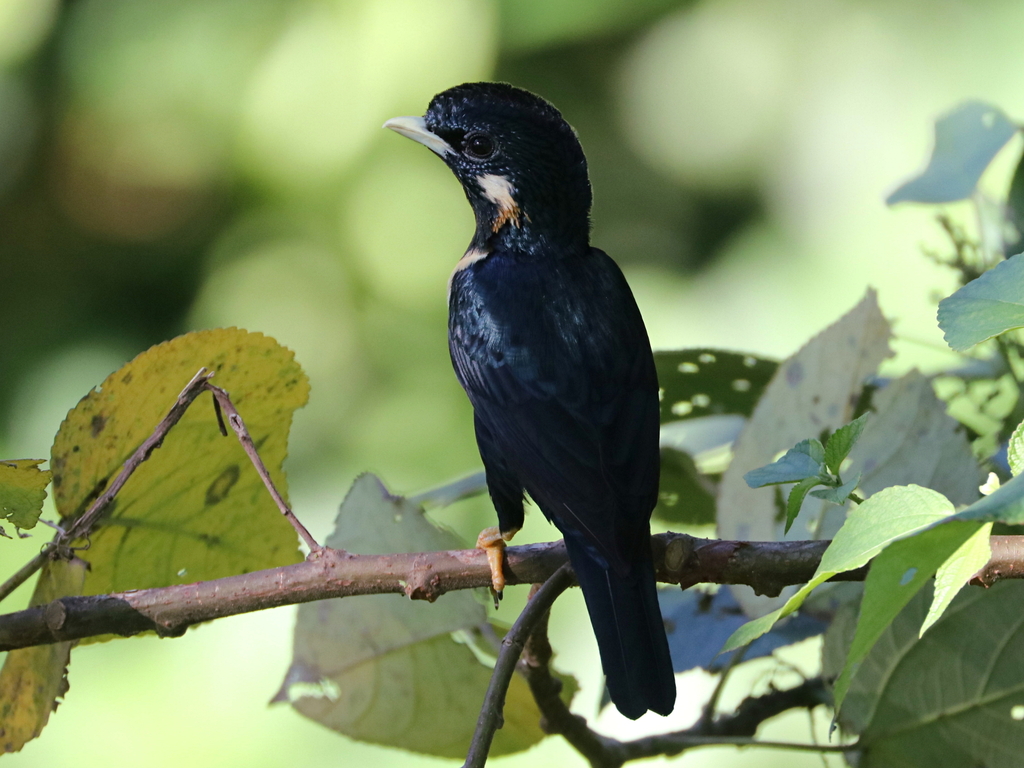
The Sulawesi myna grows to a length of 23 to 27 cm (9.1 to 10.6 in). It is a glossy black bird with a permanently raised crest which is larger in the male. The sides of the face and throat have white patches. The eye is surrounded by a bluish-black ring of bare skin, the beak is pale bluish-green and the legs are yellowish. Juvenile birds are chocolate brown. This myna has a range of sounds including grunts, high-pitched whistles, squeaks and warbles. One call is a descending sequence of whistles and another is a descending nasal call that sounds like "meeow" and is uttered with the head thrusting forwards and the back feathers fluffed up.
Range & habitat
This myna is endemic to the humid forests of hilly districts of the Indonesian island of Sulawesi. Its main habitat here is forest fringes, clearings, scattered areas of woodland and secondary forests, although it is sometimes found in primary forests. It is also present on the smaller islands of Lembeh, Muna and Buton; these are lowland islands and the habitat is mostly grassland savannah with patches of evergreen woodland in which the bird is primarily found.
Wikipedia: “Distribution and habitat”
What it does
The species usually feeds high in the forest canopy. It usually occurs in pairs or small family groups, but sometimes solitary individuals can be seen. Immature individuals may join flocks of fiery-browed starling (Enodes erythrophris) and it often associates with groups of other fruit-eating birds. Little is known about the breeding habits of this bird. Its diet is estimated to consist of about 44% fruit and 52% invertebrates, the balance being taken up by small vertebrates. It is a non-migratory species but presumably moves about the forest in response to the ripening of fruits on different species of tree.
Wikipedia: “Behaviour”
Listen
Looking for field recordings…
Where it lives
Recorded sightings
—
geo-referenced records in GBIF, from museums, herbaria and field observers.
Drag the globe to turn it. Dots are where records exist, not a range map; darker means more records.
In the stacks
Searching the stacks…
Every page naming Basilornis celebensis in the Biodiversity Heritage Library →
This page is assembled live from iNaturalist, GBIF, Wikipedia, the Source Library and the Internet Archive. It is not yet part of the hand-edited codex. iNaturalist taxon 14863.