On eBird ↗
Beautiful Nuthatch
Live sightings near you, the range map, bar charts of when it is seen, and Macaulay Library photos and recordings.
Beautiful Nuthatch
Sitta formosa
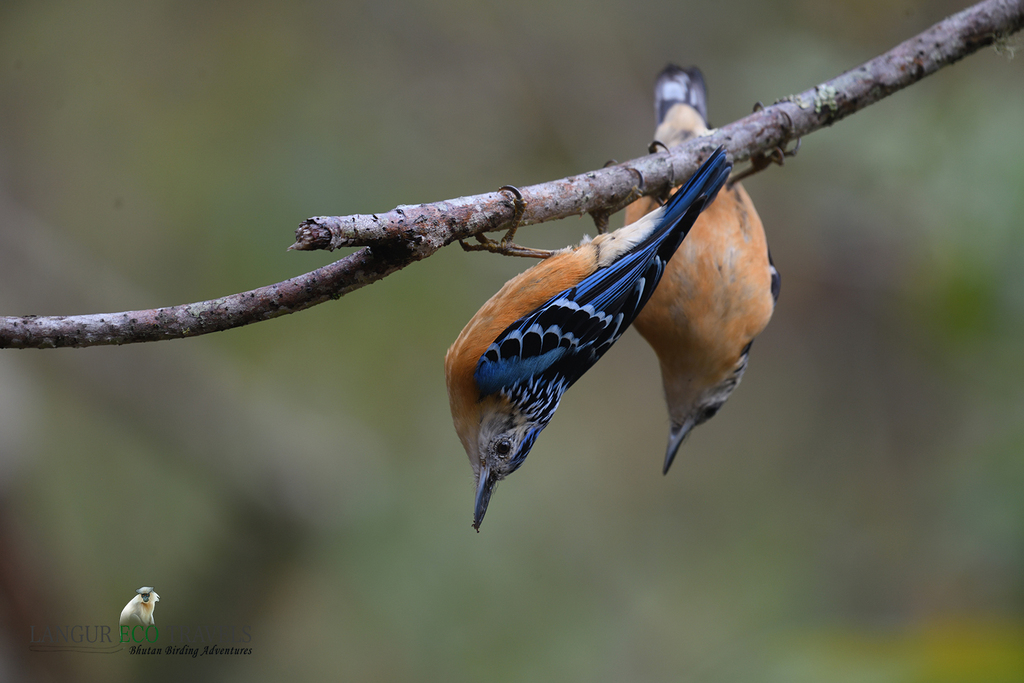
The beautiful nuthatch (Sitta formosa) is a bird species in the family Sittidae, collectively known as nuthatches. It is a large nuthatch, measuring 16.5 cm (6.5 in) in length, that is not sexually dimorphic. Its colour and markings are dramatic, the upper parts being black and azure, streaked with white and pale blue on the head and lined with the same colours on the wing feathers. The underparts are orange, and the eyebrow and throat are ochre. An irregular, dark eyestripe highlights its eye. Its ecology is not fully described, but it is known to feed on small insects and larvae found on the trunks and epiphyte-covered branches of trees in its range. Reproduction takes place from April to May; the nest is placed in the hole of an oak, rhododendron, or other large tree. The nest is made of plant material and fur in which the bird typically lays four to six eggs.
Although the species is found in most of the countries making up the mainland of Southeast Asia, it appears to be rare throughout its range, its population being highly local where it is found. The bird nests predominantly in montane forest at an altitudinal range from 950 m (3,120 ft) up to nearly 2,300 m (7,500 ft), with some seasonal height adjustment, down to around 300 m (980 ft) in winter. Its localised occurrence within its range makes rigorous estimates of its population difficult, but its habitat is threatened by deforestation and the species appears to be in decline. It has been classified as vulnerable by the International Union for Conservation of Nature.
From the article Beautiful nuthatch on Wikipedia (CC BY-SA), quoted section by section
Description
Described by Erik Matthysen in his 1998 treatise The Nuthatches as a bird that "deserves its name", the beautiful nuthatch has highly distinctive plumage. Its upperparts are black and azure, and it is orange on the underparts. The crown and upper mantle are black, streaked with pale blue and white. The scapulars, back and rump are an azure blue. The greater and medium coverts are black, finely edged with white, forming two narrow wing bars; the flight feathers are black and more or less lined with pale blue. The eyebrow and throat are white and buff and the eye is highlighted by an irregular, dark eyestripe. Under the wing, the white base of the primary coverts contrasts sharply with grey undertail-coverts; a distinguishing trait when viewing the bird in flight. The iris is reddish-brown or dark brown and the bill is black but for a whitish tinge at the base of the lower mandible. The lower parts are generally orange-cinnamon. The legs and feet are yellowish-brown, olive-brown or greenish-brown. There is no sexual dimorphism. Juveniles are very similar to adults, but the streaks on the mantle are blue rather than white. The primary coverts of juveniles are also more closely lined with blue, and the underparts are paler overall, especially on the chest. …
Range & habitat
This species lives in the eastern Himalayas, and has been reported in several scattered sites across Southeast Asia, in the northwest of Vietnam and in central Laos. Its range stretches west into the northeast of India, where it was reported seen near Darjeeling in West Bengal, but not since 1933. It is present in Bhutan, and in the Indian states of Sikkim (in the town of Rangpo), in Meghalaya (in the Khasi Hills), in Assam (in the Dima Hasao district), in the south of Arunachal Pradesh, and in Manipur and Nagaland. Its presence in Bangladesh is uncertain but it is found further east in the north of Burma, in Chin State (in the Chin Hills–Arakan Yoma montane forests), the Sagaing Region, in Kachin State and in Shan State. Data on the bird from Laos is erratic, but there are reports of sightings north of Phou Kobo, and of large numbers of the species wintering in the center of the country in the pristine wilderness of Nakai–Nam Theun. There are also reports of sightings in the southeast of China's Yunnan province, in northern Thailand and in northwestern Vietnam. Its residential and breeding range is estimated to cover 376,000 km2 (145,000 sq mi). Beautiful nuthatches typically inhabit both the interior and outskirts of evergreen or semi-evergreen montane forest, though in northern Burma they have been recorded nesting in trees scattered across open areas. …
Wikipedia: “Distribution and habitat”
What it does
The beautiful nuthatch forages alone, in pairs or in small groups of four to five individuals, though an unusual gathering of 21 individuals was observed in one tree in Bhutan. It often takes part in mixed-species foraging flocks, and has been notably observed feeding with the Himalayan cutia (Cutia nipalensis) and the velvet-fronted nuthatch (Sitta frontalis) – two other species that prospect for food on tree trunks. Other foraging flock partners surveyed are the long-tailed broadbill (Psarisomus dalhousiae), the lesser racket-tailed drongo (Dicrurus remifer), the maroon oriole (Oriolus traillii) and the white-browed scimitar babbler (Pomatorhinus schisticeps). S. formosa forages from about the middle to the apex of tall trees, exploring the trunks and epiphyte-covered branches (lichens, mosses, orchids), for small insects, but also prospect on outermost branches. In Laos, individuals were observed feeding while perched on the larger branches of a Fujian cypress (Chamaecyparis hodginsii), a tree frequently enveloped in epiphytes. The bird has been described at times as the most timid of nuthatches. It prospects in a manner typical of many others in its genus, sometimes hanging upside down for an extended time surveying its surroundings. …
Wikipedia: “Feeding”
Listen
Looking for field recordings…
Where it lives
Recorded sightings
—
geo-referenced records in GBIF, from museums, herbaria and field observers.
Drag the globe to turn it. Dots are where records exist, not a range map; darker means more records.
In the stacks
Searching the stacks…
Every page naming Sitta formosa in the Biodiversity Heritage Library →
This page is assembled live from iNaturalist, GBIF, Wikipedia, the Source Library and the Internet Archive. It is not yet part of the hand-edited codex. iNaturalist taxon 14822.