On eBird ↗
Krüper's Nuthatch
Live sightings near you, the range map, bar charts of when it is seen, and Macaulay Library photos and recordings.
Krüper's Nuthatch
Sitta krueperi
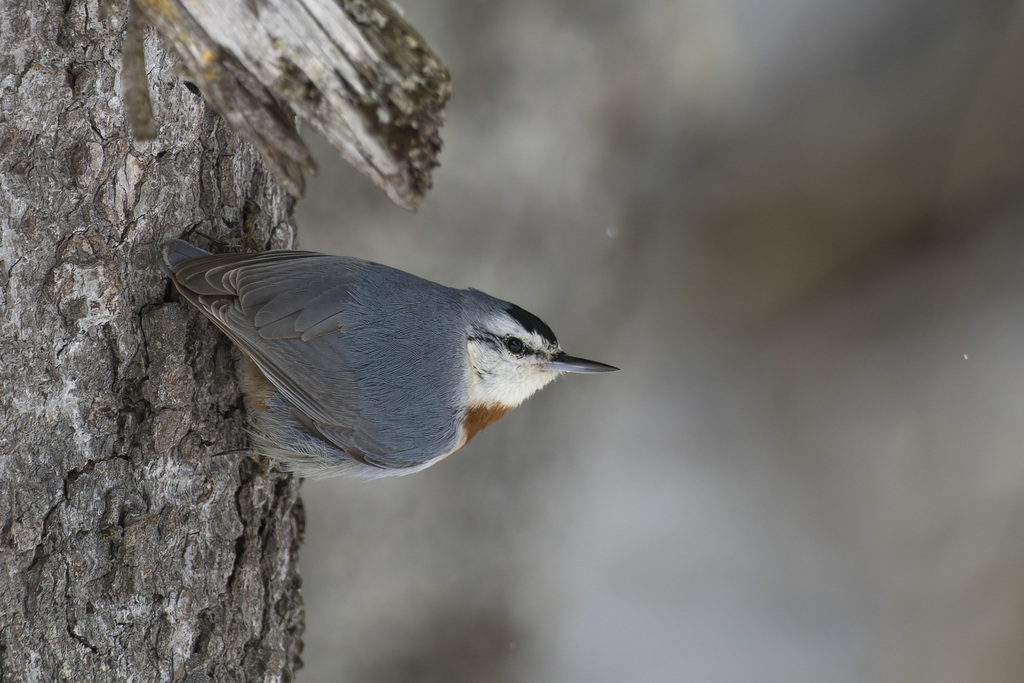
Krüper's nuthatch (Sitta krueperi) is a species of bird in the nuthatch family Sittidae. It is a small to medium-sized nuthatch, measuring 12.5 centimetres (4.9 in) in length. The upperparts are blue-grey, with the front half of the crown black in adults of both sexes, but with a less marked in the female rear. The species has a black or grey eyestripe and a prominent white supercilium. The underparts are blue-grey in males and buff-grey in females, with a large, crescent-shaped rufous pectoral patch. It feeds on insects in the summer and seeds, especially pine seeds, in autumn and winter. Breeding takes place between March and May, and the nest is usually placed in a tree hole. The clutch consists of five to seven eggs, incubated by the female and fed by the male. Both parents take part in feeding the young.
Krüper's nuthatch is found in pine and other coniferous forests in Turkey, Lesbos (Greece), and in the western Caucasus mountains in Georgia and Krasnodar Krai and Karachay-Cherkessia (southern Russia), largely following the distribution of Turkish pine (Pinus brutia). It is found from sea level up to 2,500 metres (8,200 ft) above sea level in places. This species is one of the small nuthatches of the "Sitta canadensis group" and is particularly very close to the Algerian nuthatch (S. ledanti), the only other species in which the black half-crown is found. Krüper's nuthatch is threatened by habitat loss caused by forestry and especially by tourist development on the Turkish coasts.
From the article Krüper's nuthatch on Wikipedia (CC BY-SA), quoted section by section
Description
The Krüper's nuthatch is a small to medium-sized nuthatch, measuring 12.5 centimetres (4.9 in) in length. In males and females, the folded wing measures 71–81 millimetres (2.8–3.2 in) and 68–74 millimetres (2.7–2.9 in) respectively, the tail 33–40 millimetres (1.3–1.6 in) and 33–38 millimetres (1.3–1.5 in). The bill measures 17.9–20.2 millimetres (0.70–0.80 in) and the tarsus 16.9–19.3 millimetres (0.67–0.76 in). The adult male weighs 10–14.3 grams (0.35–0.50 oz). The study of 41 different measurements of many individuals across different localities in Turkey showed small variations in size along the range. The upperparts are blue-grey with a black front crown in adults of both sexes, and the primary and secondary flight feathers are grey-brown. The supercilium is white and underlined by a black eyestripe that is a little less well defined behind the eye. The throat is white and the rest of the underparts are pale grey with a large reddish patch on the crescent-shaped breast. The underwing-coverts are off-white and the undertail is rufous, with white tips. The eye is surrounded by a thin white eye ring, and the iris is dark cinnamon or brown; the bill is dark horn-grey; the upper mandible cutting edge at the base is blue-grey, as is the entire lower mandible base. …
Range & habitat
Krüper's nuthatch is found almost entirely in Turkey, where it is common in western Anatolia, and where it also lives along the Mediterranean coast in the Taurus Mountains and along the Black Sea coast north of the country, as far east as southern Georgia. It also lives on the Greek island of Lesbos and is vagrant in mainland Greece, where one was observed at Thessaloniki in October 1955. In 2010, a new nesting area was reported in central Anatolia, in Yozgat province, in the Ak Dağları mountains. This site consists of pure Scots pine (Pinus sylvestris) forest, and may support around 560 individuals. Krüper's nuthatch has a very close relationship with the Turkish pine (Pinus brutia), and the range of the bird almost completely overlaps that of the tree. Outlying populations of Turkish pine in the Crimea, northwestern Syria, Lebanon, northern Iraq, and Azerbaijan, which are mostly small, may have once held Krüper's nuthatches, or may still hold undiscovered populations. Krüper's nuthatch is sedentary, but undertakes some dispersal after the breeding season. Seasonal altitudinal shifts have also been noted, with some birds, possibly bird in their first year, moving down from the high ground in winter to mixed or deciduous forests. …
Wikipedia: “Distribution and habitat”
What it does
The Krüper's nuthatch lives alone or in pairs during the breeding season, and the pair stays with their young. In autumn, it is observed in groups of two to five individuals, sometimes taking part in mixed-species foraging flocks.
Vocalisations. The Krüper's nuthatch is a noisy bird, and is often easily detected and identified by its calls. The contact call is a dvui, sometimes made in a dui-dui-dui-dui series and reminiscent of the European greenfinch (Chloris chloris). When agitated, it produces a rough èèhch reminiscent of the Eurasian jay (Garrulus glandarius) or a dry puik. The song is a "tutitutitutitutituti… nasal, alternating high and low notes", with variable rhythm between different song strophes.
Food. The Krüper's nuthatch is an active bird, and it finds its food among the smallest branches in the tops of large trees, but also in other levels of vegetation. It can forage in bushes, and even feed on the ground. It feeds mainly on insects during the breeding season, but when these become scarce, in autumn and winter, it consumes seeds of pine and other conifers. Insects are gleaned along branches, or caught in flight, and conifer seeds are extracted from cone scales with the bill, before being wedged into a crack in the bark and hammered open. …
Wikipedia: “Ecology and behaviour”
Listen
Looking for field recordings…
Where it lives
Recorded sightings
—
geo-referenced records in GBIF, from museums, herbaria and field observers.
Drag the globe to turn it. Dots are where records exist, not a range map; darker means more records.
In the stacks
Searching the stacks…
Every page naming Sitta krueperi in the Biodiversity Heritage Library →
This page is assembled live from iNaturalist, GBIF, Wikipedia, the Source Library and the Internet Archive. It is not yet part of the hand-edited codex. iNaturalist taxon 14814.