On eBird ↗
Rusty-belted Tapaculo
Live sightings near you, the range map, bar charts of when it is seen, and Macaulay Library photos and recordings.
Rusty-belted Tapaculo
Liosceles thoracicus
The rusty-belted tapaculo (Liosceles thoracicus) is a species of bird in the Rhinocryptidae family. First described by Philip Lutley Sclater in 1865, it is monotypic within the genus Liosceles. It is found in Bolivia, Brazil, Colombia, Ecuador, and Peru, where its natural habitat is subtropical or tropical moist lowland forests.
From the article Rusty-belted tapaculo on Wikipedia (CC BY-SA), quoted section by section
Description
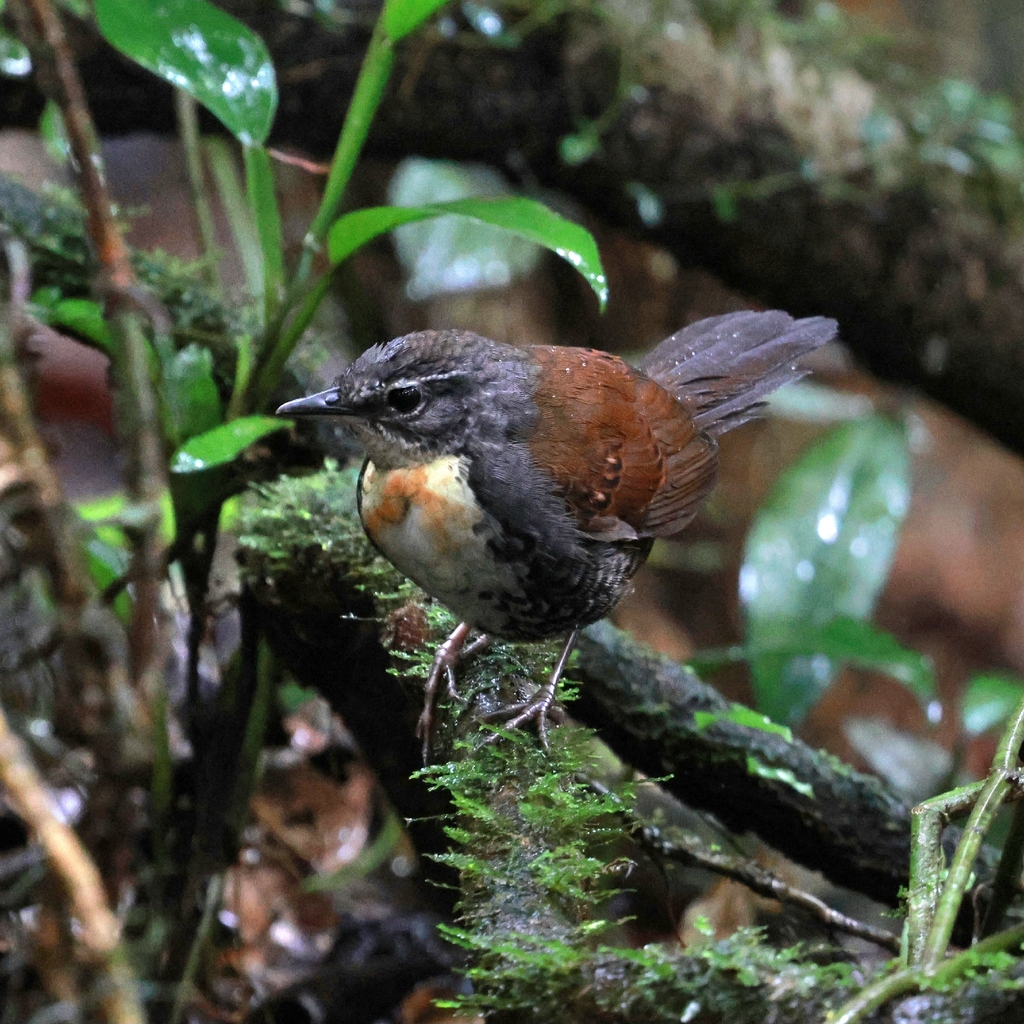
The rusty-belted tapaculo is 19.5 cm (7.7 in) long and weighs 39 to 42 g (1.4 to 1.5 oz). Its plumage is unlike that of any other tapaculo. The nominate subspecies has a grayish brown head with a white supercilium and a reddish brown back, wings, and rump. The throat is white with black streaks at the side, most of the breast is white, and the flanks and vent are barred with black, brown, and white. The upper breast has a yellow to orange brown band the gives the species its common name. Subspecies L. t. erithacus is browner on the head and the breast band is larger and darker. Subspecies L. t. dugandi is also similar to the nominate, but the breast band is rufous and extends into the neck and throat. The rusty-belted tapaculo vocalizes from the ground or low branches. Its song is an "easily imitated whistled note...repeated at intervals...[ending in a] descending series" [1]. Its call is described as a repeated cree or "cree-cree".
Range & habitat
The nominate subspecies of the rusty-belted tapaculo is found in west and central Amazonian Brazil, and is believed to be the race found in southeastern Peru and northern Bolivia. Subspecies L. t. dugandi inhabits southeastern Colombia and adjacent western Brazil. Subspecies L. t. erithacus is found in eastern Ecuador and eastern Peru. The rusty-belted tapaculo is the only member of its family to inhabit the Amazonian rainforest. It is primarily found in humid terra firme forest, whose ground is dry year-round, but also inhabits várzea, which is seasonally flooded. It ranges generally up to 600 m (2,000 ft) elevation, in some places to 900 m (3,000 ft), and in Peru up to 1,000 m (3,300 ft).
Wikipedia: “Distribution and habitat”
What it does
The rusty-belted tapaculo's primary prey is terrestrial true bugs, Hemiptera. It forages by walking and hopping on the forest floor, picking the bugs from atop the litter, and also feeds along fallen tree trunks.
Wikipedia: “Feeding”
Listen
Looking for field recordings…
Where it lives
Recorded sightings
—
geo-referenced records in GBIF, from museums, herbaria and field observers.
Drag the globe to turn it. Dots are where records exist, not a range map; darker means more records.
In the stacks
Searching the stacks…
Every page naming Liosceles thoracicus in the Biodiversity Heritage Library →
This page is assembled live from iNaturalist, GBIF, Wikipedia, the Source Library and the Internet Archive. It is not yet part of the hand-edited codex. iNaturalist taxon 14789.