- Plants
- ›Vascular Plants
- ›flowering plants
- ›Dicots
- ›pepper plants, birthworts, and allies
- ›birthwort family
- ›Asaroideae
- ›Asarum
- ›Asarum
- ›Asarum canadense
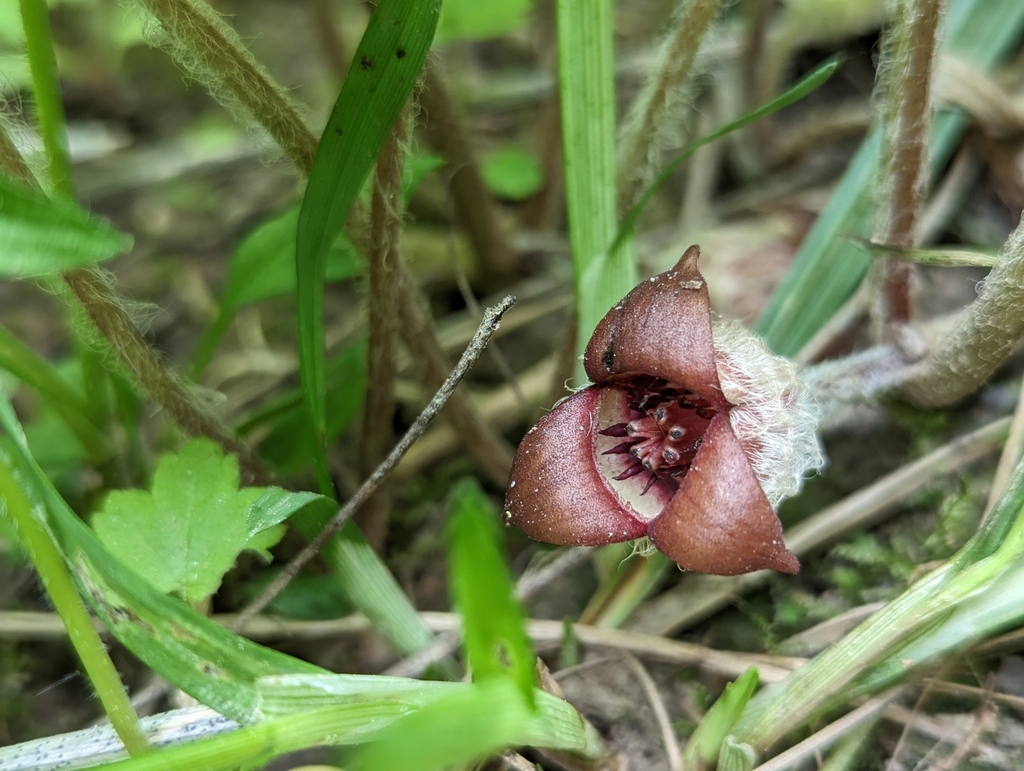
Reflexed Wild Ginger
Asarum reflexum
Asarum canadense, commonly known as Canada wild ginger, Canadian snakeroot, Indian Ginger, Coltsfoot, and Broad-Leaved Asarabacca, is a herbaceous, perennial plant. It should not be confused for Asarum reflexum, a closely related species, or Asarum acuminatum, a variety of A. canadense.
It forms dense colonies in the understory of deciduous forests throughout its native range in eastern North America. It is protected as a threatened species in Maine due to habitat loss. The species has been used by Native Americans for cooking and medicine, although recent research has suggested that compounds within the plant could cause negative health problems.
From the article Asarum canadense on Wikipedia (CC BY-SA), quoted section by section
Range & habitat
The plant forms dense colonies in the understory of deciduous forests throughout its native range in eastern North America, from the Great Plains east to the Atlantic Coast, and from southeastern Canada south to around the Fall Line in the southeastern United States. Shaded habitats lead to longer surviving ramets and more genetically unique genets. Yet, individuals within environments with more shade are thought to have less energy to devote towards defenses against herbivores. Extensive logging in Maine is thought to be the reason for the species' threatened status in the state.
Wikipedia: “Habitat”
What it does
The species' primary form of reproduction is through clones spread via rhizomes, although it can also produce genetically different seedlings via self-pollination. Individuals produced by asexual reproduction are able to use energy more efficiently and develop larger leaves, but the trade-offs between sexual reproduction and asexual are thought to be insignificant. Although some local populations are at risk of extirpation, they can be reestablished even through low initial plantings.
Wikipedia: “Reproduction”
At the table
The long rhizomes of A. canadense were historically used by Native Americans as a seasoning. The odor and flavor of Canadian snakeroot oil are spicy and has been used in many flavor preparations. However, due to it containing aristolochic acid I, it is not recommended for consumption.
Wikipedia: “Cooking”
In medicine
Historically, Native Americans used the plant as a medicinal herb to treat a number of ailments including dysentery, digestive problems, swollen breasts, coughs and colds, typhus, scarlet fever, nerves, sore throats, cramps, heaves, earaches, headaches, convulsions, asthma, tuberculosis, urinary disorders, and venereal disease. In addition, they also used it as a stimulant, appetite enhancer, charm and an admixture to strengthen other herbal preparations. Tribes that used the species medicinally and culinarily include the Chippewa, the Iroquois, the Ojibwe, the Meskwaki, the Menomini, the Potawatomi, the Cherokee, the Abnaki, and the Micmac.
Wikipedia: “Medicinal Uses”
Where it lives
Recorded sightings
—
geo-referenced records in GBIF, from museums, herbaria and field observers.
Drag the globe to turn it. Dots are where records exist, not a range map; darker means more records.
In the stacks
Searching the stacks…
Every page naming Asarum reflexum in the Biodiversity Heritage Library →
This page is assembled live from iNaturalist, GBIF, Wikipedia, the Source Library and the Internet Archive. It is not yet part of the hand-edited codex. iNaturalist taxon 1473617.