- Plants
- ›Vascular Plants
- ›flowering plants
- ›Dicots
- ›carrots, ivies, and allies
- ›cheesewood family
- ›Marianthus
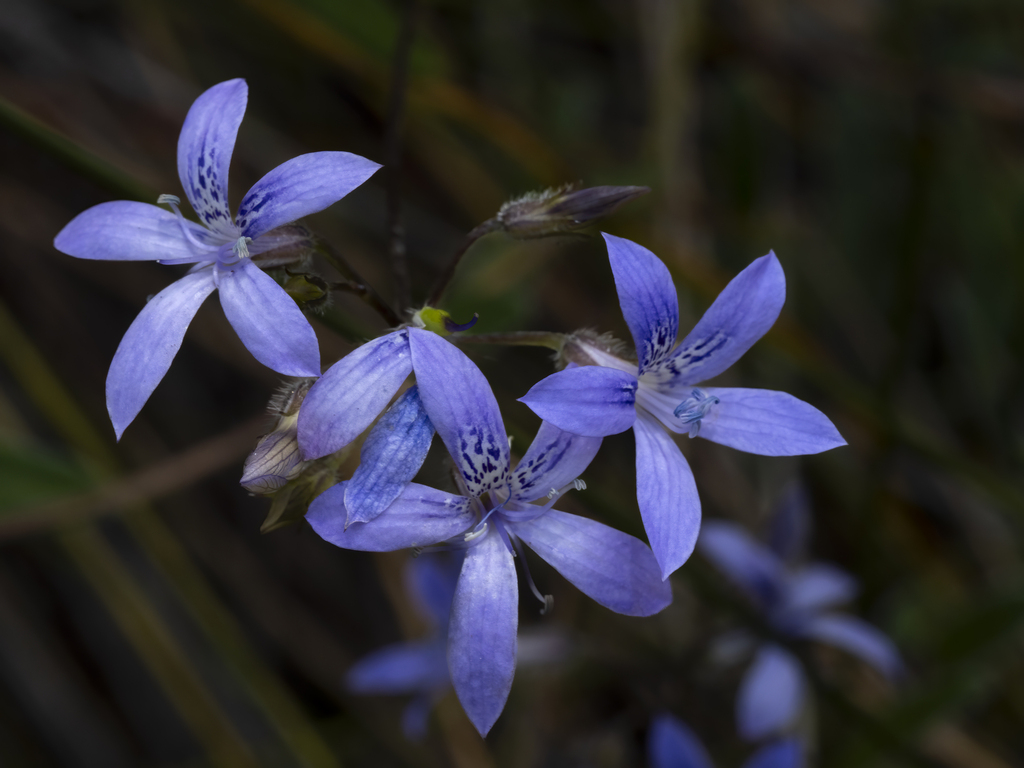
Marianthus coeruleopunctatus
Marianthus coeruleopunctatus, commonly known as blue-spotted marianthus, is a species of flowering plant in the family Pittosporaceae and is endemic to the southwest of Western Australia. It is a twining shrub or climber with narrowly elliptic leaves and pale blue flowers sometimes with dark blue spots or lines, arranged in branched clusters.
From the article Marianthus coeruleopunctatus on Wikipedia (CC BY-SA), quoted section by section
Description
Marianthus coeruleopunctatus is a twining shrub or climber with silky-hairy new stems. Its adult leaves are narrowly elliptic, 28–50 mm (1.1–2.0 in) long and 4–10 mm (0.16–0.39 in) wide and more or less sessile. The edges of the leaves are slightly thickened and turned downwards. The flowers are borne in branched clusters of up to 30 on a twining rachis 40–120 mm (1.6–4.7 in) long, the peduncles 10–15 mm (0.39–0.59 in) long. The sepals are linear, 4–5 mm (0.16–0.20 in) long and tinged with blue. The five petals are 11–15 mm (0.43–0.59 in) long and pale blue, sometimes with darker blue spots and lines. Flowering occurs in April and May or from October to December.
Range & habitat
Blue-spotted marianthus grows in woodland and forest near Perth, extending as far north as Mount Lesueur and as far east as Northam, in the Avon Wheatbelt, Geraldton Sandplains, Jarrah Forest and Swan Coastal Plain bioregions of south-western Western Australia.
Wikipedia: “Distribution and habitat”
Where it lives
Recorded sightings
—
geo-referenced records in GBIF, from museums, herbaria and field observers.
Drag the globe to turn it. Dots are where records exist, not a range map; darker means more records.
In the stacks
This page is assembled live from iNaturalist, GBIF, Wikipedia, the Source Library and the Internet Archive. It is not yet part of the hand-edited codex. iNaturalist taxon 1473530.