- Plants
- ›Vascular Plants
- ›flowering plants
- ›monocots
- ›Agaves, Orchids, Irises, and Allies
- ›iris family
- ›Iridoideae
- ›Irideae
- ›Iris
- ›Iris
- ›Iris
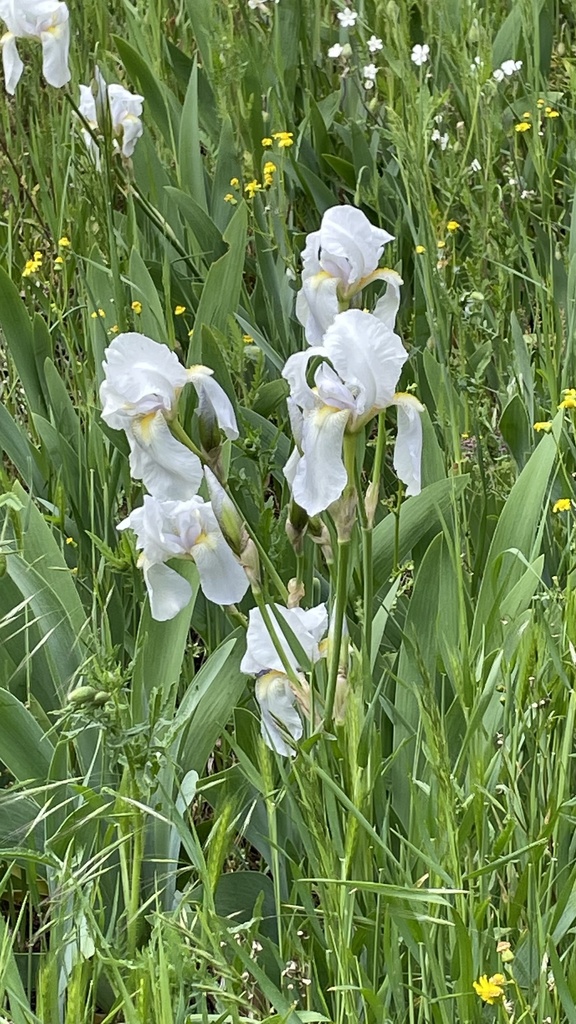
white flag iris
Iris florentina
Iris florentina, also known as Iris albicans, cemetery iris, white cemetery iris, or the white flag iris, is a species of iris which was planted on graves in Muslim regions and grows in many countries throughout the Middle East and northern Africa. It was later introduced to Spain, and then other European countries.
The identity of the plant first described by Carl Linnaeus as Iris florentina remains unclear, as of December 2021. In horticulture, it has been treated as a white-flowered variant of Iris × germanica, under names such as Iris germanica nothovar. florentina, Iris × germanica var. florentina and Iris × germanica 'Florentina'. Iris florentina has also been treated as the correct name for the true species also known as Iris albicans Lange.
From the article Iris florentina on Wikipedia (CC BY-SA), quoted section by section
Description
Iris florentina has a thick or stout rhizome, which is short, fleshy, horizontal, and has a strong violet scent. The rhizomes spread across the surface of the soil, to form clumps of plants. This habit can often create a dense network of fibrous roots that can crowd out other plants. It has basal (rising up from the rhizome), ensiform (sword-shaped), light green, pale green, or grey-green leaves. They are semi-evergreen, or evergreen (in mild winters). The leaves can grow up to between 30 and 70 cm (12 and 28 in) long, and between 2.5 and 4 cm (1 and 2 in)wide. They are shorter than the stem. It has a straight, stem or peduncle, that can grow up to between 38 and 100 cm (15 and 39 in) tall. It grows to 30–60 cm tall. The leaves are grey-green, and broadly sword-shaped. It may reach up to 75–100 cm (30–39 in) after about 3 years. Although it may reach 121 cm (48 in), (in ideal conditions). The stems have 2–4 branches. The branches reduce in size as you go up the stem, starting from the middle. The branches can be long. The stem has 1–2, (scarious) membranous or sub-scarious, spathes (leaves of the flower bud). At flowering time, the spathes become brown and papery, or fully scarious. They can be up to 40–80 cm (16–31 in) long. …
Range & habitat
It is found in Italy, (including Tuscany,) France, and the Mediterranean islands, (including Malta). Iris florentina has been cultivated since ancient times and may be the oldest iris in cultivation. Collected by Lange in 1860, it has been in cultivation since at least 1400 BC. Originating from Yemen and Saudi Arabia, it appears in a wall painting of the Botanical Garden of Tuthmosis III in the Temple of Amun at Karnak in ancient Thebes dated around 1426 BC. Botanist Desfontaines found it in Algiers, where it is grown with Iris germanica near graves. It has been naturalised in many other countries, from the Mediterranean, (including west Africa and southern Spain,) to India, and Iran. In Russia, it grows in the south of western Siberia. Outside of Russia, it is found in Kazakhstan, Mongolia and China. In many regions of the world, especially in Italy, it is cultivated for commercial use.
Wikipedia: “Range”
At the table
The violet scented rhizome has many uses including, a perfume, for mixing with hair powder, powder used for washing clothes, hair, and teeth, used as a fresh scent for linen, a base for dry shampoos, base for tooth powders, in face-packs, as a fixative in pot-pourri. It was used medicinally as an expectorant (clearance of mucus from the airways) and decongestant. It was also formerly used for treating wounds and chest infections. It was also administered for the cure of dropsy. It was also used sometimes for bronchitis, coughs and sore throat, for colic and for congestion of the liver. It is rarely used medicinally nowadays. It has been chewed as a breath freshener, carved into rosary beads, and given to babies as a teething aid. It is still used in cosmetics, perfumes, soaps and sweets. Also it is used for maturing Chianti wine, and as an ingredient in Bombay Sapphire Gin.
Wikipedia: “Uses”
Toxicity
Like many other irises, most parts of the plant are poisonous (rhizome and leaves) and, if ingested, can cause stomach pains and vomiting. Also, handling the plant may cause a skin irritation or an allergic reaction. It was noted by G.R Winter (in 1948, J Periodont 19:108) that allergic manifestations can be caused by the use of a dentifrice (teeth cleaner) containing orris root powder.
How it is grown
It is hardy, to between USDA Zone 3 and Zone 9, or between 5 and 8. It is also hardy to Zone H2 (in Europe), between −15 and -20oC (5 to −4oF). It has been tested for hardiness in Russia, in the botanical gardens of; Barnaul, Novosibirsk, St. Petersburg and Ufa. In the winter, it requires protection from moisture (in Russia). It can be cultivated well throughout Europe and N America, except in the warm moist climates of Florida and Gulf Coast. Iris florentina is included in the Tasmania Fire Service's list of low flammability plants, indicating that it is suitable for growing within a building protection zone. It prefers to grow in moist, well drained soils, in loam. It can tolerate sandy soils, or any common garden soil. It also tolerates most soil pH levels of, and will tolerate very alkali or acid soils. It prefers a situation in full sun, to light shade. It will suffer from rhizome viruses in waterlogged soil. It can be grown in mixed flower borders, rock gardens, and beside the edges of shrubberies. As well as being naturalized in the garden. It can be a cut flower for displays. It is deer and rabbit resistant, but can suffer from leaf spot, Iris borer, thrips, slug and snails. Aphids Aphis newtoni and Dysaphis tulipae can also be found on the plant. The irises are planted shallow, leaving the tops of the rhizomes exposed, to the sun. …
Wikipedia: “Cultivation”
In human culture
Iris florentina is considered one of the irises (with Iris pseudacorus) that inspired the fleur-de-lys (or fleur-de-luce) of heraldry, which was the symbol of the city of Florence for centuries, and is on the coat of arms of the city. A legend of the city tells that on St. Reparata's Day in the year 405 the Goths had the city of Florence under siege, and the city defences were failing. Suddenly, St. Reparata appeared in the midst of the fighting, holding a blood-red banner emblazoned with a white iris. This changed the battle and lifted the spirits of the Florentines, which led them to be victorious. In gratitude (to St Reparata), the city adopted the symbol for its coat of arms from the eleventh century onwards. After the battle in which the Guelfs (or Guelphs) routed the Ghibellines in the late thirteenth century, the colours were reversed, and the red lily (or red giglio,) on a field of white became the symbol of Florence. During the Middle Ages and the Renaissance period, ‘Iris green' (or 'Verdelis' and 'Vert d'iris'), was a rare, paint pigment colour used by manuscript illuminators and painters. It was made from the juice of the fresh flowers of Iris florentine and/or Iris germanica. The bluish or purplish petal juice was steeped (soaked) in boiling water, then combined and thickened with alum. It then produces a clear green paint. …
Wikipedia: “Culture”
Where it lives
Recorded sightings
—
geo-referenced records in GBIF, from museums, herbaria and field observers.
Drag the globe to turn it. Dots are where records exist, not a range map; darker means more records.
In the old herbals & bestiaries

In the stacks
Searching the stacks…
Every page naming Iris florentina in the Biodiversity Heritage Library →
This page is assembled live from iNaturalist, GBIF, Wikipedia, the Source Library and the Internet Archive. It is not yet part of the hand-edited codex. iNaturalist taxon 1472012.