- Plants
- ›Vascular Plants
- ›flowering plants
- ›Dicots
- ›Mallows, Rock Roses, and Allies
- ›Mallow and Hibiscus Family
- ›Malvoideae
- ›Malveae
- ›Malva
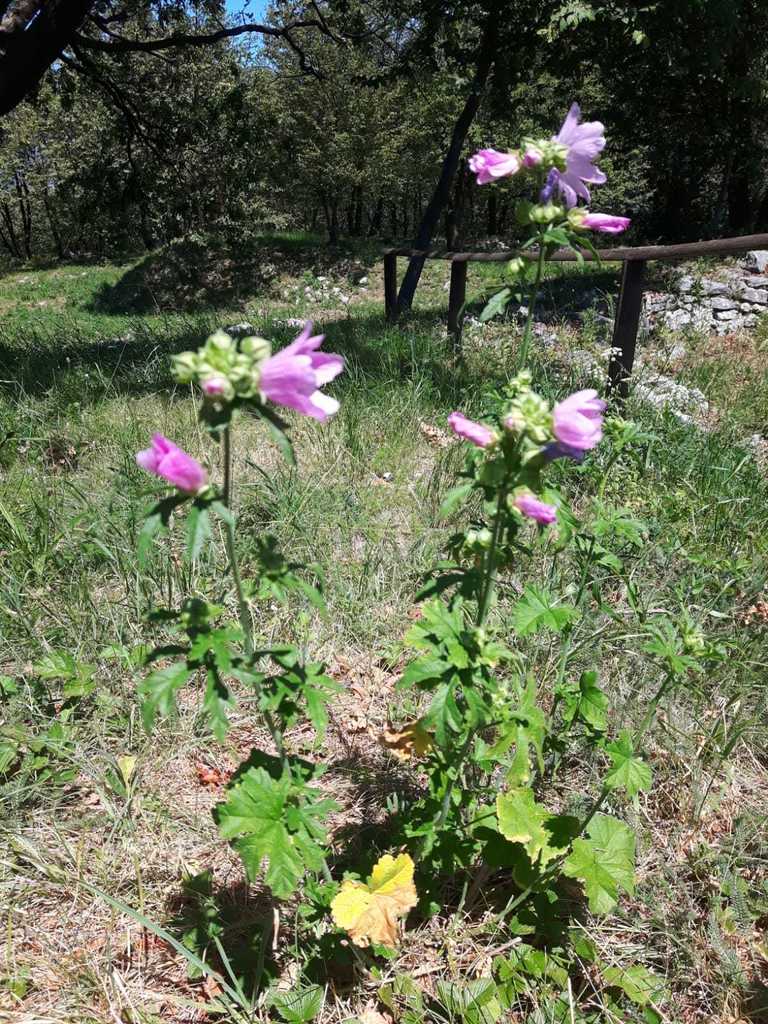
Greater Musk-mallow
Malva alcea
Malva alcea, commonly known as the greater musk-mallow, cut-leaved mallow, vervain mallow or hollyhock mallow, is a plant in the mallow family native to southwestern, central and eastern Europe and southwestern Asia, from Spain north to southern Sweden and east to Russia and Turkey.
From the article Malva alcea on Wikipedia (CC BY-SA), quoted section by section
Description
It is a herbaceous perennial plant growing to 50–125 cm tall, with stems covered in stellate hairs, meaning they branch at the free end into several strands. The leaves are 2–8 cm long and 2–8 cm broad, palmately lobed with five to seven blunt lobes; basal leaves on the lower stem are very shallowly lobed, those higher on the stems are deeply divided, with digitate finger-like lobes. The flowers appear singly near the apex of corymbose racemes growing from the leaf axils in summer to early fall. They are 3.5–6 cm diameter, with five sepals and five bright pink petals, and have no scent. The bracteoles that make up the epicalyx are ovate and wide at the base where they are fused with the calyx. The fruit is a hairless disc-shaped schizocarp 4–8 mm diameter, containing several seeds, the seeds individually enclosed in a glabrous or hairy mericarp. It has a chromosome count of 2n=84.
What it does
It is most common in drier soils in thickets, along paths and in waste places. Natural hybrids with the closely related Malva moschata are occasionally found. In central Europe it grows at altitudes of up to 2,000 m.
Wikipedia: “Ecology”
At the table
It has been widely grown outside of its native range as an ornamental plant. Several cultivars exist such as 'Fastigata', an upright form, and 'Alba', a white flowered form. In some areas, such as the northeastern United States, the plant has escaped from cultivation and become naturalised. It is very similar to, and often confused with Malva moschata.
Wikipedia: “Cultivation and uses”
Where it lives
Recorded sightings
—
geo-referenced records in GBIF, from museums, herbaria and field observers.
Drag the globe to turn it. Dots are where records exist, not a range map; darker means more records.
In the old herbals & bestiaries

In the stacks
Searching the stacks…
Every page naming Malva alcea in the Biodiversity Heritage Library →
This page is assembled live from iNaturalist, GBIF, Wikipedia, the Source Library and the Internet Archive. It is not yet part of the hand-edited codex. iNaturalist taxon 146876.