- Plants
- ›Vascular Plants
- ›flowering plants
- ›Dicots
- ›Gentians, Dogbanes, Madders, and Allies
- ›gentian family
- ›Potalieae
- ›Potaliinae
- ›Fagraea
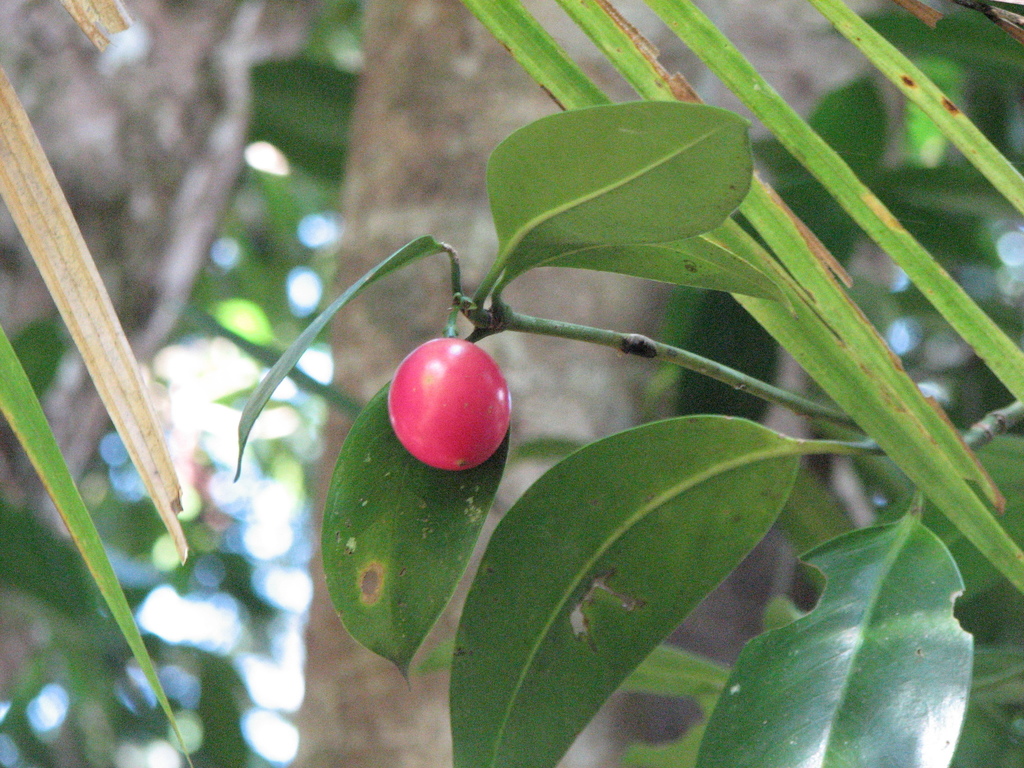
Porcelain Fruit
Fagraea cambagei
Fagraea cambagei, commonly known as porcelain fruit, pink jitta, or yellowheart, is a plant in the family Gentianaceae which is endemic to rainforested parts of coastal northeast Queensland, Australia.
From the article Fagraea cambagei on Wikipedia (CC BY-SA), quoted section by section
Description
This is an evergreen tree growing up to 20 m (66 ft) in height, and the trunk of the tree is often marked with a plaited or woven pattern (see gallery). The leaves are simple (i.e., without lobes or divisions) with an opposite arrangement. They are held on thick petioles (stems) measuring between 2 and 3.5 cm (0.79 and 1.38 in) long, they are elliptic to obovate in outline, and they measure up to 23 by 9 cm (9.1 by 3.5 in). The inflorescence is a terminal panicle with up to 30 fragrant bell-shaped flowers. They measure up to 5 cm (2.0 in) long with five cream-coloured petals, and may occur at any time of year. The fruit is, in botanical terms, a berry up to 3.5 by 4.5 cm (1.4 by 1.8 in), white, pink or red and with a shiny appearance that gives rise to the common name "porcelain fruit". They may or may not contain seeds, which are about 7 mm (0.28 in) long.
Range & habitat
The porcelain fruit grows as an understory tree in well developed coastal or sub-coastal rainforest, often in very waterlogged habitats such as swamps and close to creeks. Its range extends from near Rossville south to the area around Innisfail, and from sea level to 500 m (1,600 ft).
Wikipedia: “Distribution and habitat”
In human culture
The genus name Fagraea was coined by Carl Peter Thunberg in honour of the botanist and physician Jonas Theodor Fagraeus. Domin created the species epithet cambagei in honour of the Australian botanist and surveyor Richard Hind Cambage.
Wikipedia: “Etymology”
Where it lives
Recorded sightings
—
geo-referenced records in GBIF, from museums, herbaria and field observers.
Drag the globe to turn it. Dots are where records exist, not a range map; darker means more records.
In the stacks
Searching the stacks…
Every page naming Fagraea cambagei in the Biodiversity Heritage Library →
This page is assembled live from iNaturalist, GBIF, Wikipedia, the Source Library and the Internet Archive. It is not yet part of the hand-edited codex. iNaturalist taxon 1468699.