On eBird ↗
Chihuahuan Meadowlark
Live sightings near you, the range map, bar charts of when it is seen, and Macaulay Library photos and recordings.
Chihuahuan Meadowlark
Sturnella lilianae
Chihuahuan meadowlark (Sturnella lilianae), also known as Lilian's meadowlark, is a bird in the family Icteridae. It is found in northern Mexico and the southwestern portion of the United States. It was formerly usually treated as a subspecies of the eastern meadowlark (Sturnella magna).
From the article Chihuahuan meadowlark on Wikipedia (CC BY-SA), quoted section by section
Description
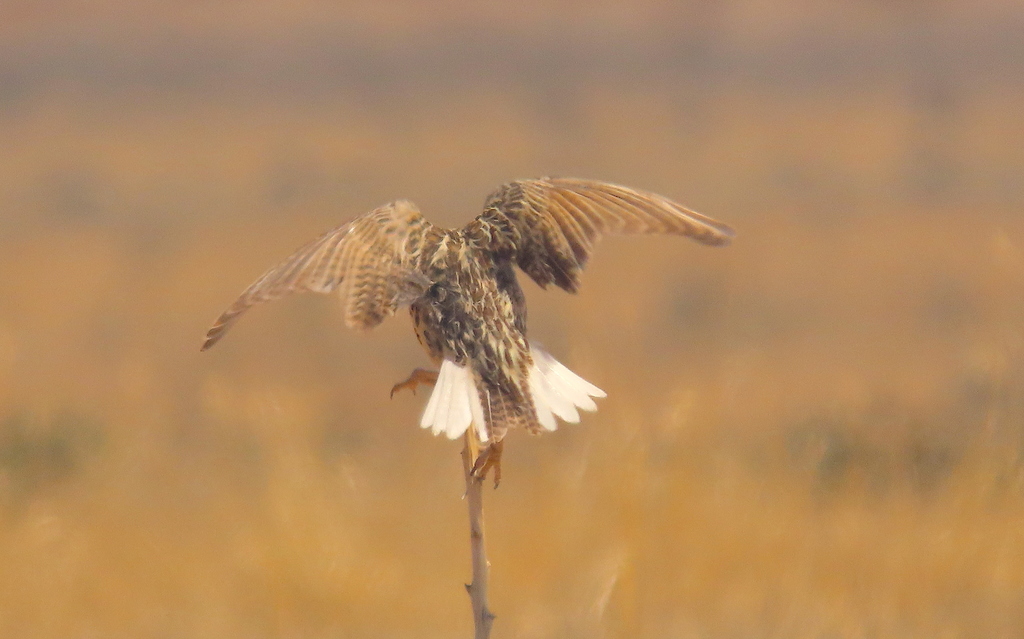
The Chihuahuan meadowlark is about 25 cm (9.8 in) long. It weighs 77 to 130 g (2.7 to 4.6 oz); males are larger than females. The sexes have the same plumage. Adults of the nominate subspecies have a dark brown crown with a paler stripe through its middle. They have a supercilium that is dark yellow from the bill to the eye and whitish beyond it and a dark line from the eye to the nape on an otherwise whitish face. Their upperparts are brown with blackish barring and with white edges on the back and scapular feathers. The two innermost pairs of tail feathers are brown with blackish barring like the upperparts. The other four pairs are mostly white with some dark edges on the innermost of them. Their wing coverts and flight feathers have a complex pattern of brown, cinnamon-brown, and blackish. Their chin, throat, and the center of their underparts are rich yellow with a black "V" on the breast. Their sides, flanks, and undertail coverts are whitish with thin dark brown streaks. They have a brown iris, a black or dusky maxilla, a bluish gray mandible with a dusky tip, and dusky pinkish legs and feet. Juveniles resemble adults with an overall buffy wash, less distinct barring, and paler yellow underparts. They lack the black "V" and have brownish mottling instead. They have a pinkish buff bill, legs, and feet. Adults of subspecies S. l. …
Range & habitat
The Chihuahuan meadowlark has a disjunct distribution. The nominate subspecies is the more northerly of the two. It is found from northern Arizona, northern New Mexico, and western Texas in the U. S. south into Mexico's northern Sonora and Chihuahua states. It occasionally is found further west in Arizona and further east in Texas. There are also breeding records in Colorado and tentative sightings north and east of its range. Subspecies S. l. auropectoralis is found in west-central Mexico from southern Sinaloa and Durango south to Nayarit and east to Michoacán and México. The nominate subspecies of the Chihuahuan meadowlark inhabits desert grasslands. Subspecies S. l. auropectoralis is also in desert grasslands but in the eastern part of its range is more often found in irrigated farmland.
Wikipedia: “Distribution and habitat”
What it does
The Chihuahuan meadowlark's diet has not been studied separately from that of it former "parent" eastern meadowlark. That species feeds on insects and seeds by picking and probing the ground.
Wikipedia: “Feeding”
Listen
Looking for field recordings…
Where it lives
Recorded sightings
—
geo-referenced records in GBIF, from museums, herbaria and field observers.
Drag the globe to turn it. Dots are where records exist, not a range map; darker means more records.
In the stacks
Searching the stacks…
Every page naming Sturnella lilianae in the Biodiversity Heritage Library →
This page is assembled live from iNaturalist, GBIF, Wikipedia, the Source Library and the Internet Archive. It is not yet part of the hand-edited codex. iNaturalist taxon 1456513.