- Plants
- ›Vascular Plants
- ›flowering plants
- ›Dicots
- ›Guinea-flowers and allies
- ›Guinea-flower family
- ›Hibbertia
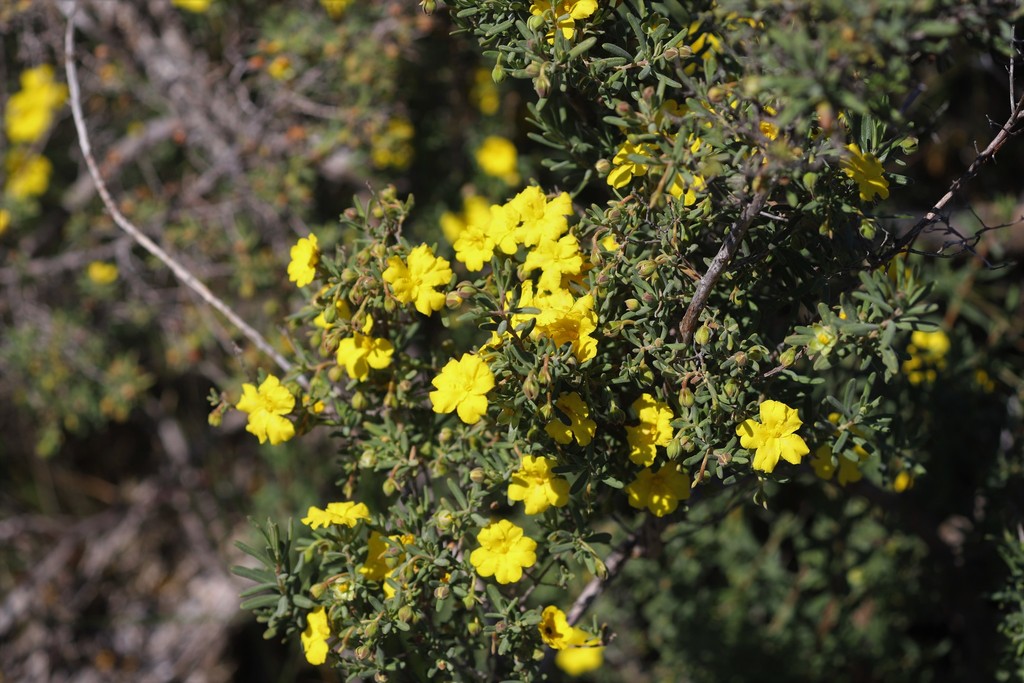
Yellow Buttercups
Hibbertia hypericoides
Hibbertia hypericoides, commonly known as yellow buttercups, is a species of flowering plant in the family Dilleniaceae, and is endemic to the south-west of Western Australia. It is usually a spreading shrub with linear to elliptic or egg-shaped leaves, and yellow flowers, usually with ten to fifteen stamens arranged in a cluster on one side of the two densely hairy carpels.
From the article Hibbertia hypericoides on Wikipedia (CC BY-SA), quoted section by section
Description
Hibbertia hypericoides is a spreading shrub, rarely an erect shrub, that typically grows to a height of up to 30–80 cm (12–31 in) with densely hairy branchlets. The leaves are linear to elliptic or egg-shaped with the narrower end towards the base, 15–25 mm (0.59–0.98 in) long and 1–8 mm (0.039–0.315 in) wide. The upper surface is mostly glabrous, the edges of the leaves are turned down or rolled under and the lower surface in densely covered with white hairs. The flowers are arranged singly in leaf axils or on the ends of the branchlets on a peduncle 4–12 mm (0.16–0.47 in) long, with a bract 4.5–6 mm (0.18–0.24 in) long at the base. The five sepals are hairy, 5.5–6.8 mm (0.22–0.27 in) long and the five petals are yellow and egg-shaped with the narrower end towards the base, 10–13 mm (0.39–0.51 in) long with a notch on the end. There are usually ten to fifteen stamens arranged in a single cluster on one side of the two carpels as well as seven to twenty staminodes in bundles. The carpels are densely hairy and each has two ovules.
Range & habitat
Subspecies hypericoides grows in a wide variety of habitats including woodland and shrubland and is widely distributed from Dongara to Augusta and inland as far as Wongan Hills. Subspecies septentrionalis typically grows in kwongan and Banksia woodland and is found in two disjunct populations - one between Kalbarri and Dongara and the other inland from the Arrowsmith River.
Wikipedia: “Distribution and habitat”
What it does
Some pollination surveys place beetles (from the Scarabaeidae, Chrysomelidae and Curculionidae) as the main pollinators of Hibbertia hypericoides, as well as Hibbertia scandens (Willd.) Gilg, and other species from the Dilleniaceae family, they also place bees and flies as secondary importance (such as Keighery 1975).
Wikipedia: “Ecology”
Where it lives
Recorded sightings
—
geo-referenced records in GBIF, from museums, herbaria and field observers.
Drag the globe to turn it. Dots are where records exist, not a range map; darker means more records.
In the stacks
Searching the stacks…
Every page naming Hibbertia hypericoides in the Biodiversity Heritage Library →
This page is assembled live from iNaturalist, GBIF, Wikipedia, the Source Library and the Internet Archive. It is not yet part of the hand-edited codex. iNaturalist taxon 145403.