On eBird ↗
African Silverbill
Live sightings near you, the range map, bar charts of when it is seen, and Macaulay Library photos and recordings.
African Silverbill
Euodice cantans
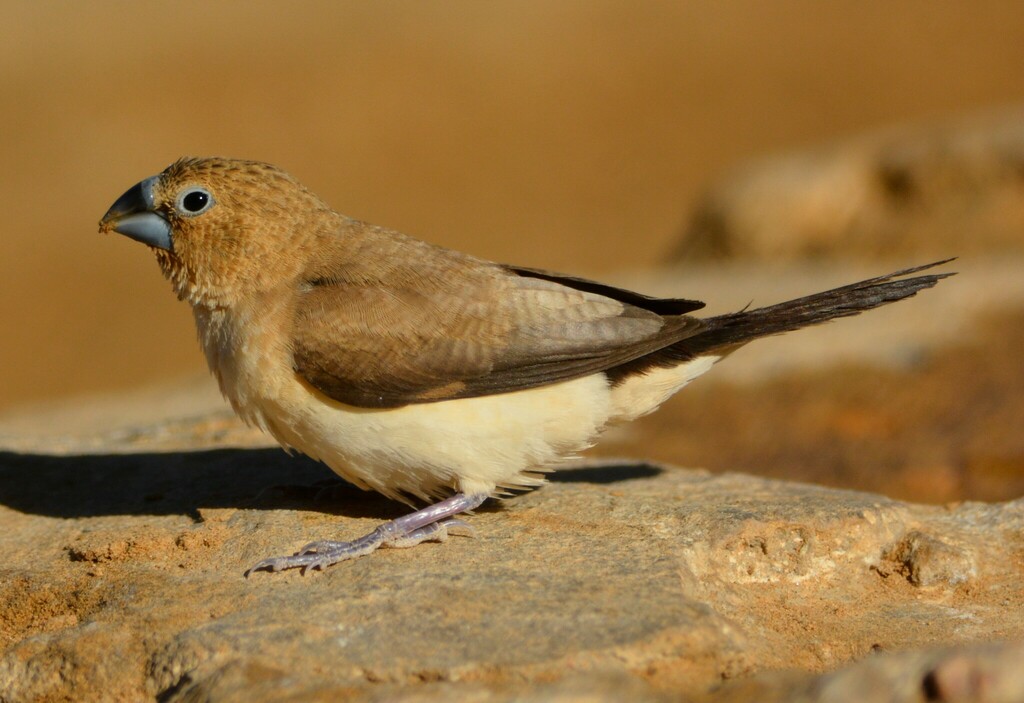
The African silverbill (Euodice cantans) is a small passerine bird formerly considered conspecific with the Asian species Indian silverbill, (Euodice malabarica). This estrildid finch is a common resident breeding bird in dry savanna habitat, south of the Sahara Desert. This species has also been introduced to other countries such as Portugal, Qatar and United States.
From the article African silverbill on Wikipedia (CC BY-SA), quoted section by section
Description
The African silverbill is approximately 10 cm (3.9 in) in length with a long black pointed tail. The adult has a stubby silver-blue bill, finely vermiculated light-brown upper parts, whitish underparts, black rump and black wings. The sexes are similar, but immatures lack the vermiculations. This species has a tseep call and a trilling song. The contact call of the male is a single tseep while the female is a double noted tsiptsip. Birds in flight keep up a constant tseep tseep tseep. The subspecies E. c. orientalis is darker on the face and upperparts than the other subspecies.
Range & habitat
The species is widespread in savanna country, arid landscape with thorn bush, and grasslands with acacias or dry grassland. It may also be found in cultivated areas and dry grassland. It is by nature a bird of dry country. It is primarily a lowland species but can be found up to 2,000 m (6,600 ft) altitude.
Wikipedia: “Distribution and habitat”
What it does
The African silverbill is tame and sociable, often found perching in trees in dense flocks, touching one another. However, it is a particularly inactive bird, sitting huddled together for a long period of time. It stays in flocks all year round and usually breeds in loose colony.
Feeding. The African silverbill feeds mostly on grass seeds, picked from the ground but also taken from the growing plants if available. It will cling to grass stems to take seeds from the inflorescences. It seems that it feeds mainly on vegetable matter and rearing its young on seed as well. However, it has been recorded to take aphids from water mint (Meinertzhagen 1954).
Courtship. The male displays by grasping a stem of grass at one end, and hops or files to near the female. At once he sleeks down his feathers, stands upright with tail straight down, and jerks his head upwards a few times. He then leans forward, twists his tail towards the female and fluffs his flank and belly feathers. At this stage he usually drops the straw and begins to sing and dance. The flank and ventral feathers are not always fluffed out, and the intensity of the display probably depends on the relationship of the two birds. If the female seems receptive the male will attempt copulation. However, most displays come to an end before this final phase is reached. …
Wikipedia: “Behaviour”
Listen
Looking for field recordings…
Where it lives
Recorded sightings
—
geo-referenced records in GBIF, from museums, herbaria and field observers.
Drag the globe to turn it. Dots are where records exist, not a range map; darker means more records.
In the stacks
Searching the stacks…
Every page naming Euodice cantans in the Biodiversity Heritage Library →
This page is assembled live from iNaturalist, GBIF, Wikipedia, the Source Library and the Internet Archive. It is not yet part of the hand-edited codex. iNaturalist taxon 145351.