- Animals
- ›Chordates
- ›Vertebrates
- ›Mammals
- ›Therians
- ›Marsupials
- ›Kangaroos, Possums, Wombats, and Allies
- ›Macropods
- ›Kangaroos, Wallabies and Allies
- ›Kangaroos, Wallabies, Pademelons, and Dorcopsises
- ›Kangaroos and Wallabies
- ›Osphranter
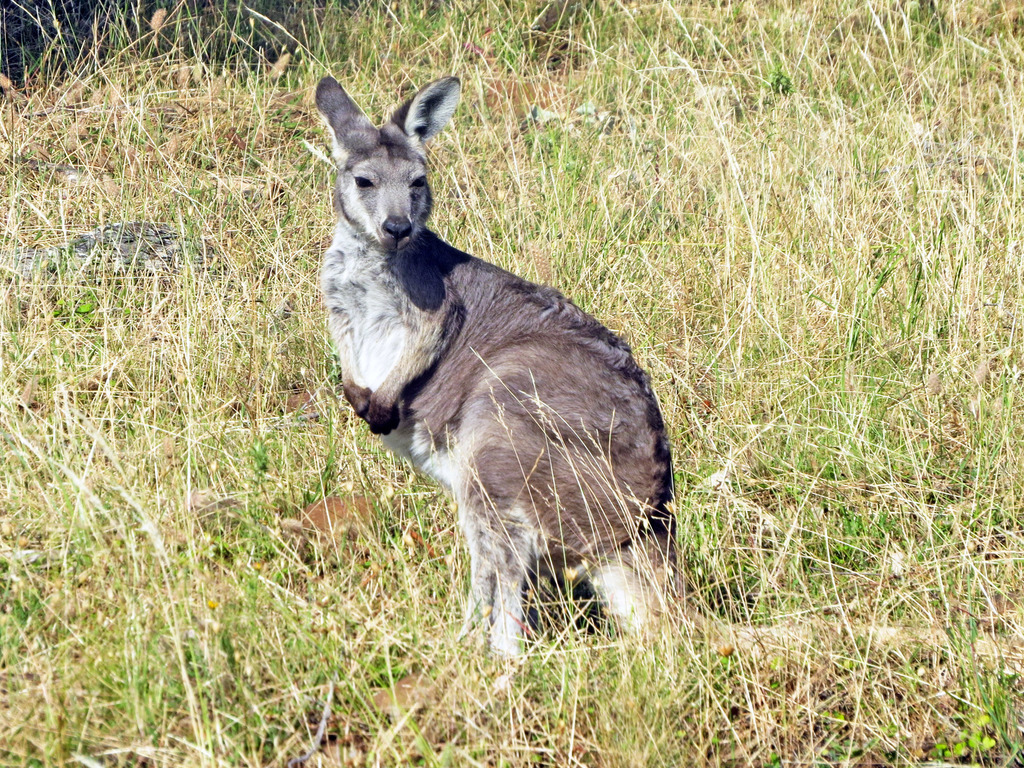
Common Wallaroo
Osphranter robustus
The common wallaroo (Osphranter robustus), also known as the euro, hill wallaroo, or simply wallaroo, is a species of macropod (a family of marsupials that also includes kangaroos and wallabies). The word euro is particularly applied to one subspecies (O. r. erubescens).
The eastern wallaroo is mostly nocturnal and solitary, and is one of the more common macropods. It can make a loud hissing noise. All four subspecies are sexually dimorphic.
From the article Common wallaroo on Wikipedia (CC BY-SA), quoted section by section
What it does
Wallaroo females can give birth at any time during the year. Through a process called embryonic diapause they are able to get pregnant any time after giving birth, but the embryo does not start to develop until the previous joey is able to leave the pouch of the mother. Wallaroos are also polygynous, which means that the males can have multiple female partners. Male wallaroos will engage in non-deadly physical combat over mating access to females. The gestation period lasts around 30 to 38 days, after which the young joey travels into the mother's pouch where it suckles and develops. The young joeys start to leave the pouch at around six months and by nine months they no longer spend most of their time in the pouch. Male wallaroos are fully developed at around 18 to 20 months; females are fully developed at around 14 to 24 months. The relationship with the joey and their parents changes as the joey grows and gets older. During the time in which the joey is in the pouch, the father stays around to protect the joey and mother from predators, but once this protection is no longer needed the relationship weakens between the two. After the joey no longer needs its mother for food, it still maintains a close relationship with her.
Wikipedia: “Reproduction”
In human culture
The common wallaroo was used for the name and cap emblem of Wallaroo FC, Australia's first rugby union football club founded in Sydney in 1870. The Australian national women's rugby union team was in 1994 named 'The Wallaroos'. The famous 1770 kangaroo sketches drawn by botanical illustrator Sydney Parkinson during Captain James Cook and Joseph Banks' HMS Endeavour voyage were determined to be an eastern wallaroo (O. r. robustus) following a 1970 study by Australian zoologist Geoffrey Sharman. The 1772 oil paintingThe Kongouro from New Holland by George Stubbs appears to be based on the Parkinson drawings.
Wikipedia: “Emblems and popular culture”
Listen
Looking for field recordings…
Where it lives
Recorded sightings
—
geo-referenced records in GBIF, from museums, herbaria and field observers.
Drag the globe to turn it. Dots are where records exist, not a range map; darker means more records.
In the stacks
Searching the stacks…
Every page naming Osphranter robustus in the Biodiversity Heritage Library →
This page is assembled live from iNaturalist, GBIF, Wikipedia, the Source Library and the Internet Archive. It is not yet part of the hand-edited codex. iNaturalist taxon 1453438.