On eBird ↗
Red Siskin
Live sightings near you, the range map, bar charts of when it is seen, and Macaulay Library photos and recordings.
Red Siskin
Spinus cucullatus
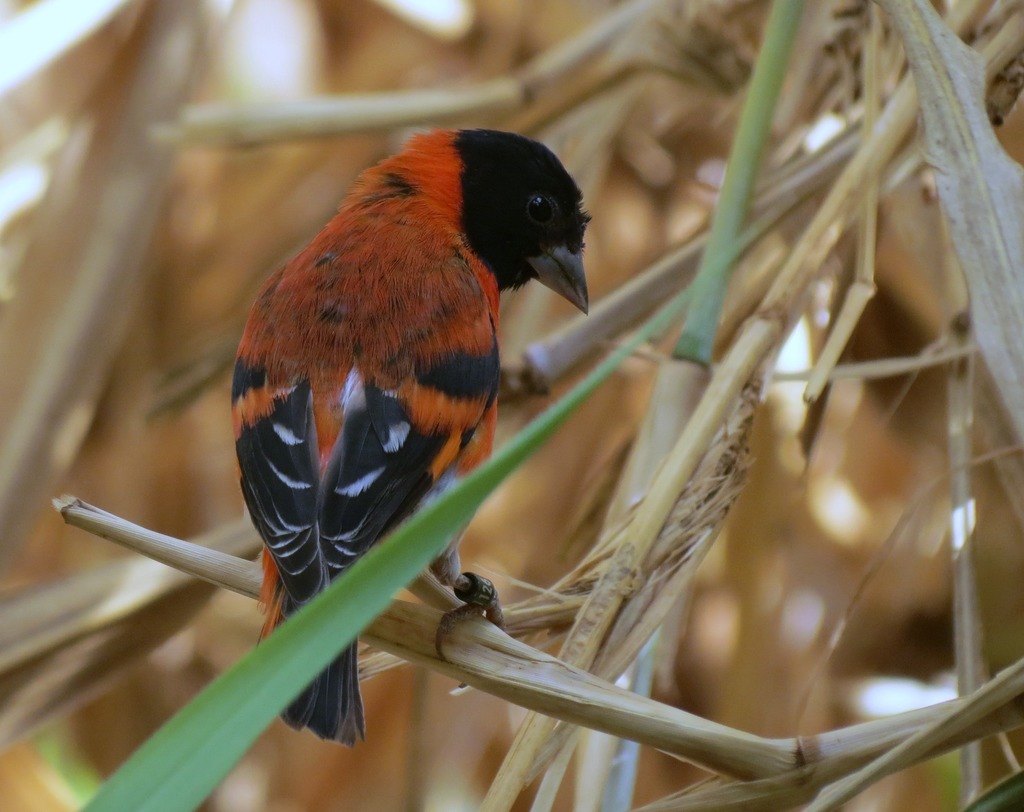
The red siskin (Spinus cucullatus) is a small passerine bird. This finch is a resident breeding bird in tropical South America in northern Colombia and northern Venezuela (where it's called "cardenalito"). The introduced population on Trinidad is believed to be extinct, with no sightings since 1960.
From the article Red siskin on Wikipedia (CC BY-SA), quoted section by section
Description
The red siskin is about 10 cm long. The male is mainly deep red, with black on the head, throat, flight feathers and tail tip, and a whitish lower belly and under tail. The female is grey on the head, breast, and upper parts, apart from a red rump and upper tail. The breast is grey with reddish flanks, and the rest of the underparts, the wings and tail resemble the corresponding areas of the male. Immature females are paler than the adults, and immature males are brown rather than red.
Range & habitat
It is native to tropical South America - in northern Colombia, northern Venezuela (where it is called the "cardenalito") and Guyana. It was common in the early 20th century, occurring throughout the foothills of northern Venezuela, but has now become extremely rare in a fragmented range. The population on Trinidad is believed to be extirpated, with no sightings since 1960. An introduced population derived from escaped cagebirds in Puerto Rico has since thought to become extinct.
Wikipedia: “Distribution”
What it does
The red siskin is found in open country, forest edges and grassland with trees or shrubs. The female is believed to lay three greenish-white eggs in a grassy cup nest in a tree. Red siskins eat seeds and are highly gregarious. When they were more numerous, they formed semi-nomadic flocks.
Wikipedia: “Behaviour and ecology”
Listen
Looking for field recordings…
Where it lives
Recorded sightings
—
geo-referenced records in GBIF, from museums, herbaria and field observers.
Drag the globe to turn it. Dots are where records exist, not a range map; darker means more records.
In the stacks
Searching the stacks…
Every page naming Spinus cucullatus in the Biodiversity Heritage Library →
This page is assembled live from iNaturalist, GBIF, Wikipedia, the Source Library and the Internet Archive. It is not yet part of the hand-edited codex. iNaturalist taxon 145314.