On eBird ↗
Antillean Siskin
Live sightings near you, the range map, bar charts of when it is seen, and Macaulay Library photos and recordings.
Antillean Siskin
Spinus dominicensis
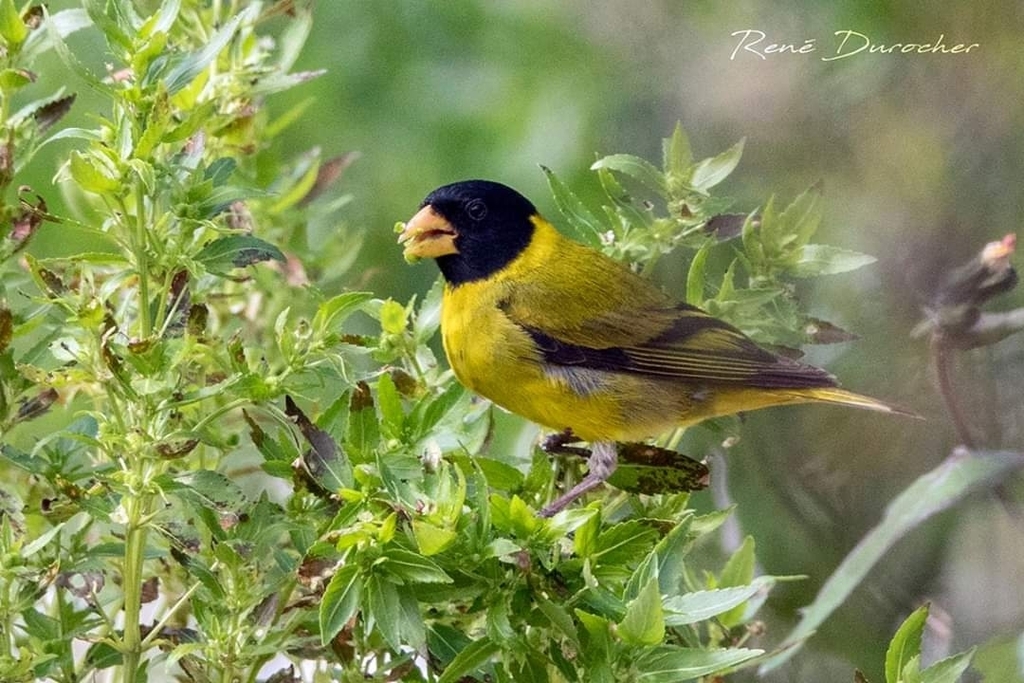
The Antillean siskin (Spinus dominicensis) is a species of finch in the family Fringillidae. It is found in Haiti and the Dominican Republic. Its natural habitats are subtropical or tropical moist montane forests and heavily degraded former forest.
From the article Antillean siskin on Wikipedia (CC BY-SA), quoted section by section
Description
The Antillean siskin is 11 to 12 cm (4.3 to 4.7 in) long and weighs about 9 g (0.3 oz). The species is sexually dimorphic. Adult males have a black crown, face, and throat with a narrow bright yellow collar around their neck. Their lower nape, scapulars, and back are light olive-green and their rump and uppertail coverts a brighter olive-yellow. Their tail is mostly black with wide, deep yellow, edges at the bases of the outer feathers. Their wings have a complicated pattern. Their greater coverts are blackish brown with yellowish-olive edges and bright yellow tips. Their primary coverts are black. Their primaries and secondaries are black with thin olive-yellow edges and their tertials are black with thin yellow edges and yellow tips. Their underparts are bright yellow with an olive wash on the flanks and belly. Adult females have an olive-green crown, nape, and back with a brownish tinge on the mantle and scapulars. Their rump and uppertail coverts are yellow-green. Their tail is like the male's. Their wings are similar to the male's with paler or buffish tips on the greater coverts, thin light green or olive-yellow edges on the secondaries, and wider edges of that color on the tertials. Their face is pale olive or yellowish olive and their chin and throat buffish yellow with a gray tinge. Their breast is pale yellowish with thin dark brown streaks. …
Range & habitat
Despite its English name, the Antillean siskin is not widely distributed but is found on only one island in the chain, Hispaniola. In Haiti it is found in the far west in the Massif de la Hotte and in the southeast in the Massif de la Selle. The latter extends into the southwestern Dominican Republic as the Sierra de Bahoruco. It is also found north of there in the Dominican Republic in the Sierra de Neiba and further northeast in the Cordillera Central. It inhabits pine forest and the edges of moist broadleaf forest and also grassy clearings in them. In elevation it mostly ranges between 1,000 and 2,500 m (3,300 and 8,200 ft) but is found as low as 500 m (1,600 ft) in very cold weather.
Wikipedia: “Distribution and habitat”
What it does
The Antillean siskin feeds mostly on seeds. It forages in small flocks or larger and looser ones, mostly on the ground or in low vegetation but also in taller shrubs and trees.
Wikipedia: “Feeding”
Listen
Looking for field recordings…
Where it lives
Recorded sightings
—
geo-referenced records in GBIF, from museums, herbaria and field observers.
Drag the globe to turn it. Dots are where records exist, not a range map; darker means more records.
In the stacks
Searching the stacks…
Every page naming Spinus dominicensis in the Biodiversity Heritage Library →
This page is assembled live from iNaturalist, GBIF, Wikipedia, the Source Library and the Internet Archive. It is not yet part of the hand-edited codex. iNaturalist taxon 145307.