On eBird ↗
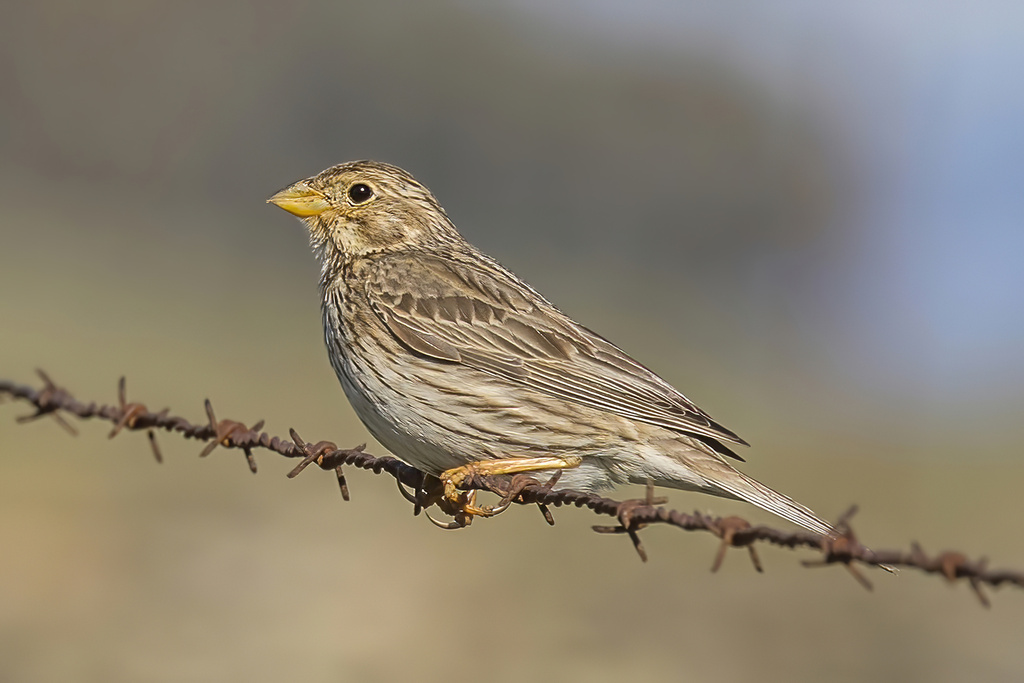
Corn Bunting
Live sightings near you, the range map, bar charts of when it is seen, and Macaulay Library photos and recordings.
Corn Bunting
Emberiza calandra
The corn bunting (Emberiza calandra) is a passerine bird in the bunting family Emberizidae, a group now separated by most modern authors from the finches, Fringillidae. It is usually placed in the genus Emberiza, but some taxonomists place it in the monotypic genus Miliaria. The genus name Emberiza is from Old German Embritz, a bunting. The specific calandra is from Ancient Greek kalandros, the calandra lark.
From the article Corn bunting on Wikipedia (CC BY-SA), quoted section by section
Description
This is an unusual bunting because the plumages of the sexes are similar in appearance, though the male is approximately 20% larger than the female. This large bulky bunting is 16–19 cm long, with a conspicuously dark eye and yellowish mandibles. Males lack any showy colours, especially on the head, which is otherwise typical of genus Emberiza. Both sexes look something like larks, being streaked grey-brown above with whitish underparts. The underparts are streaked over the flanks and breast, and the streaking forms gorget around the throat. The lesser wing coverts are distinctively dark and white-tipped. The tail is plain brown. The song of the male is a repetitive metallic sound, usually likened to jangling keys, which is given from a low bush, fence post or telephone wires.
Range & habitat
It breeds across southern and central Europe, north Africa and Asia across to Kazakhstan. It is mainly resident, but some birds from colder regions of central Europe and Asia migrate southwards in winter. The corn bunting is a bird of open country with trees, such as farmland and weedy wasteland. It has declined greatly in north-west Europe due to intensive agricultural practices depriving it of its food supply of weed seeds and insects, the latter especially vital when feeding the young. UK conservation status is red . It has recently become extinct in Wales and Ireland, where it was previously common.
Wikipedia: “Distribution and habitat”
What it does
Its natural food consists mainly of seeds but also includes insects such as crickets, especially when feeding young.
Wikipedia: “Food and feeding”
Listen
Looking for field recordings…
Where it lives
Recorded sightings
—
geo-referenced records in GBIF, from museums, herbaria and field observers.
Drag the globe to turn it. Dots are where records exist, not a range map; darker means more records.
In the stacks
Searching the stacks…
Every page naming Emberiza calandra in the Biodiversity Heritage Library →
This page is assembled live from iNaturalist, GBIF, Wikipedia, the Source Library and the Internet Archive. It is not yet part of the hand-edited codex. iNaturalist taxon 145291.