On eBird ↗
Black-headed Brushfinch
Live sightings near you, the range map, bar charts of when it is seen, and Macaulay Library photos and recordings.
Black-headed Brushfinch
Arremon atricapillus
The black-headed brush finch (Arremon atricapillus) is a species of bird in the Emberizidae family. It is found in the undergrowth of humid forest, especially near edges, at altitudes of 300 to 1,200 metres (980 to 3,940 ft) in Colombia and Panama.
From the article Black-headed brushfinch on Wikipedia (CC BY-SA), quoted section by section
Description
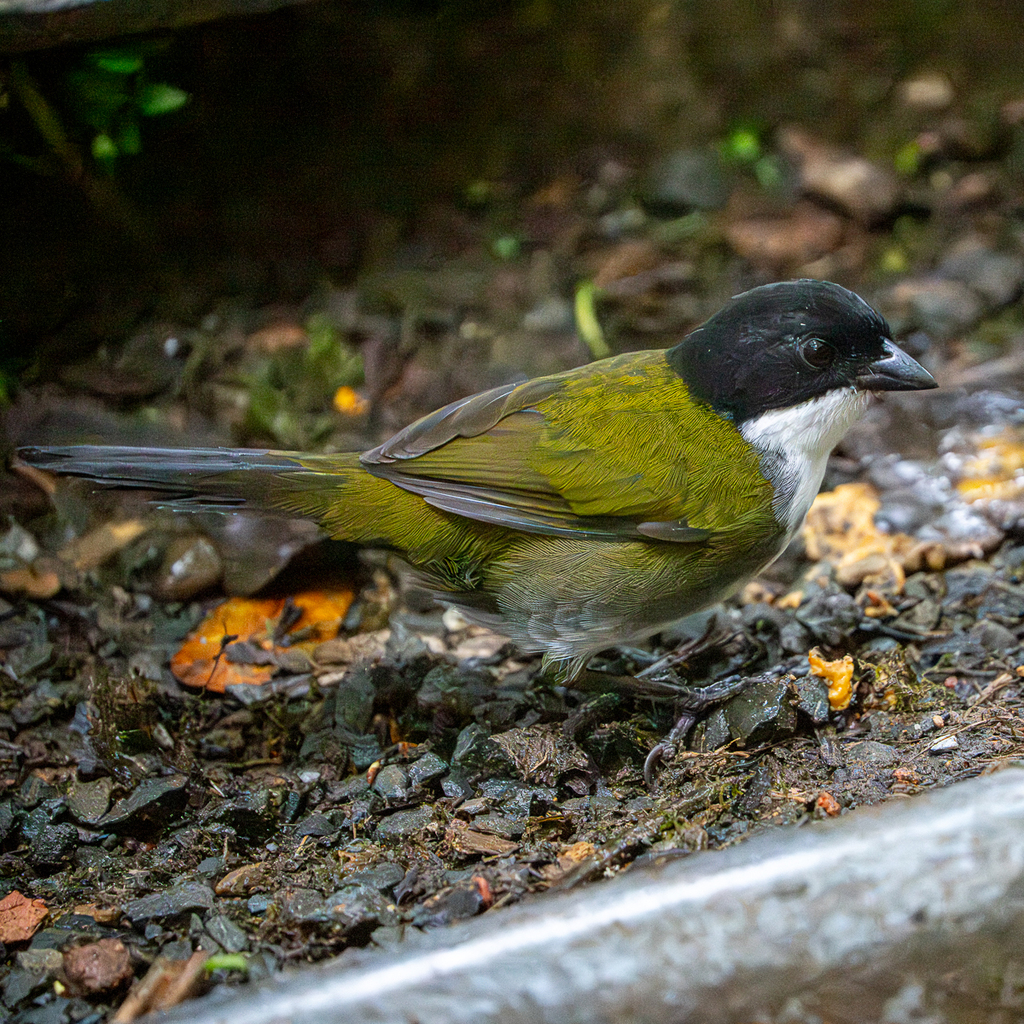
The black-headed brushfinch is about 19 cm (7.5 in) long and weighs about 49.5 g (1.7 oz). The sexes have the same plumage. Adults have an almost entirely black head with a white throat. Their upperparts, wings, and tail are olive-green. The white of the throat continues through the breast and belly. The sides of their breast are gray and their flanks and vent are grayish olive. They have a dark chestnut-brown iris, a black bill, and blackish legs and feet. Juveniles have a greenish olive head and upperparts, dull brown wings and tail, and tawny underparts. Subspecies A. a. tacarcunae is very similar to the nominate but with a faint gray stripe in the middle of the crown and a faint gray supercilium.
Range & habitat
The black-headed brushfinch has a highly disjunct distribution. Subspecies A. a. tacarcunae is the more northerly of the two. It is found in Panama in eastern Panamá, eastern Guna Yala (San Blas) , and eastern Darién provinces. The nominate is found discontinuously in the Western, Central, and Eastern ranges of the Colombian Andes. The species inhabits lowland and montane evergreen forest, secondary forest, and elfin forest, where it favors dense undergrowth in the interior and edges. Sources differ on its elevation range. One states it is 700 to 1,000 m (2,300 to 3,300 ft); a more recent one states it is 500 to 1,500 m (1,600 to 4,900 ft). A third places its upper limit at 3,300 m (10,800 ft).
Wikipedia: “Distribution and habitat”
What it does
The black-headed brushfinch's diet has not been studied but is known to include insects and seeds. It typically forages singly or in pairs. It forages on the ground, usually under vegetative cover, scratching in leaf litter with its bill.
Wikipedia: “Feeding”
Listen
Looking for field recordings…
Where it lives
Recorded sightings
—
geo-referenced records in GBIF, from museums, herbaria and field observers.
Drag the globe to turn it. Dots are where records exist, not a range map; darker means more records.
In the stacks
Searching the stacks…
Every page naming Arremon atricapillus in the Biodiversity Heritage Library →
This page is assembled live from iNaturalist, GBIF, Wikipedia, the Source Library and the Internet Archive. It is not yet part of the hand-edited codex. iNaturalist taxon 145283.