On eBird ↗
Pink-headed Warbler
Live sightings near you, the range map, bar charts of when it is seen, and Macaulay Library photos and recordings.
Pink-headed Warbler
Cardellina versicolor
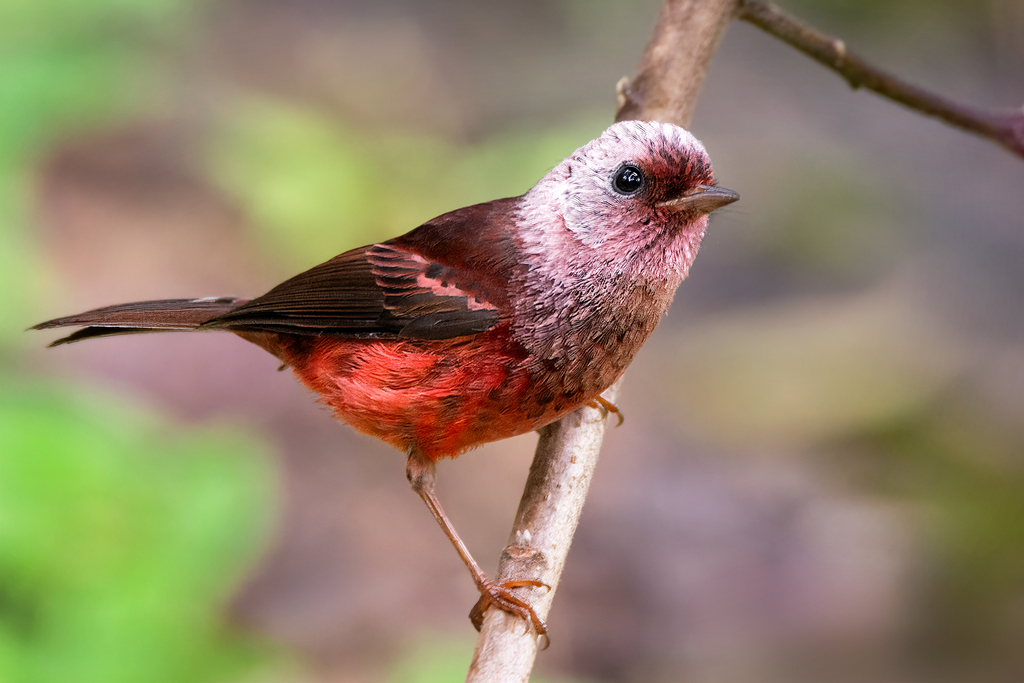
The pink-headed warbler (Cardellina versicolor) is a small passerine bird found in the southwestern highlands of Guatemala and the central and southeastern highlands of the Mexican state of Chiapas. The adult is primarily red, with a silvery-pink head and chest. It is a fairly common to common resident of humid to semi-humid pine-oak, pine-evergreen and evergreen forest and edge, at altitudes ranging from 1,800–3,500 m (5,900–11,500 ft) above sea level.
From the article Pink-headed warbler on Wikipedia (CC BY-SA), quoted section by section
Description
The pink-headed warbler measures 12.5–13.5 cm (4.9–5.3 in) in length, and weighs 10 g (0.35 oz). Both sexes have a similar plumage, though females are, on average, slightly duller overall. The adult has dark red upperparts, a silvery-pink chest and pinkish-red underparts. Its head is silvery-pink, with a reddish forehead, dusky lores and dark brown irises. Its bill is blackish, sometimes showing some horn color on the lower mandible, and its legs are flesh-colored. The juvenile is a rich brown with slightly paler underparts. However, that plumage is quickly molted. By late summer, young birds are virtually indistinguishable from adults; only their unossified skulls distinguish them.
Voice. The pink-headed warbler's call is high, thin, and somewhat metallic, variously transcribed as tsiu, ssing or tseeip. It also has a low, weak chip that it uses to stay in contact with its mate. Its song is a series of short trills and chips, described as being "clear and cheery" and reminiscent of the song of the yellow warbler, as well as slower and less varied than that of the red warbler. Only males sing. While its calls are heard year-round, the pink-headed warbler sings mostly between February and May, and is silent during the rainy month of June.
Range & habitat
The pink-headed warbler is endemic to the highlands of central and eastern Chiapas in Mexico, and to western Guatemala. It is a fairly common to common resident of humid to semi-humid pine-oak, pine-evergreen and evergreen forest and edge, at altitudes ranging from 1,800–3,500 m (5,900–11,500 ft) above sea level. It prefers forest with dense, undisturbed understory, but is also found in disturbed forest with damaged understory in its strongholds in Guatemala; this is thought to be suboptimal habitat. Though it is among the species expected to occur in El Salvador, it has not yet been reported there.
Wikipedia: “Distribution and habitat”
What it does
Except when they are feeding fledged young, it is uncommon to find more than two pink-headed warblers together. Mated pairs typically remain together year-round.
Food and feeding. Like other New World warblers, the pink-headed warbler is an insectivore, gleaning insects and other invertebrates from vegetation (primarily in dense understory) and making aerial sallies after flying prey. It typically forages between 2–5 m (6.6–16.4 ft) off the ground, only seldom foraging above 7 m (23 ft) — except during the breeding season, when the male may hunt near the tops of trees from which it sings, as high as 15 m (49 ft) up. The species often joins mixed species flocks that pass through its territory. There is some evidence that volcanic eruptions, which can coat vegetation with thick ash and impact insect populations, cause declines in pink-headed warbler numbers.
Breeding. In the spring, the male begins singing on good weather days in early February and continues for the next several months, with song frequency peaking between March and May. The female makes a globular nest from pine needles, building it on the ground in an area with a significant layer of fallen pine needles, often on a steep bank. She collects pine needles more than 50 ft (15 m) away from the nest's location, checking carefully for potential predators before returning to the nest site. …
Wikipedia: “Behavior”
Listen
Looking for field recordings…
Where it lives
Recorded sightings
—
geo-referenced records in GBIF, from museums, herbaria and field observers.
Drag the globe to turn it. Dots are where records exist, not a range map; darker means more records.
In the stacks
Searching the stacks…
Every page naming Cardellina versicolor in the Biodiversity Heritage Library →
This page is assembled live from iNaturalist, GBIF, Wikipedia, the Source Library and the Internet Archive. It is not yet part of the hand-edited codex. iNaturalist taxon 145278.