On eBird ↗
Red Warbler
Live sightings near you, the range map, bar charts of when it is seen, and Macaulay Library photos and recordings.
Red Warbler
Cardellina rubra
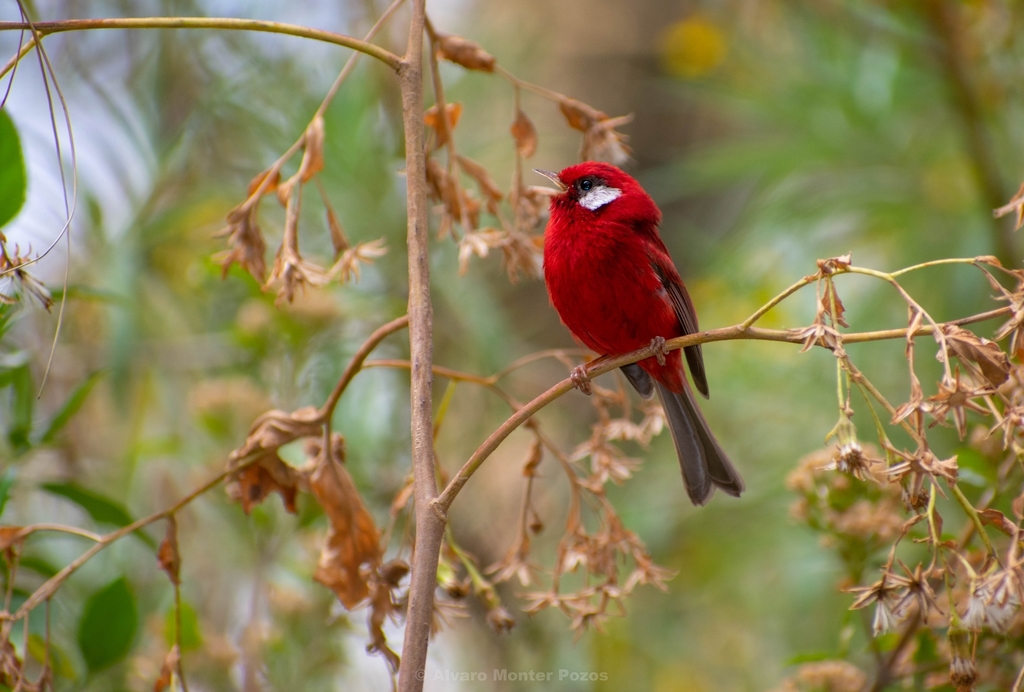
The red warbler (Cardellina rubra) is a small passerine bird of the New World warbler family Parulidae endemic to the highlands of Mexico, north of the Isthmus of Tehuantepec. It is closely related to, and forms a superspecies with, the pink-headed warbler of southern Mexico and Guatemala. There are three subspecies, found in disjunct populations, which differ in the color of their ear patch and in the brightness and tone of their body plumage. The adult is bright red, with a white or gray ear patch, depending on the subspecies; young birds are pinkish-brown, with a whitish ear patch and two pale wingbars.
Breeding typically occurs between February and May. The female lays three or four eggs in a domed nest, which she builds on the ground. Though she alone incubates the eggs, both sexes feed the young and remove fecal sacs from the nest. The young fledge within 10–11 days of hatching. The red warbler is an insectivore, gleaning primarily in understory shrubs. Although this bird is considered to be a least-concern species according to the International Union for Conservation of Nature (IUCN), its numbers are thought to be declining due to habitat destruction.
From the article Red warbler on Wikipedia (CC BY-SA), quoted section by section
Description
The red warbler is a small passerine, measuring 12.5–13.5 cm (4.9–5.3 in) in length, and weighing from 7.6 to 8.7 g (0.27 to 0.31 oz). As an adult, it is red overall, with either a white or dark gray (depending on the subspecies) auricular patch on each side of its head. Its wings and tail are slightly darker, dusky red, and edged in pinkish-red. Its legs are a dull red-brown, and its thin bill is pinkish-gray with a dark tip. The iris is dark brown to blackish. Plumage varies little between the sexes, although the female tends to be a little duller or more orange-tinged. Adult pairs separate and molt fully from August, after the breeding season. The adult red warbler is hard to confuse with any other bird species in its range; the scarlet tanager and summer tanager have similar mostly-red plumage but are larger with thick conical bills. As a juvenile, the red warbler is pinkish-brown with a whitish auricular patch. Its darker wings and tail show pinkish-cinnamon edges, with two paler wingbars on the former.
Voice. The red warbler has several common calls, including a high, thin tsii and a stronger pseet. Its song is a mix of short trills and richer warbles, interspersed with high-pitched chips. Unlike other species in the same habitat zone, it tends to sing only during bright morning hours during the breeding season. …
Range & habitat
Endemic to the highlands of Mexico north of the Isthmus of Tehuantepec, the red warbler has three disjunct populations that correspond to the three subspecies: from southwestern Chihuahua to northern Nayarit, from southern Jalisco and southern Hidalgo to Oaxaca, and from Guerrero into southern Oaxaca in the Sierra Madre del Sur mountains. It is fairly common to common in the country's interior and on adjacent slopes, where it occurs at elevations ranging from 1,800 to 3,900 metres (5,900 to 12,800 ft) above sea level; it does not occur along either coast. It is an altitudinal migrant, moving from higher humid or semi-humid pine, pine-oak and fir forests in the breeding season to lower elevations, often in oak forests, in the winter. It is among the most common of the small birds in its woodland habitat, second only to the golden-crowned kinglet in fir forests in one study and the third most common warbler in oak-conifer woodlands in another. Though the species was reported to have been collected in Texas in the late 19th century, the record's location was not widely believed, and there is no strong evidence that it ever occurred there. It has strayed as far north as southeastern Arizona, where a bird was found on Mount Lemmon in 2018.
Wikipedia: “Distribution and habitat”
What it does
Though it occasionally joins mixed-species flocks, the red warbler is more typically found alone or in pairs. Youngsters probably choose mates in the autumn of their first year, and pairs remain together year-round, except during severe weather and during post-breeding molt.
Breeding. The red warbler breeds primarily in early spring, from February until May, though at least one nest containing young has been found as late as the end of June. By late February, the male establishes a territory that averages about 40 square metres, defending it with song. Other males may intrude by silently flying in at a height of around 3 m (10 ft) and back to their own territory. Deep incursions result in combat, after which the interloper usually leaves. Beginning in mid-March, the male courts the female by chasing her through the undergrowth. The pair then perch together while the male sings and the female calls softly. The female alone builds the nest, a task which typically takes 4–6 days. She chooses a sunlit area, such as an area of windfall, the brushy edge of a trail or water course, or a small clearing, for its location. Tightly woven of plant material, the nest is hidden in ground vegetation and anchored to the stalks of surrounding vegetation. …
Wikipedia: “Behavior”
Listen
Looking for field recordings…
Where it lives
Recorded sightings
—
geo-referenced records in GBIF, from museums, herbaria and field observers.
Drag the globe to turn it. Dots are where records exist, not a range map; darker means more records.
In the stacks
Searching the stacks…
Every page naming Cardellina rubra in the Biodiversity Heritage Library →
This page is assembled live from iNaturalist, GBIF, Wikipedia, the Source Library and the Internet Archive. It is not yet part of the hand-edited codex. iNaturalist taxon 145277.