On eBird ↗
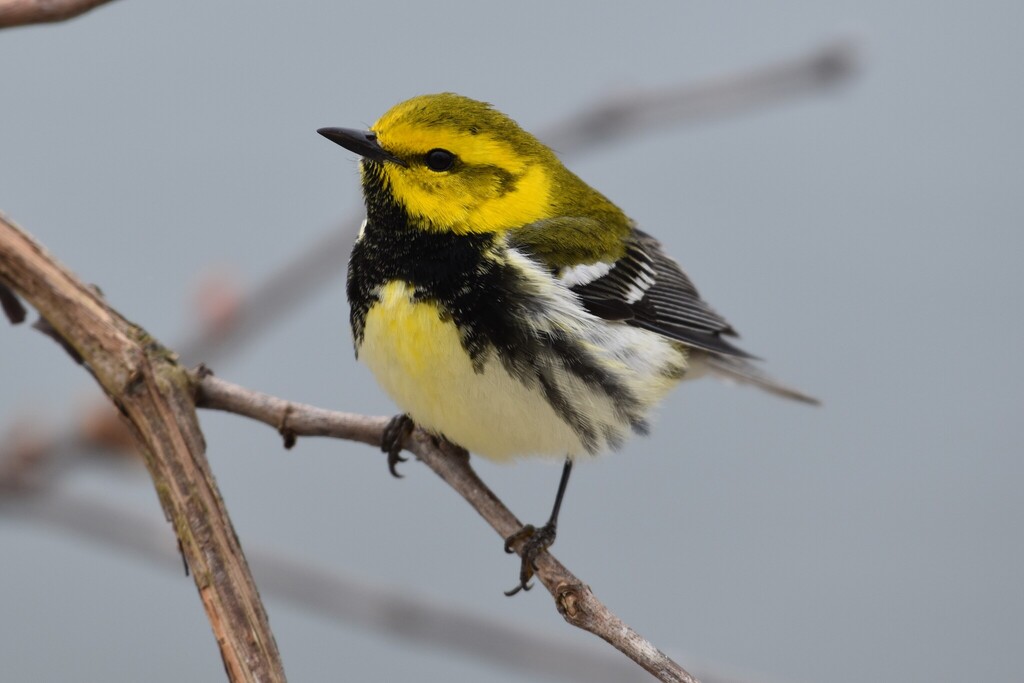
Black-throated Green Warbler
Live sightings near you, the range map, bar charts of when it is seen, and Macaulay Library photos and recordings.
Black-throated Green Warbler
Setophaga virens
The black-throated green warbler (Setophaga virens) is a small songbird of the New World warbler family.
From the article Black-throated green warbler on Wikipedia (CC BY-SA), quoted section by section
Description
It has an olive-green crown, a yellow face with olive markings, a thin pointed bill, white wing bars, an olive-green back and pale underparts with black streaks on the flanks. Adult males have a black throat and upper breast; females and immature males have a pale throat and black markings on their breast. Measurements:
Length: 4.3–4.7 in (11–12 cm) Weight: 0.3–0.4 oz (8.5–11.3 g) Wingspan: 6.7–7.9 in (17–20 cm)
Range & habitat
The breeding habitat of the black-throated green warbler is coniferous and mixed forests in eastern North America and western Canada and cypress swamps on the southern Atlantic coast, with preference for dense stands of conifers. These birds' nests are open cups, which are usually situated close to the trunk of a tree. These birds migrate to Mexico, Central America, the West Indies and southern Florida. One destination is to the Petenes mangroves of the Yucatán. Some birds straggle as far as South America, with the southernmost couple of records coming from Ecuador.
Wikipedia: “Habitat and distribution”
What it does
Black-throated green warblers forage actively in vegetation, and they sometimes hover (gleaning), or catch insects in flight (hawking). Insects are the main constituents of these birds' diets, although berries will occasionally be consumed. The song of this bird is a buzzed zee-zee-zee-zooo-zeet or zoo-zee-zoo-zoo-zeet. The call is a sharp tsip. This bird is vulnerable to nest parasitism by the brown-headed cowbird.
Wikipedia: “Behavior”
Listen
Looking for field recordings…
Where it lives
Recorded sightings
—
geo-referenced records in GBIF, from museums, herbaria and field observers.
Drag the globe to turn it. Dots are where records exist, not a range map; darker means more records.
In the stacks
Searching the stacks…
Every page naming Setophaga virens in the Biodiversity Heritage Library →
This page is assembled live from iNaturalist, GBIF, Wikipedia, the Source Library and the Internet Archive. It is not yet part of the hand-edited codex. iNaturalist taxon 145258.