On eBird ↗
Townsend's Warbler
Live sightings near you, the range map, bar charts of when it is seen, and Macaulay Library photos and recordings.
Townsend's Warbler
Setophaga townsendi
Townsend's warbler (Setophaga townsendi) is a small songbird of the New World warbler family.
From the article Townsend's warbler on Wikipedia (CC BY-SA), quoted section by section
Description
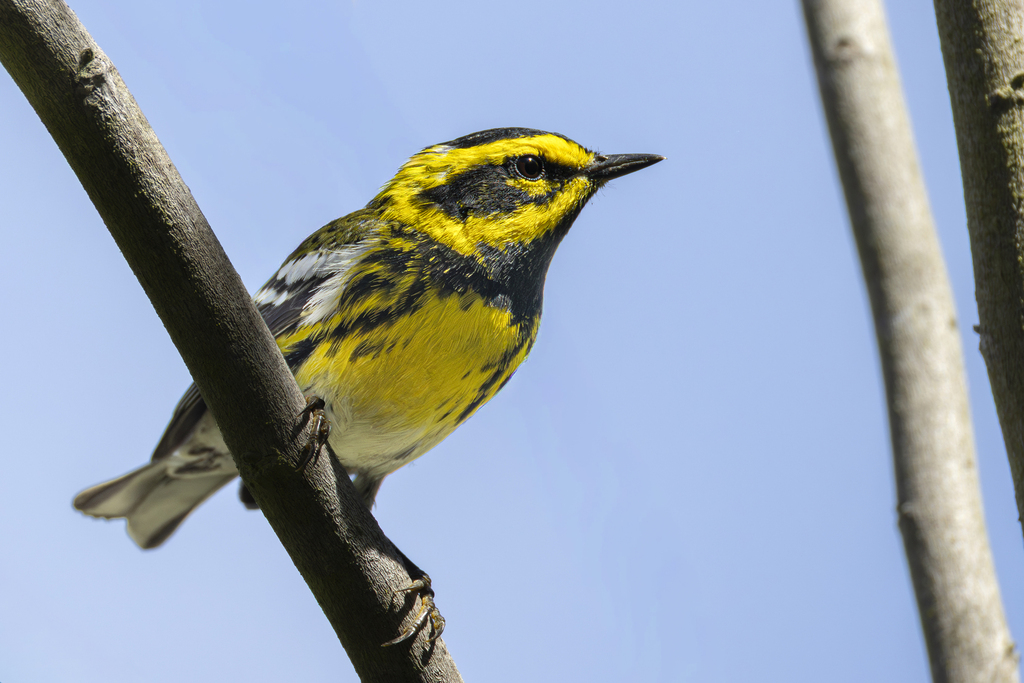
Townsend's warbler has a yellow face with a black stripe across its cheeks extending into an ear patch, a thin pointed bill, two white wing bars, olive upperparts with black streaks on their backs and flanks, and a white belly. Adult males have a black cap, black throat and yellow lower breast; females have a dark cap and a yellow throat. Immature birds are similar to females with a dark green cap and cheeks.
In human culture
Their breeding habitats are coniferous forests with large trees on the northwestern coast of North America. Their nests are shallow cups built with grass and lined with moss. These nests are usually placed atop a branch in a conifer. The female lays 4 to 5 brown-speckled white eggs. This bird is closely related to the hermit warbler, and the two species interbreed where their ranges overlap. Birds from Haida Gwaii migrate short distances further south on the Pacific coast. Other birds winter in Mexico, Central America, and the south-western United States. They forage actively in the higher branches, often gleaning insects from foliage and sometimes hovering or catching insects in flight. They mainly eat insects, spiders, and seeds. Outside of the nesting season, these birds forage in mixed flocks. In winter, they also eat berries and plant nectar, and honeydew directly from the anus of scale insects. The song of the male bird is a buzzed zee-zee-zee-bzz-zee or weazy weazy weazy weazy twea, somewhat similar to that of its eastern relative, the black-throated green warbler. The call is a sharp tup. This bird was named after the American ornithologist, John Kirk Townsend. Although Townsend is also credited with first describing this bird, he used a name chosen by Thomas Nuttall, who was travelling with him, and so sidestepped the convention against naming a species after oneself.
Wikipedia: “Life history”
Listen
Looking for field recordings…
Where it lives
Recorded sightings
—
geo-referenced records in GBIF, from museums, herbaria and field observers.
Drag the globe to turn it. Dots are where records exist, not a range map; darker means more records.
In the stacks
Searching the stacks…
Every page naming Setophaga townsendi in the Biodiversity Heritage Library →
This page is assembled live from iNaturalist, GBIF, Wikipedia, the Source Library and the Internet Archive. It is not yet part of the hand-edited codex. iNaturalist taxon 145255.