On eBird ↗
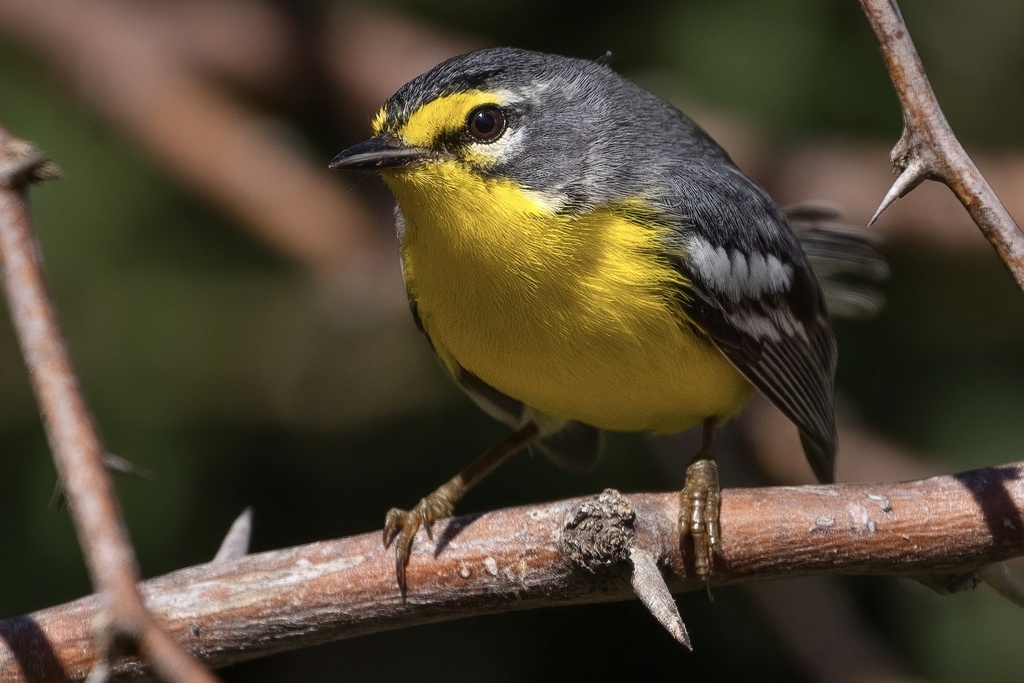
Adelaide's Warbler
Live sightings near you, the range map, bar charts of when it is seen, and Macaulay Library photos and recordings.
Adelaide's Warbler
Setophaga adelaidae
Adelaide's warbler (Setophaga adelaidae) is a bird endemic to the archipelago of Puerto Rico belonging to the Setophaga genus of the Parulidae family. The species is named after Adelaide Swift, daughter of Robert Swift, the person who captured the first specimen.
From the article Adelaide's warbler on Wikipedia (CC BY-SA), quoted section by section
Description
Adelaide's warbler is 12.5 cm (4.9 in) long. Adult males have a slate-gray crown with a thin black stripe below it, a wide yellow supercilium that becomes thin and white behind the eye, a thin gray line through the eye, a white arc below the eye, gray ear coverts. Their upperparts are slate-gray. Their wings are mostly dull black or dusky with slate-gray edges on the flight feathers and white tips on the greater and median upperwing coverts that show as two wing bars. Their tail is dull black or dusky with white ends on the inner webs of the outer three pairs of tail feathers. Their underparts from the chin through the breast are lemon-yellow, their belly a paler yellow, and their undertail coverts white. Females are slightly duller than males with a thinner black line below the crown and less white on the tail feathers. Both sexes have a dark brown iris, a blackish bill, and legs and feet variously described as dark grayish pink, light grayish brown, and pale yellowish. Juveniles have no black on their head. Their head and upperparts are brownish gray with a strong brown wash on the back. Their supercilium is much narrower than adults' and their underparts are paler yellow. Their wings and tail feathers have brownish or olive-gray edges.
Range & habitat
Adelaide's warbler is found the main island of Puerto Rico, though not at the extreme eastern end, and in the island municipality of Vieques. The species occurs more commonly in dry forests in the south, such as Guánica State Forest. It also occurs in the Northern Karst Belt, in flatter areas of the Cordillera Central, and in secondary forest, shade coffee plantations and citrus orchards throughout the island. On Vieques it is found in dry forest on limestone and dry scrublands.
Wikipedia: “Distribution and habitat”
What it does
Adelaide's warbler feeds on a wide variety of insects and other arthropods. It takes at least half of its prey by gleaning from leaves but also takes it from other substrates, during brief hovers, and in mid-air. It feeds from ground level to at least 10 m (33 ft) above it. In some areas it regularly joins mixed-species feeding flocks which can include Puerto Rican todies, vireos and other New World warblers.
Wikipedia: “Feeding”
Listen
Looking for field recordings…
Where it lives
Recorded sightings
—
geo-referenced records in GBIF, from museums, herbaria and field observers.
Drag the globe to turn it. Dots are where records exist, not a range map; darker means more records.
In the stacks
Searching the stacks…
Every page naming Setophaga adelaidae in the Biodiversity Heritage Library →
This page is assembled live from iNaturalist, GBIF, Wikipedia, the Source Library and the Internet Archive. It is not yet part of the hand-edited codex. iNaturalist taxon 145250.