On eBird ↗
Yellow-throated Warbler
Live sightings near you, the range map, bar charts of when it is seen, and Macaulay Library photos and recordings.
Yellow-throated Warbler
Setophaga dominica
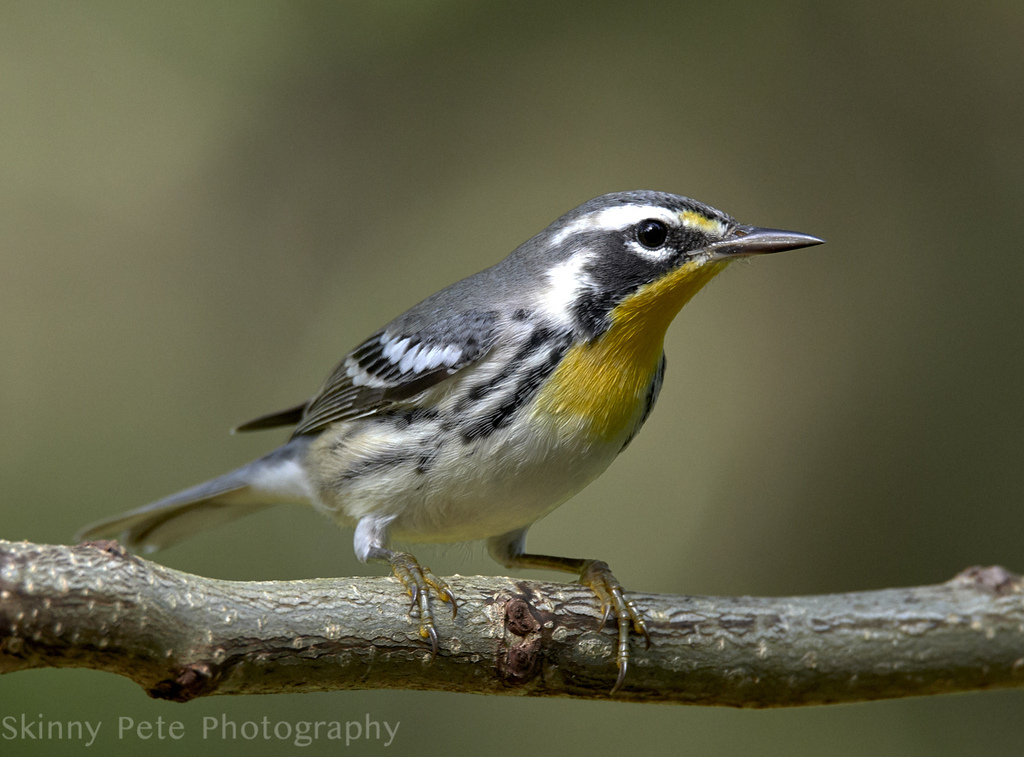
The yellow-throated warbler (Setophaga dominica) is a small migratory songbird species breeding in temperate North America. It belongs to the New World warbler family (Parulidae).
From the article Yellow-throated warbler on Wikipedia (CC BY-SA), quoted section by section
Description
The yellow-throated warbler is 13–14 cm (5.1–5.5 in) long, with a wingspan of 21 cm (8.3 in), and weighs 8.5–11.3 g (0.30–0.40 oz). In summer, male yellow-throated warblers display gray upperparts and wings, with double white wing bars. Their throats are yellow, and the remainder of their underparts are white, and are streaked with black on the flanks. Their heads are strongly patterned in black and white, with a long supercilium. The remiges and rectrices are black. The females, immatures and non-breeding males resemble washed-out versions of the summer males; in particular they have a less crisply defined strong head pattern. They also have less bright yellows, and dark gray feathers instead of black ones in the body plumage. Compared to many other New World warblers, sexual dimorphism is slight. The males' songs are clear, descending whistles. The calls are high sees or sharp chips.
Range & habitat
These birds breed in southeastern North America, and their breeding ranges extend from southern Pennsylvania and northern Missouri, to the Gulf of Mexico. One subspecies, from northwest Florida, is resident all year round. The other populations of this species are migratory, wintering at the Gulf Coast, eastern Central America, and the Caribbean. Vagrant wintering birds are sometimes seen in northernmost South America. In the United States, its range differs from typical Setophaga warblers because they have a more expansive resident population in the South than other Setophaga warblers. Moreover, their breeding range is more southerly, and their wintering range more is northerly, than the other warblers in the genus. According to McKay et al., "[t]he near absence of the species from the lower Piedmont of the Carolinas and Georgia ... presents a puzzle." The yellow-throated warbler is a woodland species with a preference for coniferous or swamp tree species, in which it preferably nests.
Wikipedia: “Distribution and habitat”
What it does
They are insectivorous, but will include a considerable amount of berries and nectar in their diet outside the breeding season. Food is typically picked off tree branches directly, but flying insects may be caught in a brief hover. They have also been observed catching and eating anoles.
Wikipedia: “Food and feeding”
Listen
Looking for field recordings…
Where it lives
Recorded sightings
—
geo-referenced records in GBIF, from museums, herbaria and field observers.
Drag the globe to turn it. Dots are where records exist, not a range map; darker means more records.
In the stacks
Searching the stacks…
Every page naming Setophaga dominica in the Biodiversity Heritage Library →
This page is assembled live from iNaturalist, GBIF, Wikipedia, the Source Library and the Internet Archive. It is not yet part of the hand-edited codex. iNaturalist taxon 145246.