On eBird ↗
Magnolia Warbler
Live sightings near you, the range map, bar charts of when it is seen, and Macaulay Library photos and recordings.
Magnolia Warbler
Setophaga magnolia
The magnolia warbler (Setophaga magnolia) is a member of the wood warbler family Parulidae.
From the article Magnolia warbler on Wikipedia (CC BY-SA), quoted section by section
Description
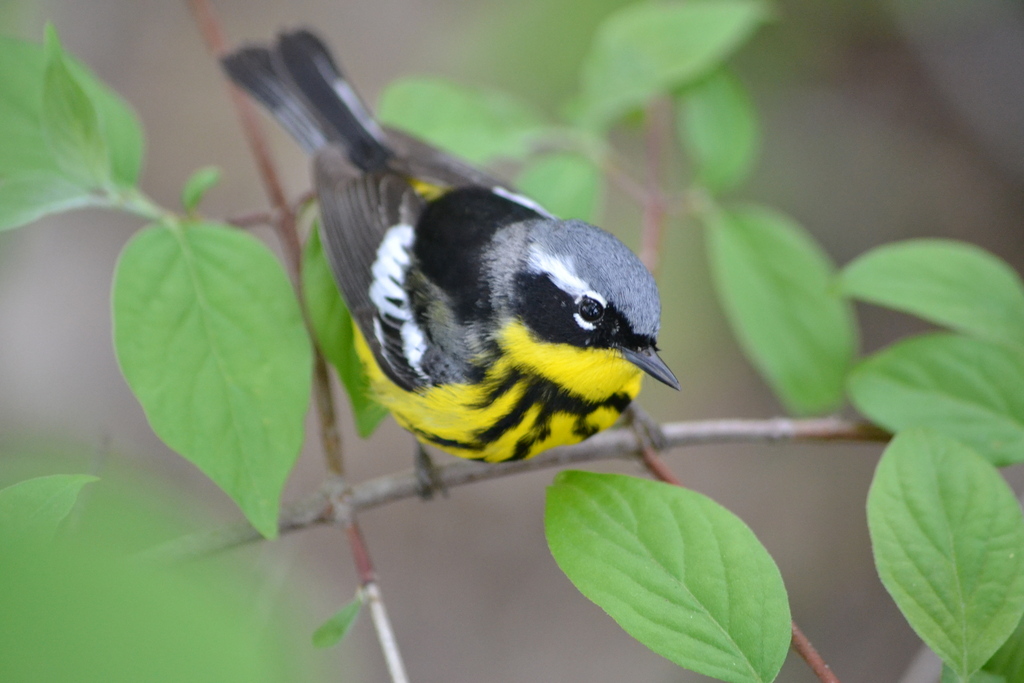
This species is a moderately small New World warbler. It measures 11 to 13 cm (4.3 to 5.1 in) in length and spans 16 to 20 cm (6.3 to 7.9 in) across the wings. Body mass in adult birds can range from 6.6 to 12.6 g (0.23 to 0.44 oz), though weights have reportedly ranged up to 15 g (0.53 oz) prior to migration. Among standard measurements, the wing chord is 5.4 to 6.4 cm (2.1 to 2.5 in), the tail is 4.6 to 5.2 cm (1.8 to 2.0 in), the bill is 0.8 to 1 cm (0.31 to 0.39 in) and the tarsus is 1.7 to 1.85 cm (0.67 to 0.73 in). The magnolia warbler can be distinguished by its coloration. The breeding males often have white, gray, and black backs with yellow on the sides; yellow and black-striped stomachs; white, gray, and black foreheads and beaks; distinct black tails with white stripes on the underside; and defined white patches on their wings, called wing bars. Breeding females usually have the same type of coloration as the males, except that their colors are much duller. Immature warblers also resemble the same dull coloration of the females. The yellow and black-striped stomachs help one to distinguish the males from other similar birds, like the prairie warbler and Kirtland's warbler (which, however, have a breeding range to the south and east of the magnolia warbler's).
Range & habitat
The magnolia warbler breeds in the boreal forests of northern portions of the Great Lakes, New England, and Appalachian regions of the United States, as well as across large parts of central and eastern Canada. The warbler breeds in dense forests, where it will most likely be found among the branches of young, densely packed, coniferous trees. During the winter, the warbler migrates through the eastern and central half of the United States, as far west as Oklahoma and Kansas to reach its wintering grounds in southern Mexico, Central America, and the Caribbean. During migration season, the magnolia warbler can be found in various types of woodlands.
Wikipedia: “Distribution and habitat”
What it does
The magnolia warbler undergoes multiple molts during its lifetime. The first molts begin while the young offspring are still living in the nest, while the rest take place on or near their breeding grounds. The warblers molt, breed, care for their offspring, and then migrate. Chicks hatch after a two-week incubation period, and can fledge from the nest after close to another two weeks when their feathers are more developed. After about a month, the chicks can leave the nest to begin living (and later breeding) on their own since they are solitary birds. Magnolia warblers typically live up to seven years.
Wikipedia: “Life cycle”
In human culture
The genus name Setophaga is from Ancient Greek ses, "moth", and phagos, "eating", and the specific magnolia refers to the type locality. American ornithologist Alexander Wilson found this species in magnolias near Fort Adams, Mississippi.
Wikipedia: “Etymology”
Listen
Looking for field recordings…
Where it lives
Recorded sightings
—
geo-referenced records in GBIF, from museums, herbaria and field observers.
Drag the globe to turn it. Dots are where records exist, not a range map; darker means more records.
In the stacks
Searching the stacks…
Every page naming Setophaga magnolia in the Biodiversity Heritage Library →
This page is assembled live from iNaturalist, GBIF, Wikipedia, the Source Library and the Internet Archive. It is not yet part of the hand-edited codex. iNaturalist taxon 145235.