On eBird ↗
Green Catbird
Live sightings near you, the range map, bar charts of when it is seen, and Macaulay Library photos and recordings.
Green Catbird
Ailuroedus crassirostris
The green catbird (Ailuroedus crassirostris) is a species of bowerbird found in subtropical forests along the east coast of Australia, from southeastern Queensland to southern New South Wales. It is named for its distinctive call which sounds like a cat meowing, although it has also been mistaken for a crying child. The green catbird resembles the spotted catbird, which is only found in an isolated population in Far North Queensland.
From the article Green catbird on Wikipedia (CC BY-SA), quoted section by section
Description
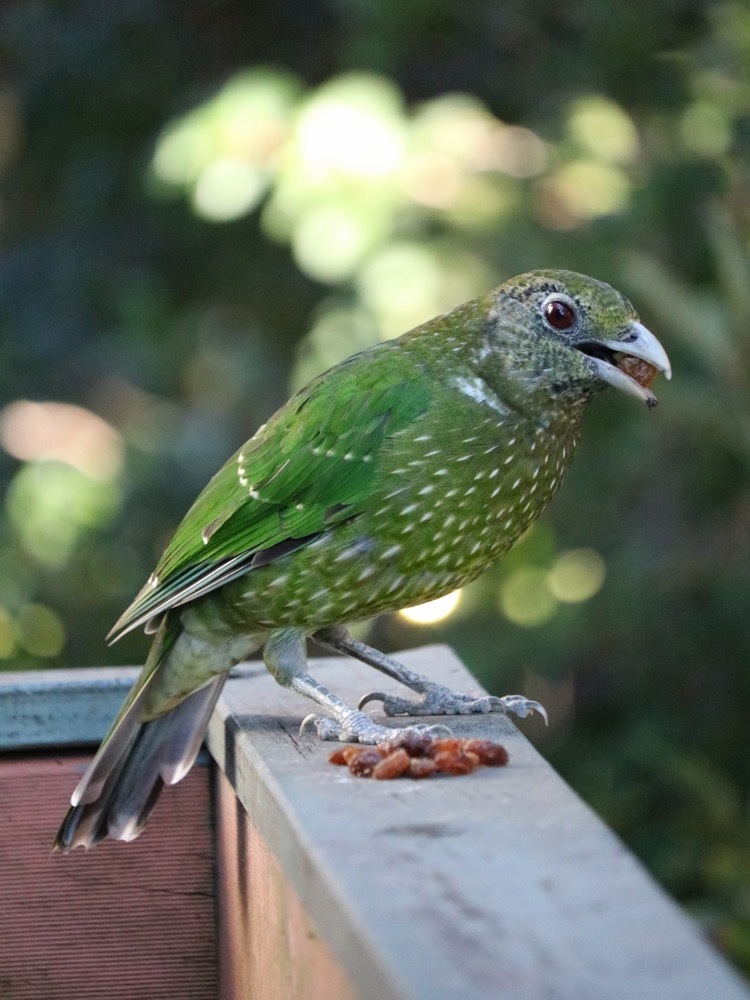
Green catbirds are a medium-sized stocky bird with long, powerful legs and a long, stout bill. The back, wings and rump are brilliant emerald green, with very conspicuous pure white spots at the tips of the tertiaries and secondaries, which, on the tips of coverts, form two white wing-bars. The tail is brownish emerald with white tips. The head is greenish brown mottled black and finely flecked pale buff. The chest is greenish buff to dull emerald with distinctive short white streaks. The bill is horn coloured and the legs are greyish brown. The iris is bright red in direct sun with a partial white eye-ring. Male and female birds share similar plumage, making it very difficult to distinguish between the sexes. Juvenile birds also have similar plumage, although it is duller. Very young birds have fluffy grey down on their heads (Donaghey. R. 1996).
Range & habitat
According to The Field Guide to Australian Birds (Michael Morcombe, 2003) (2nd edition), green catbirds are found along the length of the east coast of NSW (in areas of suitable habitat) through to the Cooloola Coast in South East Queensland. The birds are found in subtropical and temperate rainforest and paperbarks, and occasionally in adjacent eucalypt forest. The average home range of the birds is two hectares, although this is greatly reduced during breeding season. Breeding territories usually contain several fig trees which regularly produce large amounts of ripe fruit for several months which coincides with the catbird breeding season. Green catbirds drink and bath in pools of water that are found in the crevices of surrounding trees or water courses.
Wikipedia: “Distribution and habitat”
What it does
Unlike other male bower birds, the male green catbird does not build a bower, however the male will clear an area from which he will perform and display to other females. Similar to other male bower birds, he will attempt to attract females by displaying colourful fruits, flowers and leaves in his beak. Green catbirds are monogamous breeders. Once a female accepts a male they will mate for life. The pair bonding is maintained by the male feeding the female throughout the year, as well as by calls in duet. The breeding season is usually from October to January, although can be as early as September and as late as March. The nest is a large and bulky; built of large sticks bound with vine tendrils and with an inner lining of dry leaves. The nest interiors are noted for having an unusual layer of wet, soft decayed wood beneath the lining of fine twigs and leaves; adding to its overall large size relative to the size of the bird. The nest is placed in the dense crown of a low understorey tree where there are many twigs and stems to support its bulk, or in thorny or stinging trees, the crown of a tree fern, or in the upwardly cupped fronds of a bird's nest fern. The clutch typically consists of 2 - 3 eggs which are incubated by the female for 23 – 24 days. The male assists in rearing the young through the 20 – 22 days to fledging. No detailed studies have been undertaken on the …
Wikipedia: “Breeding and life cycle”
Listen
Looking for field recordings…
Where it lives
Recorded sightings
—
geo-referenced records in GBIF, from museums, herbaria and field observers.
Drag the globe to turn it. Dots are where records exist, not a range map; darker means more records.
In the stacks
Searching the stacks…
Every page naming Ailuroedus crassirostris in the Biodiversity Heritage Library →
This page is assembled live from iNaturalist, GBIF, Wikipedia, the Source Library and the Internet Archive. It is not yet part of the hand-edited codex. iNaturalist taxon 14514.