On eBird ↗
Chestnut-faced Babbler
Live sightings near you, the range map, bar charts of when it is seen, and Macaulay Library photos and recordings.
Chestnut-faced Babbler
Zosterornis whiteheadi
The chestnut-faced babbler (Zosterornis whiteheadi) is a species of bird in the white-eye family Zosteropidae. It is endemic to the island of Luzon in the Philippines. There are two subspecies, Z. w. whiteheadi in northern and central Luzon, and Z. w. sorsogonensis in south eastern Luzon. The species is generally found in mountain forests, generally above 1000 m (although occasionally down to 100m. Within its range is catholic in its choice of habitat, frequenting broadleaf forests,...
From the article Chestnut-faced babbler on Wikipedia (CC BY-SA), quoted section by section
Description
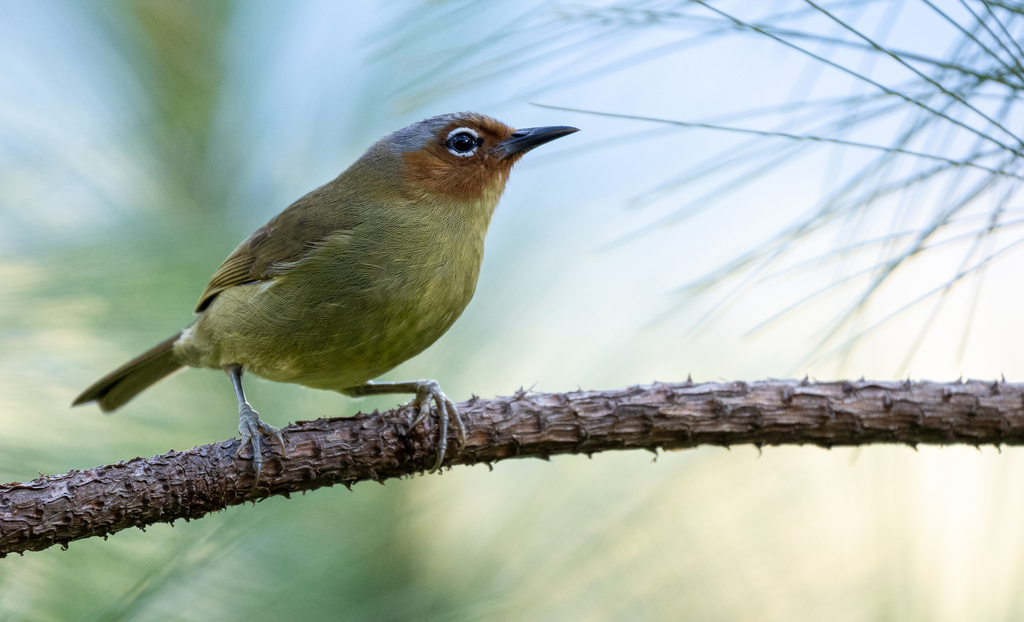
The chestnut-faced babbler is a medium-sized babbler, 15cm in length and weighing between 17 and 28 g. The plumage of this species is not sexually dimorphic, and that of juveniles has not been described. They have a chestnut face with a grey crown and nape, and an incomplete white eye ring. The wings and tail are olive-brown and the flanks paler olive, tending towards buff-yellow on the breast. The call is described as rapid, busy and metallic.
Subspecies. Two subspecies are recognized:
Z. w. whiteheadi – in northern and central Luzon, Z. w. sorsogonensis – southeastern Luzon; similar to nominate but crown and nape are edged in black Although this species name includes "babbler", it is actually a white-eye.
Wikipedia: “Description and taxonomy”
Range & habitat
It has a wide range of natural habitats are montane mossy forest, pine forest, secondary growth and scrub and even high grass. It generally is more common in higher altitudes above 1,400 meters above sea level but has been seen as low as 100 masl. Due to its ability to thrive in second growth and human altered habitat, the International Union for Conservation of Nature has assessed this bird as a least-concern species with the population believed to be stable.
Wikipedia: “Habitat and conservation status”
What it does
The species feeds on seeds, fruit, insects (particularly beetles) and spiders. Single birds, pairs or flocks of up to thirty will feed, usually in the lower growth of the forest, but occasionally up to the canopy. Forages in the understory for insects and often joins mixed-species flocks of blue-headed fantails, little pied flycatchers, turquoise flycatchers, green-backed whistlers, Negros leaf warblers and other small birds. Chestnut-faced babbler are known to drink water from pitcher plants.
Wikipedia: “Ecology and behavior”
Listen
Looking for field recordings…
Where it lives
Recorded sightings
—
geo-referenced records in GBIF, from museums, herbaria and field observers.
Drag the globe to turn it. Dots are where records exist, not a range map; darker means more records.
In the stacks
Searching the stacks…
Every page naming Zosterornis whiteheadi in the Biodiversity Heritage Library →
This page is assembled live from iNaturalist, GBIF, Wikipedia, the Source Library and the Internet Archive. It is not yet part of the hand-edited codex. iNaturalist taxon 144976.