On eBird ↗
Winter Wren
Live sightings near you, the range map, bar charts of when it is seen, and Macaulay Library photos and recordings.
Winter Wren
Troglodytes hiemalis
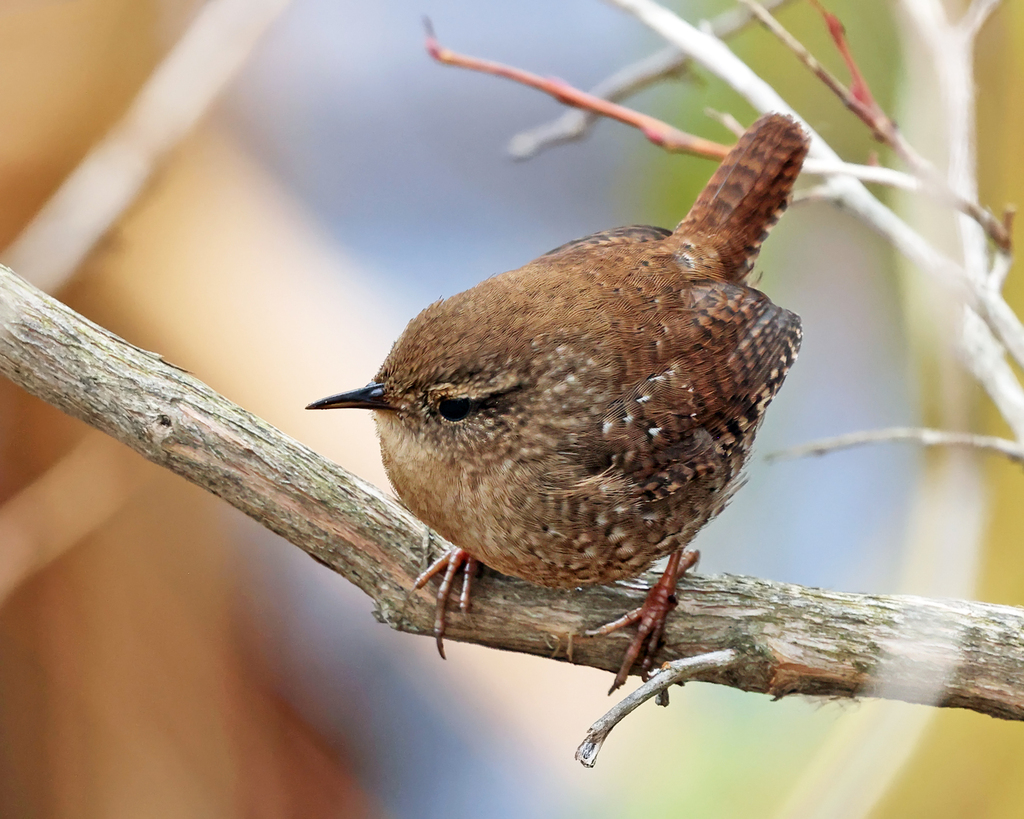
The winter wren (Troglodytes hiemalis) is a very small North American bird and a member of the mainly New World wren family Troglodytidae. The species was formerly often lumped together with Eurasian wren (Troglodytes troglodytes) of Eurasia and Pacific wren (Troglodytes pacificus) of western North America under the merged name of northern wren (with the scientific name T. troglodytes having priority), until they were split in 2010.
It breeds in coniferous forests from British Columbia to the Atlantic Ocean. It migrates through and winters across southeastern Canada, the eastern half the United States and (rarely) north-eastern Mexico. Small numbers may be casual in the western United States and Canada.
From the article Winter wren on Wikipedia (CC BY-SA), quoted section by section
Description
Small tail is often cocked above its back, and short neck gives the appearance of a small brown ball. Rufous brown above, grayer below, barred with darker brown and gray, even on wings and tail. The bill is dark brown, and the legs are pale brown. Young birds are less distinctly barred. Most are identifiable by the pale "eyebrows" over their eyes. Measurements:
Length: 8–12 cm (3.1–4.7 in) Weight: 8–12 g (0.28–0.42 oz) Wingspan: 12–16 cm (4.7–6.3 in)
Range & habitat
The winter wren nests mostly in coniferous forests, especially those of spruce and fir, where it is often identified by its long and exuberant song. Although it is an insectivore, it can remain in moderately cold and even snowy climates by foraging for insects on substrates such as bark and fallen logs. Its movements as it creeps or climbs are incessant rather than rapid; its short flights swift and direct but not sustained, its tiny round wings whirring as it flies from bush to bush. At night, usually in winter, it often roosts, true to its scientific name, in dark retreats, snug holes and even old nests. In hard weather it may do so in parties, either consisting of the family or of many individuals gathered together for warmth.
Wikipedia: “Distribution and habitat”
What it does
Winter wrens primarily eat arthropods, with preference for spiders, caterpillars, and adult beetles and flies. Other less common food items include arthropods of taxa Acari (mites and ticks), Hymenoptera (bees, wasps, and ants), Chilopoda (centipedes), Diplopoda (millipedes), and Amphipoda (amphipods).
Wikipedia: “Food and feeding”
Listen
Looking for field recordings…
Where it lives
Recorded sightings
—
geo-referenced records in GBIF, from museums, herbaria and field observers.
Drag the globe to turn it. Dots are where records exist, not a range map; darker means more records.
In the stacks
Searching the stacks…
Every page naming Troglodytes hiemalis in the Biodiversity Heritage Library →
This page is assembled live from iNaturalist, GBIF, Wikipedia, the Source Library and the Internet Archive. It is not yet part of the hand-edited codex. iNaturalist taxon 144883.